By Staff Reporter
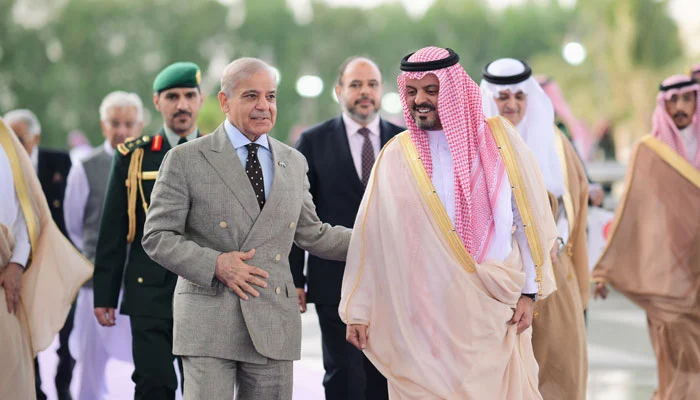
ISLAMABAD: Prime Minister Shehbaz Sharif touched down in Jeddah on Thursday evening at the start of a three-day visit to Saudi Arabia, arriving alongside Chief of Defence Forces and Army Chief Field Marshal Asim Munir for talks expected to centre on the kingdom’s deepening security partnership with Islamabad.
The prime minister was met on arrival by the Deputy Governor of Mecca, Prince Saud bin Mishal bin Abdulaziz, according to a post from the government on X. Saudi Arabia’s Minister of Agriculture, Water and Environment, Engineer Abdulrahman, and Pakistan’s ambassador to Saudi Arabia, Ahmad Farooq, were also among those who greeted him at the airport.
Sharif travels with a heavyweight delegation. Alongside Field Marshal Munir, he is accompanied by Defence Minister Khawaja Asif, Information Minister Attaullah Tarar and Special Assistant Tariq Fatemi. Deputy Prime Minister and Foreign Minister Ishaq Dar, who arrived in the kingdom after wrapping up a separate visit to Jordan, will also join the delegation.
Beyond the diplomacy, the visit carries a personal dimension: the government said the prime minister will perform Umrah and visit the Prophet’s Mosque in Madina during his stay.
‘Anchored in decades of mutual trust’
The trip was confirmed earlier in the day by Foreign Office spokesperson Tahir Andrabi, who told journalists at a regular briefing that Sharif would hold talks with Crown Prince Mohammed bin Salman focused on “consolidating the Pakistan-Saudi bilateral relationship” and exchanging views on regional and international developments of shared concern.
Andrabi described the relationship as a “long-standing partnership” between the two countries, rooted in “decades of mutual trust, cooperation and brotherhood”. He acknowledged the visit falls during a period of heightened Gulf tension, but insisted its significance stretched well beyond the immediate crisis, adding it would “further strengthen bilateral relations, deepen strategic cooperation, enhance coordination on regional and international issues of mutual interest and also reinforce multilateral cooperation”.
It is Sharif’s second trip to the kingdom this year; he last visited Saudi Arabia in April for talks with senior Saudi leadership.
A region on edge
The prime minister’s arrival comes against a backdrop of escalating instability across the Middle East, with conflict spreading to new fronts and shipping lanes increasingly under threat. Saudi Arabia has moved to establish a multinational maritime coalition to safeguard vessels and energy shipments passing through the Red Sea — a proposal that has already drawn support from fourteen countries, Pakistan among them.
Islamabad’s backing for Riyadh has been vocal in recent months. In July, Pakistan endorsed Saudi air strikes on Popular Mobilisation Units installations in Iraq, characterising the action as a legitimate exercise of Saudi Arabia’s right to self-defence, after Saudi Arabia and the US carried out joint strikes accusing elements within the Iraqi umbrella force of targeting Saudi oil facilities.
That statement of support followed an earlier warning from Islamabad, after Yemen’s Houthi rebels announced a maritime blockade targeting shipping connected to Saudi Arabia. Pakistan called threats to its maritime interests a “red line”, warning that any attack on Pakistani-flagged vessels or commercial shipping would be treated as an attack on Pakistan itself, while simultaneously reaffirming its commitment to Saudi security and to the free flow of lawful maritime commerce through the Red Sea and the Bab al-Mandeb strait.
The two countries’ security relationship was formalised last year through a Strategic Mutual Defence Agreement, under which aggression against either signatory is treated as aggression against both. The pact became operational earlier this year — just as Pakistan launched a separate diplomatic push to mediate between Iran and the United States.
Condemnation over Bab al-Mandab attacks
Speaking at the same briefing, Andrabi condemned recent attacks on commercial vessels transiting the Bab al-Mandab Strait, calling them a clear breach of international law. Pakistan is among the fourteen nations that last week endorsed the Saudi-led maritime coalition designed to protect shipping through the strait, the Red Sea and the Gulf of Aden — a corridor roughly 20 miles wide and 70 miles long, linking the Red Sea to the Gulf of Aden and carrying an estimated 12 per cent of global trade. Plans for the coalition emerged after Iran-backed Houthi rebels declared what they called a maritime blockade against Saudi Arabia and claimed responsibility for strikes on Saudi-linked vessels.
“We have condemned attacks on vessels belonging either to Saudi Arabia or to any other countries because, essentially, these are commercial vessels,” Andrabi told reporters. “Attacks on them are a blatant violation of international law and go against the safety and security of commercial maritime traffic.”
Andrabi said defence cooperation between the two countries would continue, though he declined to confirm whether Pakistan had deployed naval assets to protect commercial shipping in the region. “I am not particularly aware of any escorting vessels,” he said. “This is an operational detail of which I am not aware.”
Hormuz standoff clouds wider settlement
The spokesperson also addressed the continuing standoff in the Strait of Hormuz, warning it was complicating efforts to reach a broader, sustainable settlement to the crisis gripping the Middle East and Gulf, particularly tensions between Iran and the United States. Iran has effectively closed the strait since the US and Israel launched strikes against it in February — a corridor through which twenty per cent of the world’s oil and gas supplies passed before the conflict began.
“The resolution of the standoff in the Strait of Hormuz will obviously create a conducive environment for the parties to return to the Islamabad MoU and the framework of talks as envisaged in the Pakistan-Qatar joint statement,” Andrabi said.
Asked about Pakistan’s role as mediator in the US-Iran standoff, he said Islamabad remained actively engaged: “We remain engaged with the parties. On certain issues, specific countries take the lead, while on others, comprehensive efforts are undertaken by Pakistan, Qatar, and other brotherly countries.”
He also confirmed that Deputy Prime Minister Ishaq Dar has extended an invitation to Iranian Parliament Speaker Mohammad Bagher Ghalibaf and Foreign Minister Seyed Abbas Araghchi to visit Pakistan, with specific dates to be confirmed through diplomatic channels.
Copyright © 2021 Independent Pakistan | All rights reserved