By Staff Reporter
ISLAMABAD: Prime Minister Shebaz Sharif has persuaded one of the country’s most disciplined religious political parties to pause a march on the capital, but only after conceding, in a phone call placed from New York, that his government’s fuel relief package has not gone far enough to satisfy protesters angered by months of rising petrol and diesel prices.
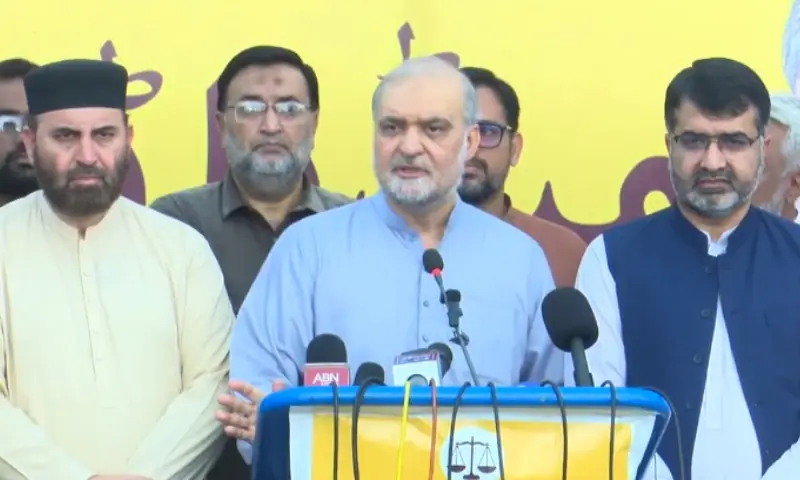
Hafiz Naeemur Rehman, the head of Jamaat-e-Islami, told a press conference in Multan on Tuesday that his party’s caravan would remain stationed in the city rather than continue toward Islamabad, following a direct and personal request from Prime Minister Sharif. But he was careful to frame the decision as a temporary concession rather than a retreat, telling supporters gathered at the city’s railway station that the movement against the levy would resume “with the same force” if talks failed to produce results.
“We will not step back from our protests. We will not step back from our long march either,” Rehman said, according to a statement carried by the party’s media office. “We just want to give a chance to the government, as the prime minister has gotten involved for the first time. We will meet him, listen to what he has to say and present our arguments. We are a sensible party.”
The intervention came as Rehman’s train of supporters — thousands of Jamaat-e-Islami workers who had departed Karachi by rail on Sunday — pulled into Multan on Monday night, some four hours behind schedule. Rehman addressed the crowd from the platform, telling them the delay had done nothing to dampen turnout. “Those who conspired should see how many people came out to welcome us in Multan,” he said.
According to the Prime Minister’s Office, Sharif telephoned Rehman on Tuesday, while the premier was in New York for the 81st session of the United Nations General Assembly, and asked him to “postpone the sit-in.” The two men agreed to meet once Sharif returns to Pakistan, with a further round of “consultation on this matter” to follow. Jamaat-e-Islami’s own account of the call, relayed in a post on the social media platform X, quoted Sharif telling Rehman: “I have already announced a relief package for the nation. However, as soon as I return to Pakistan, I will meet the JI chief and announce a better relief package for the public.”
Accounts of Rehman’s immediate response to that offer have varied. Some reports quote him as flatly declining the prime minister’s request for a delay, insisting the campaign would continue regardless of any meeting. Others, including the party’s own statement, describe a more measured position: that Rehman told Sharif he would need to consult Jamaat-e-Islami’s Shura, its central decision-making council, before deciding whether to grant the pause the prime minister was asking for. What is not in dispute is the outcome by Tuesday afternoon — the march would stop in Multan, the protest camps elsewhere in the country would stay open, and a meeting with the prime minister would take place once he was back on Pakistani soil.
Rehman made plain that any goodwill extended to the government had firm limits attached. “I told him that your ministers have been making these promises for so many days, and we have been forced into this situation,” he said, adding that his party had no appetite for prolonging demonstrations in punishing heat if the dispute could be settled at the negotiating table. He dismissed the relief package Sharif has already announced as “not acceptable in any way,” and gave the government a deadline of sorts: if no firm commitment emerges from the promised meeting, the long march would resume in the first week of October.
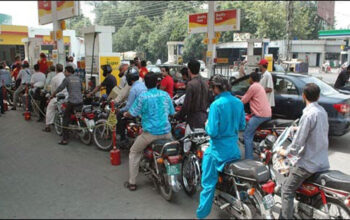
The dispute at the heart of the standoff is the petroleum levy, a tax Jamaat-e-Islami brands the “extortion levy” or, in Rehman’s more pointed formulation on Friday, a “goon tax.” Pakistan currently charges Rs114 per litre in taxes and duties on petrol and Rs100 per litre on diesel, on top of a global oil price that has been pushed upward by the war between the United States and Iran and by escalating Houthi attacks on Saudi Arabia. Rehman argues the burden falls hardest on the poor and the middle class, telling reporters in Multan: “We have no political or personal agenda. This is the problem of 250 million people of Pakistan.”
He was similarly dismissive of the government’s flagship response, the Prime Minister’s Fuel Relief Scheme, which came into effect on 17 September and offers a subsidy of Rs100 per litre, within a fixed quota, to owners of two- and three-wheeled vehicles. According to Rehman, the scheme amounts to no more than Rs25 billion to Rs30 billion of relief spread across a month, set against a levy that continues to bring in roughly Rs150 billion in the same period — arithmetic he has repeatedly cited as evidence that the government’s gesture falls well short of what is required.
Jamaat-e-Islami has been building toward this confrontation since early August. Rehman told reporters the party had staged demonstrations at 510 locations nationwide from 7 August, expanding four days later into sustained sit-ins that, by his account, have now spread to 42 towns and cities. A shutdown strike on 3 September, which he said drew support from traders as well as the public, was followed by five rounds of formal negotiations with a government committee — talks that, in Rehman’s telling, collapsed each time over the same obstacle. The government maintains it cannot scrap the levy because doing so would run afoul of conditions attached to Pakistan’s programme with the International Monetary Fund, an argument Rehman has rejected as an excuse rather than a genuine constraint.
The Islamabad march that brought Rehman to Multan was launched in two stages: a train journey from Karachi to Rohri, followed by a second leg from Rohri onward to Multan. Further contingents are said to be travelling separately from Khyber Pakhtunkhwa and Balochistan, part of what Rehman described as an effort to draw supporters from those provinces, as well as from Azad Kashmir, into what he called the political mainstream. He was adamant that the party would not confine its eventual entry into the capital to a single route. “You should know that the plans that we have made, ABC, according to them we won’t be entering Islamabad from one place alone,” he told the crowd in Multan.
Rehman used the same appearance to address the government’s separate and more fraught confrontation with the Pakistan Tehreek-e-Insaf, the party founded by jailed former prime minister Imran Khan, which is preparing its own march on the capital for 27 September to demand his release. Khan has been in custody since 2023. Rehman described him as a political prisoner, condemned a recent crackdown on PTI supporters, and urged the government to take up a proposal from Senator Allama Raja Nasir Abbas aimed at opening talks between the two sides — while stressing that Jamaat-e-Islami regards peaceful protest as a constitutional right regardless of which party is exercising it.
The government, for its part, has shown little sign of softening its posture toward the PTI march even as it worked to defuse the Jamaat-e-Islami one. Islamabad’s Red Zone, the high-security enclave housing the presidency, the prime minister’s residence, parliament and a cluster of foreign embassies, has been sealed with more than 600 shipping containers, with police reportedly seeking upward of a thousand more. All five main routes into the zone are being fortified with two layers of barriers, and the wider Islamabad Capital Police force has had routine leave suspended until 5 October. Interior Minister Mohsin Naqvi has warned protesters against taking the law into their own hands, while Information Minister Attaullah Tarar said over the weekend that the government would not tolerate any group reaching the capital by force or blocking roads to get there.
Copyright © 2021 Independent Pakistan | All rights reserved