By Staff Reporter
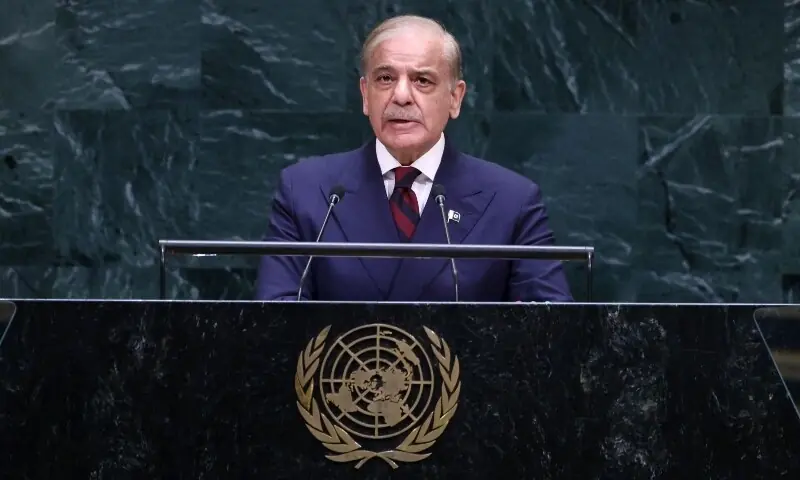
ISLAMABAD: Prime Minister Shehbaz Sharif told the UN General Assembly that Islamabad has “made its choice” for peace with New Delhi but also warned India that any attempt to obstruct or divert his country’s share of shared river waters would be regarded as an act of war, in a wide-ranging address that also touched on Kashmir, the war in Gaza, and escalating turmoil across the Middle East.
Sharif told the assembled leaders of the 193-member body that “any attempt to stop, impede or divert Pakistan’s share of the waters will be treated as an act of war. India must make no mistake about it.”
The remark represented Islamabad’s firm stand on the Indus Waters Treaty, the six-decade-old water-sharing arrangement that India placed in abeyance last year in the aftermath of a deadly attack on tourists in Indian-occupied Kashmir. Sharif told the chamber that New Delhi’s position had “no legal basis whatsoever”, asserting that both UN experts and the Permanent Court of Arbitration had backed Pakistan’s reading of the treaty’s continued validity — although these claims remain disputed by India, and the underlying legal questions have not been definitively settled between the two nuclear-armed neighbours.
“Water must never be weaponised,” the prime minister said. “Rivers should nourish nations, not divide them.”
He described the Indus River system as the “lifeblood” not just of Pakistan but of the wider South Asian region, framing the dispute as one with consequences that extend well beyond the two countries directly involved.
A speech built around a single defining choice
Speaking under this year’s assembly theme — “Restoring Trust, Managing Transformation: A United Nations That Delivers for All” — Sharif structured much of his address around the idea that nations, like individuals, face a stark binary in moments of crisis.
“We live at a dangerous moment. But our future is certainly not predetermined,” he told the assembled delegates. “War is a choice. Peace is also a choice. And sometimes, the greater courage lies not in starting a war, but in preventing one. Pakistan has made its choice. We have chosen dialogue over confrontation. We have chosen cooperation over coercion. We have chosen peace over war.”
It was a theme he returned to repeatedly, framing Pakistan’s diplomatic interventions across multiple regional flashpoints — from the Gulf to the Red Sea to South Asia — as evidence of a country actively working to de-escalate rather than inflame tensions.
Recalling last year’s conflict with India
The prime minister used part of his address to revisit the brief but intense military confrontation between Pakistan and India last May, which followed the Pahalgam incident. New Delhi blamed Islamabad for the attack, though it has not produced public evidence tying Pakistan directly to it; Pakistan has firmly rejected the allegation and called for an independent investigation.
Sharif told the assembly that Pakistan’s armed forces, under the command of Field Marshal Syed Asim Munir, had “responded with precision and professionalism” during the confrontation, exercising the country’s inherent right to self-defence.
He once again credited US President Donald Trump with halting the crisis before it escalated further, calling Trump’s role “resolute and visionary” and crediting it with saving “hundreds of millions of lives” — a statement he has used on previous occasions when discussing the ceasefire.
“Who knows the extent of devastation that could have taken place had President Trump not stepped in at this critical moment with clarity of thought and action?” he asked the chamber.
Kashmir dispute again takes centre stage
As he has in previous years, Sharif devoted a substantial portion of his address to the disputed territory of Kashmir, telling delegates that “for eight decades, the Kashmiri people have waited for the United Nations to fulfil its solemn commitment of a free and impartial plebiscite.”
He accused Indian authorities of subjecting the population of Indian-administered Kashmir to “illegal occupation, arbitrary detention, extrajudicial killings, enforced disappearances, sexual violence and collective punishment”, and spoke of what he described as the enduring grief of families whose relatives have disappeared.
“Helpless Kashmiri mothers and fathers yearn for their sons and daughters who never return,” he said. “Their homes lie silent, under curfew and in deep grief. For many, there is no closure — only a lifetime spent searching for graves that bear no names.”
He reaffirmed that Pakistan would continue to extend “full diplomatic, political and moral support” to Kashmiris until they achieved what he called their right to self-determination, describing the territory once again as “Pakistan’s jugular vein” — a phrase long used in Pakistani political discourse to underline the perceived centrality of the dispute to national identity.
Middle East diplomacy and the Strait of Hormuz
Beyond South Asia, Sharif devoted considerable attention to the deteriorating security situation across the Middle East, warning that vital shipping and energy corridors risked becoming flashpoints in a widening regional conflict.
“The Strait of Hormuz and Bab-el-Mandeb are arteries of the global economy,” he told the assembly. “They must remain open, connecting nations, not becoming choke points of confrontation. These waters must carry the promise of prosperity, not the perils of war.”
The warning comes against the backdrop of a marked disruption to shipping through both waterways, following renewed conflict between the United States and Iran earlier this year and intensified fighting involving Yemen’s Houthi movement. Traffic through Hormuz — the critical corridor for much of the Gulf’s oil and gas exports — has fallen sharply since hostilities began, while insecurity around Bab-el-Mandeb has similarly disrupted the route linking the Red Sea to the Gulf of Aden.
Sharif credited Pakistan with playing a mediating role in bringing Washington and Tehran to the negotiating table in Islamabad, a process that produced the Islamabad Memorandum of Understanding in June, providing for an end to hostilities and steps toward reopening the strait. Fighting has since resumed, however, underscoring the fragility of that earlier accord.
“Amid the roar of missiles, drones and guns, the voice for diplomacy must echo even louder and stronger,” he said.
Condemnation of Houthi attacks on Saudi Arabia
The Pakistani leader reserved some of his strongest language for recent Houthi attacks on Saudi Arabia, including an alleged drone strike targeting the vicinity of Makkah earlier this month — an incident Saudi authorities say they intercepted before it could enter the city’s restricted airspace, though the Houthis have denied that Makkah itself was the intended target.
“Any threat to the safety and sanctity of the Haramain Sharifain is a red line that must never be crossed,” Sharif said, describing the attacks as “deplorable” and reaffirming Islamabad’s solidarity with Riyadh.
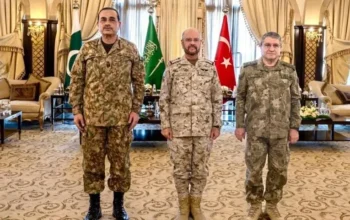
He pointed to the Makkah Joint Defence Agreement signed by Pakistan, Saudi Arabia and Turkey on 7 August — under which an attack on any one signatory is treated as an attack on all three — as evidence of Pakistan’s broader commitment to regional stability, while insisting the pact was defensive in nature.
“This alliance is not directed against any country,” he said. “It is a collective commitment for defence, stability and peace in the region, and nothing more.”
Gaza and the “genocidal agenda” in the West Bank
Sharif also used his address to renew Pakistan’s support for the Palestinian cause, invoking the deaths of Palestinian children as a rebuke to what he characterised as the international community’s continued inaction.
He recalled the case of Hind Rajab, a five-year-old girl killed by Israeli forces in Gaza last year while trapped in a vehicle with family members — a case he had raised in his address to the assembly previously — before turning to a more recent death, that of eight-year-old Wafaa Akila.
“What should have been the first day of her school became the last day of her life,” he told the chamber. “Does not a child born in Gaza deserve the same life, the same future and the same dream as a child anywhere else in the world? The tragedies of Hind Rajab, Wafaa Akila and countless others will echo through history as an indictment of our collective silence and inaction.”
He went further in describing Israel’s actions in the occupied West Bank, stating that the forcible eviction of Palestinian residents there “clearly reflects Israel’s genocidal agenda” — language that places Pakistan among the more forceful critics of Israeli policy at this year’s assembly.
Sharif reaffirmed Pakistan’s long-standing position that the only viable resolution lay in the creation of an independent Palestinian state along pre-1967 borders, with East Jerusalem — referred to in his address as Al-Quds Al-Sharif — serving as its capital. He also called for an immediate end to Israeli military action against Lebanon and Syria.
Afghanistan told to act against militant sanctuaries
Turning to the security situation along Pakistan’s western border, the prime minister said his country had paid a heavy price in its fight against militancy, citing losses of nearly 100,000 lives among civilians and security personnel, along with economic damage exceeding $150bn.
He accused elements operating from Afghan territory — specifically the Tehreek-e-Taliban Pakistan and the Balochistan Liberation Army, which Islamabad officially designates using the terms Fitna al-Khawarij and Fitna al-Hindustan respectively — of exploiting sanctuaries across the border to destabilise Pakistan.
“This must come to a grinding halt,” he said, calling on Afghanistan’s Taliban administration to take “verifiable, decisive action” to prevent its territory being used for cross-border attacks. Sharif also called on the Taliban government to respect the fundamental rights of the Afghan population, “especially women and girls” — a recurring theme in Pakistani statements on Afghanistan, even as Islamabad has maintained a working relationship with the Taliban administration since it returned to power.
Calls for UN reform and closing appeal
In the closing portion of his address, Sharif turned to the broader architecture of the United Nations itself, arguing that meaningful reform of bodies such as the Security Council was essential if the institution was to remain relevant.
“The theme of this session calls upon us to restore trust,” he said. “But trust cannot be restored by words alone. It must be earned through action.” He said reform “must reflect the interests and aspirations of the overwhelming majority of member states, not the ambitions of a select few” — summarising Pakistan’s position with the phrase “Reform for All, Privilege for None.”
He closed his remarks with an appeal for unity that echoed the speech’s opening framing of choice and consequence.
“Let this 81st General Assembly make it a unanimous choice,” he said. “Let us restore trust. Let us preserve peace. And let us prove that even in a divided world, humanity can still choose to stand together.”
Copyright © 2021 Independent Pakistan | All rights reserved