By Staff Reporter
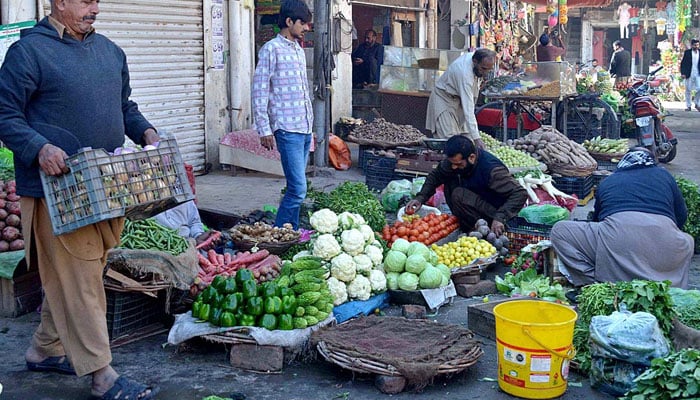
ISLAMABAD: Rupee devaluation and rising energy prices are likely to push up consumer prices in the near term that are already sky high, the finance ministry warned on Friday.
Inflation is expected to stay at an elevated level owing to market frictions caused by relative demand and supply gap of essential items, exchange rate depreciation and recent upward adjustment of administered prices of petrol and Diesel,” the ministry said in its ‘Monthly Economic Update & Outlook’.
It said the production losses especially of major agricultural crops have not yet been fully recovered due to the lagged effect of floods.
“Consequently, the shortage of essential items has emerged and persisted. Inflation may further jack up because of the second-round effect.”
The ministry viewed the ongoing political and economic uncertainties as another potential reason for rising price levels.
“The economic distress resulting from the delay of the stabilization program has exacerbated the economic uncertainty due to which inflationary expectations have remained strong.”
It said despite SBP’s contractionary monetary policy, the inflationary expectations are not settling down. “Moreover, bulk buying during the month of Ramadan may cause a demand-supply gap and result in the prices of essential items escalating.”
Recent monetary policy restrictions and efforts towards fiscal consolidation along with the administrative, policy, and relief measures are expected to ease out the inflationary pressure by the end of the current fiscal year.
The ministry said the economy is showing continuous signs of resilience, despite challenges and uncertainties, as depicted through contained fiscal and current account deficits during the current fiscal year.
Furthermore, Pakistan is currently confronted with a shortage in external liquidity.
“Through demand management policies, the government is trying to limit the current account deficit, which will not transfer further pressure on dwindling reserves.”
It said the government is firmly inclined to successfully complete the IMF’s program, which includes necessary policy measures and will bring additional relief to the financial account of the balance of payments.
“The policy measures are intended to bring expenditures more in line with the income generated within the country.”
At the fiscal front, the government is pursuing consolidation to reduce the overall deficit through expenditure management, austerity measures, and revenue mobilization.
Agriculture
Wheat production largely depends on the prevailing climatic conditions. As witnessed last year, delay in rains and early heat waves are expected to adversely impact wheat production.
According to the Pakistan Met office, the country might witness different spells of heatwaves within the upcoming months of April and May 2023.
Industrial Activities
LSM’s cyclical pattern is well positively correlated with the cyclical position of Pakistan’s main trading partners. In January, LSM activity came in marginally below expectations.
Although the CLI in Pakistan’s main export areas remains below its neutral level, some stabilization in its current cyclical condition seems to appear in recent months.
This may bode well for domestic industrial production. But current monetary restriction and fiscal consolidation, both required to bring external and internal balance may cause further short-run pain to the domestic economy, which also translates into domestic industrial production below its neutral capacity level.
YoY growth of LSM is expected to remain negative in February while MoM LSM is expected to remain positive.
Exports/Remittances
Exports of goods and services decreased marginally on an MoM basis to $2.77 bn as compared to $2.8 billion in Jan. on a YoY basis, which declined by 19.2 percent. Imports of goods and services have continued to contain and decreased by 24.2 percent on a YoY basis.
Remittances increased by 5.0 percent on an MoM basis to $2.0 billion in February 2023 as compared to $1.9 billion in January 2023, due to an improved situation after narrowing down deference between the interbank and open markets, subsequently allowing adjustments of the exchange rate.
Another factor that contributes mainly to current account improvement for the month of February is a balance on primary income which is contained by $200 million.
Accordingly, the current account deficit contained $74 million as compared to $230 million in January 2023.
For the month of March, it is expected that exports and imports will remain at the current level due to slow growth in the major trading partners and contained domestic economic activities.
However, remittances will probably further improve due to positive seasonal and Ramzan factors.
Taking these factors into account, as well as other components, the current account deficit is likely to remain on the lower side.
Fiscal
Presently, the government is pursuing fiscal consolidation to reduce the overall fiscal deficit through a combination of expenditure management and revenue increase. These measures are paying off in the form of improved fiscal accounts. The fiscal deficit has been reduced to 2.3 percent of GDP during Jul-Jan FY2023, down from 2.8 percent of GDP in the same period the previous year, while the primary balance is in surplus due to a significant decline in non-markup expenditures.
On the revenue side, FBR tax collection is currently growing at 18 percent despite unprecedented challenges due to the slowdown in economic activity and import compression.
However, the current performance indicates the resolve of the government to optimize the revenue collection and to achieve the full-year target.
Copyright © 2021 Independent Pakistan | All rights reserved