By Staff Reporter
ISLAMABAD: The party of former prime minister Imran Khan accused the government and the election authorities on Friday of orchestrating the “biggest voter fraud” in the country’s history, saying that it was cheated out of dozens of seats in the parliamentary elections held last week.
The Pakistan Tehreek-e-Insaf, (PTI) said that it had evidence of widespread irregularities and manipulation in the vote counting and consolidation process, which it claimed skewed the outcome of the polls in favor of the Pakistan Muslim League-Nawaz, (PMLN), and its allies.
The PTI’s allegations came amid mounting criticism from domestic and international observers, who raised concerns over the transparency and credibility of the elections, which were disrupted by a day-long suspension of cellular services, the detention of political activists, and reports of violence and terror threats.
The elections, held on Feb. 8, were the 12th in Pakistan’s history and the third consecutive transfer of power from one civilian government to another. Nearly 60.6 million Pakistanis cast their ballots for 266 seats in the National Assembly, the lower house of parliament.
According to the official results announced by the Election Commission of Pakistan on Feb. 10, the PML-N of three-time prime minister Nawaz Sharif emerged as the largest party in the National Assembly with 79 seats, followed by the Pakistan Peoples Party of Bilawal Bhutto Zardari with 54 seats. However, Khan’s supporters, who ran as independents, won 93 seats, making them the largest bloc in the assembly.
The election results have stunned many observers, who had expected Khan’s popularity to suffer after a crackdown by the authorities that saw him and several of his aides arrested and several of his senior party leaders either quit politics or made a breakaway group. Khan is currently in jail on corruption charges and barred for 10 years. PTI was barred from contesting the election by the election watchdog for conducting flawed party polls.
Some analysts say the election reflects a backlash against the perceived interference of the powerful military in the country’s politics. The military has ruled Pakistan for about half of its 74-year history. Others say the election was rigged in favor of Sharifs, who are seen as more pliable to the military’s interests.
The United States, Britain, and the European Union have expressed concerns about the credibility of the election and called for an investigation into the allegations of irregularities.
The PTI also rejected the results and claimed that it had won 177 seats, of which 85 were “fraudulently” taken away from it by the ECP and the military establishment.
The party said that it had verified data about 46 seats and was compiling data for another 39 seats, where it alleged that there were discrepancies between the forms used to record and consolidate the results.
Observers also said there was a huge difference in the number of votes polled for the National Assembly seats, and that the number of rejected votes, in some cases, exceeded the margin of victory.
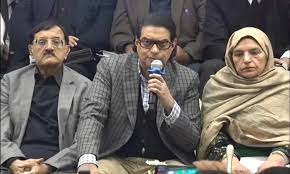
At a news conference in Islamabad, PTI’s information secretary, Raoof Hasan, said that the party was taking constitutional and legal steps to challenge the results and seek a recount or re-election in the disputed constituencies.
“We will not accept this rigged mandate,” Hasan said. “We will not let them steal our votes and our seats. We will fight for our rights and the rights of the people of Pakistan.”
A video of alleged rigging in the polls, showing people stuffing ballot boxes, stamping multiple ballot papers, and altering the results forms was also played at the news briefing.
Salman Akram Raja, a lawyer who contested the elections with the PTI’s support, said that the rigging took place at the office of the returning officer (RO), the official responsible for conducting the elections and consolidating the results in each constituency.
Raja said the ROs created “fictitious” forms to show the final results, which did not match the forms that recorded the results from each polling station.
“What is the point in holding an election if you are going to create a result out of thin air?” Raja asked. “If the state officials responsible for safeguarding the election can be won over by the ruling party, then every election to be carried out in Pakistan becomes a farce.”
Raja said that the rigging was not just an election fraud, but a “wholesale assault on democracy”, and that it needed to be reversed to save the country from further instability and chaos.
Analysts said last week’s election has plunged the country into a political crisis, with no clear winner emerging and accusations of fraud and military meddling casting doubt on the legitimacy of the vote.
The political uncertainty has raised fears of instability and violence in the nuclear-armed nation, which faces multiple challenges, including a faltering economy, a resurgent Taliban insurgency, and strained relations with its neighbors and allies.
Pakistan is also in urgent need of a new loan from the International Monetary Fund to avoid a balance of payments crisis, but the prospects of securing one depend on the formation of a stable and credible government that can implement reforms.
Copyright © 2021 Independent Pakistan | All rights reserved