By Staff Reporter
QUETTA: At least 14 people were killed and several others injured on Sunday morning when a powerful blast tore through a shuttle train in this southwestern Pakistani city, authorities said, in an attack that officials immediately attributed to militants and that the Balochistan Liberation Army later claimed responsibility for.
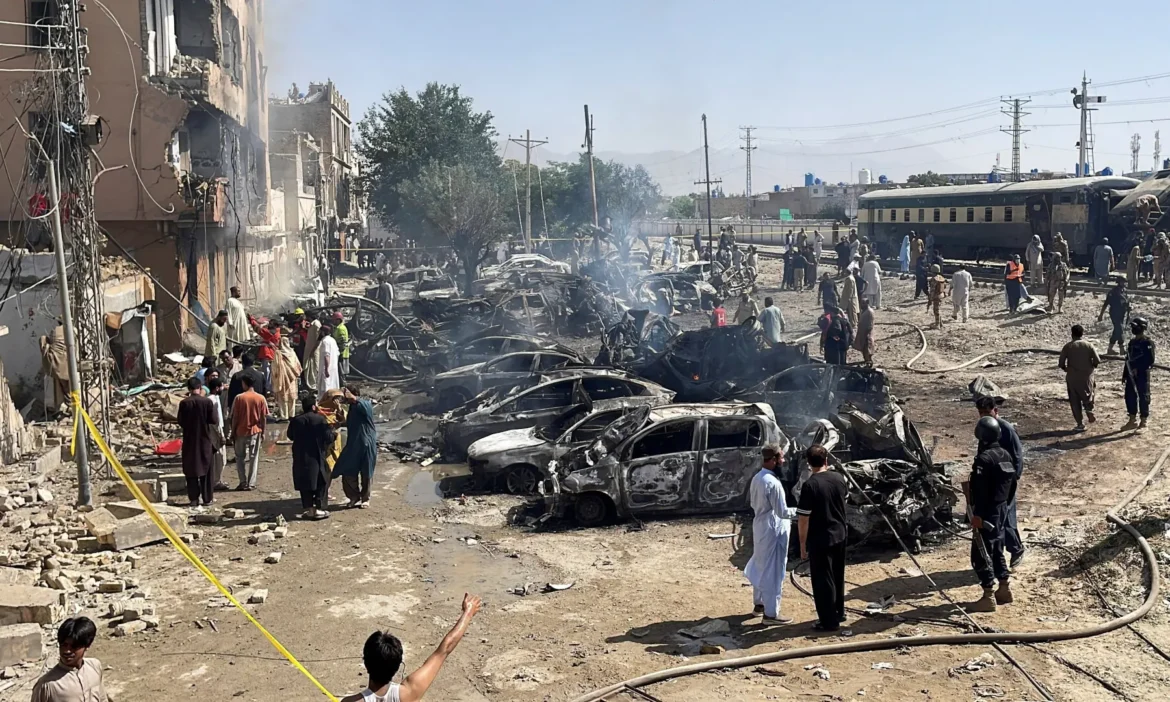
The explosion struck the train as it traveled from Quetta Cantonment to the main railway station, shortly after 8 am near Chaman Phatak, a state-run news agency reported, citing railway officials. The blast derailed the locomotive and three coaches and overturned two others, sending plumes of smoke visible across parts of the city and igniting fires in several nearby vehicles that firefighters struggled to bring under control.
Among the dead were three personnel from the Frontier Corps, a paramilitary force often deployed in the region, according to Shahid Rind, an aide to Balochistan Chief Minister Sarfraz Bugti on media and political affairs. Rind said the dead included civilians and that multiple people were injured, among them women and children who were rushed to area hospitals. He described the attack as one on “innocent civilians” and said security forces had cordoned off the area while police, the Counter-Terrorism Department, and the bomb disposal squad began collecting evidence.
The nature of the device was not immediately clear, and officials expressed concern that the toll could rise. Images from the scene showed a mangled carriage lying on its side, with civilians clambering over the wreckage to reach survivors and carrying blood-soaked victims away on stretchers as armed security personnel stood guard. One video captured roughly 10 small cars charred and smoldering, black smoke still rising from some of them, while ambulances converged on the site.
Witnesses described a sudden, shattering explosion that shook homes and buildings nearby. Mohammad Rahim, who lives close to the track, told Agence France-Presse he was asleep when the blast woke his family. “My family and I jumped out of our beds when we heard a loud bang,” he said. “I heard screaming and the crying of women and children in the building, including my family.”
Abdul Basit, who was standing in a breakfast line nearby, said people immediately ran for cover. “People started running for shelter,” he recalled. Mujib Ahmad said the force of the explosion damaged his car. “When I heard the blast, I thought that it must be an attack,” he told the wire service.
Pakistan Railways dispatched rescue trucks and a relief train to the site. An emergency was declared at Quetta’s hospitals, with all doctors, paramedical staff, and other medical personnel called to duty, Rind said. The provincial government placed law enforcement agencies on high alert, and the home minister’s spokesman urged residents to stay away from the area to allow rescue teams to work unimpeded. Railway authorities halted the Peshawar-bound Jaffar Express at Quetta station as a precaution.
By midday, Interior Minister Mohsin Naqvi had flown to Quetta and joined Bugti in a high-level meeting at which the Balochistan police chief delivered an initial briefing on the investigation. A statement from the interior ministry said the gathering “strongly condemned the cowardly attack on innocent people” and expressed condolences to the victims’ families. It described the assault as “savagery” and said the federal government stood with Balochistan “in this hour of grief.” Naqvi was quoted as saying the sacrifices of those killed would not be forgotten.
Bugti, who had been personally monitoring the response, later wrote on X that the attackers — whom he and other officials repeatedly referred to as “terrorists of Fitna-al-Hindustan,” a designation the state uses to signal alleged Indian involvement — had shown their desperation by striking public places. “Let the enemy hear this: there will be no safe haven left for terrorists in Balochistan,” he vowed. “We will hunt down the terrorists, their facilitators, and their masterminds one by one and bring them to justice.”
Prime Minister Shehbaz Sharif condemned the “heinous bomb explosion” on X, writing that “such cowardly acts of terrorism cannot weaken the resolve of the people of Pakistan. We remain steadfast in our determination to eliminate terrorism in all its forms and manifestations.” He offered condolences to the families and prayers for the injured, adding that the nation stood with Balochistan.
President Asif Ali Zardari issued a statement saying the attack was intended to undermine Pakistan’s efforts toward global peace and stability. He vowed that the country would defeat the terrorists, their financiers, and any foreign patrons or safe havens they might enjoy, declaring that “every drop of blood of those killed would be accounted for.”
Chinese embassy in Islamabad issued a statement expressing “deep condolences” and reaffirming its support for Pakistan’s fight against terrorism. The Russian embassy similarly condemned the attack, voiced hopes that the perpetrators would be brought to justice, and wished the injured a swift recovery.
Late Sunday, the Balochistan Liberation Army, the region’s most prominent separatist group, claimed responsibility. In a statement, the BLA said its Majid Brigade had carried out a “highly organized” suicide attack on the train, which it asserted was transporting army personnel from Quetta Cantonment. The claim fit a pattern. The BLA and other Baloch separatist outfits have long accused the federal government in Islamabad of exploiting the mineral-rich province’s resources while denying its people a fair share, fueling a low-level insurgency that has simmered for years.
Pakistani officials and the military have repeatedly charged that the BLA and similar groups receive support from India and sanctuaries in Afghanistan — allegations New Delhi and Kabul have always denied. The group has struck passenger trains before. In August 2025, BLA militants seized the Jaffar Express in Balochistan, holding hundreds of passengers hostage until a military operation freed them. That siege left 33 militants, 23 soldiers, three railway staff members, and five passengers dead.
Rind, the chief minister’s aide, said the latest attack on unarmed civilians reflected the militants’ growing desperation. Evidence collection and the investigation continued Sunday evening, he said, while the injured received the best available treatment. “The involved elements cannot escape the law,” he added.
Copyright © 2021 Independent Pakistan | All rights reserved