By Staff Reporter
ISLAMABAD: Bilawal Bhutto-Zardari has said he will seek an urgent meeting with Prime Minister Shehbaz Sharif over the deteriorating situation in Azad Jammu and Kashmir, as federal authorities moved to suppress a popular protest movement days before a scheduled demonstration and less than three weeks before regional elections.
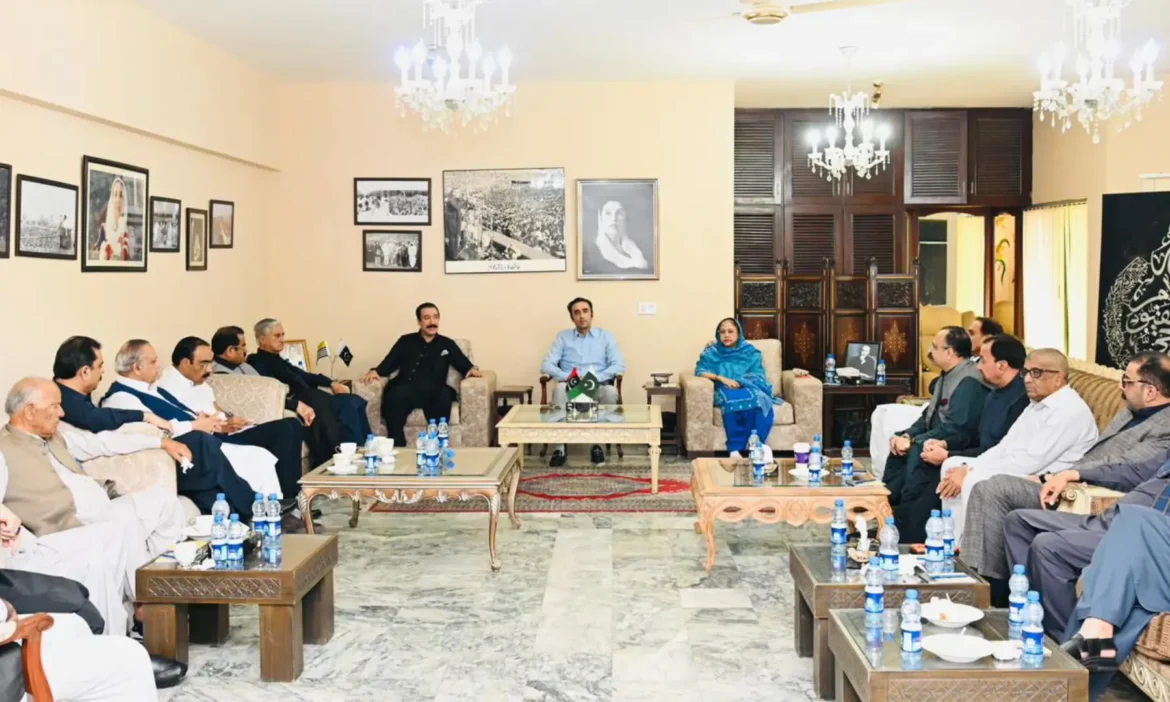
The Pakistan Peoples Party chairman, whose party commands the majority in the AJK Legislative Assembly, chaired an emergency session of the PPP’s AJK parliamentary party in Islamabad on Sunday, where he voiced concern over conditions in the territory and insisted that political grievances must be resolved through negotiation rather than confrontation.
“We have always prioritised the issues of Kashmiris,” he told the gathering, attended by party lawmakers and PPP’s AJK political affairs in-charge Faryal Talpur. “I will meet PM Shehbaz and a solution to the issues would be found through talks and the assembly.”
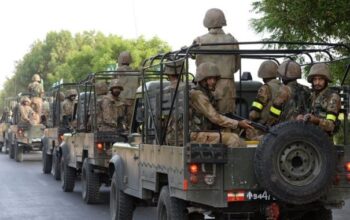
The pledge came as AJK authorities escalated a crackdown on the Joint Awami Action Committee — declared a proscribed organisation under anti-terrorism legislation on Friday — arresting scores of its leaders and activists across the territory. The government cited the group’s alleged engagement in terrorism and conduct “prejudicial to peace and security” of the state as grounds for the ban. Federal paramilitary forces have been dispatched to reinforce the region’s overstretched police, and the authorities have advised intending visitors to postpone travel to AJK until at least 20 June.
The JAAC, which has staged several waves of mass protest since its founding in September 2023, is pressing ahead with a demonstration planned for 9 June — a timeline that puts it squarely in the run-up to the 27 June AJK elections.
At the heart of the latest standoff is a demand that the government abolish the 12 seats in the AJK Legislative Assembly reserved for refugees from Indian-occupied Jammu and Kashmir who settled in mainland Pakistan after partition in 1947. The JAAC contends these seats have historically been used by mainstream Pakistani parties to manipulate the formation of governments in Muzaffarabad. The AJK Assembly, for its part, voted last Thursday to defend the status quo and call for elections to proceed on schedule.
The dispute has its roots in a series of escalating confrontations. The JAAC first mobilised around economic grievances — flour subsidies, electricity tariffs, the curtailment of elite privileges — which prompted a shutter-down strike in 2024 accompanied by protests that turned violent. In September 2025, demonstrations erupted again, ultimately producing a 38-point charter of demands and a formal agreement signed with the government on 4 October.
Parliamentary Affairs Minister Tariq Fazal Chaudhry, who addressed journalists alongside AJK political leaders in Islamabad on Sunday, insisted that Islamabad had largely honoured its commitments. “Thirty-five out of 38 demands have been implemented,” he said, listing among the fulfilled pledges the withdrawal of first information reports against JAAC demonstrators, the reinstatement of civil servants who had participated in protests, electricity supplied to AJK at Rs3 per unit, subsidies on flour and other essentials, amendments to local government laws, the establishment of two new federal boards and restoration of the health card facility for the territory. Some 170 cases registered during past demonstrations had also been dropped, he added.
The three outstanding items, Chaudhry argued, were either subject to court orders or simply not feasible. Major infrastructure commitments — including tunnel construction — “cannot be completed within a few days,” he said.
The minister was scathing about what he characterised as deliberate misrepresentation of the government’s record. “Negative propaganda is being spread that the government has fulfilled only three out of 38 demands,” he said. He also raised what he described as deeper questions about the movement’s intentions, asking whether the unrest represented an attempt to portray Pakistan and AJK as separate entities, to damage relations between refugees from Indian-administered Kashmir and AJK’s resident population, or to undermine Pakistan’s broader Kashmir cause.
On the specific demand to abolish the 12 refugee seats, Chaudhry was categorical. “Around 2-2.2 million Kashmiri refugees are living in Pakistan, and 12 people sitting in a closed room cannot abolish those seats,” he said, noting that the courts had already ruled that any change to what are constitutionally designated seats would require primary legislation. At a meeting in Muzaffarabad on 30 May, government representatives proposed that the matter be referred to an all-parties conference or adjudicated by the AJK Supreme Court, and asked the JAAC to postpone the 9 June protest by eight to ten days to allow further consultations. The request was declined.
Chaudhry, who said he and Kashmir Affairs Minister Amir Muqam had been holding monthly review meetings with JAAC since October, expressed exasperation at what he described as the group’s refusal to engage. “When we talk to them about resolving issues through dialogue, they respond with violent demonstrations; these are two contradictory approaches,” he said. “It is not justified to hold long marches every six months under such circumstances.”
The JAAC’s protests have previously extracted significant concessions from Islamabad but have also carried a heavy human cost. Clashes with law enforcement in May 2024 and again in September 2025 resulted in fatalities.
Bhutto-Zardari, in remarks that appeared designed to preserve the PPP’s position as a mediating force in the crisis, emphasised the party’s historical connection to the Kashmir cause. “PPP was founded on the Kashmir issue,” he said, stressing that political matters must be resolved through dialogue and within the framework of the elected assembly rather than on the streets.
Copyright © 2021 Independent Pakistan | All rights reserved