By Staff Reporter
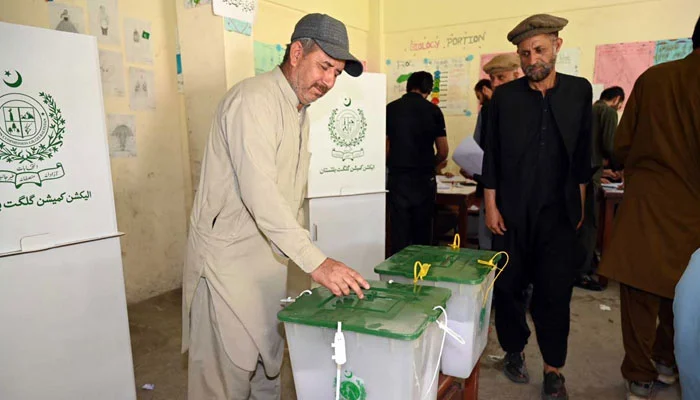
GILGIT: Polling for Gilgit-Baltistan’s legislative assembly concluded on Sunday after a day of largely uninterrupted voting across one of Pakistan’s most strategically significant and geographically forbidding territories — though the relative calm of the contest itself was punctured almost immediately as the Pakistan Peoples Party began alleging systematic attempts to withhold vote count documentation and manipulate the result.
Ballots were cast from 8am to 5pm across 24 directly contested seats, with counting underway by early evening. Of the assembly’s 33 seats in total, six are reserved for women and three for technocrats and professionals, allocated through proportional representation. A field of 396 candidates — 266 of them independents — competed for the general seats, with just eight women among them.
The elections had originally been scheduled for the winter months but were postponed by four months, with authorities citing the region’s brutal winter conditions. The delay meant voters had waited six years since the previous contest, held in November 2020.
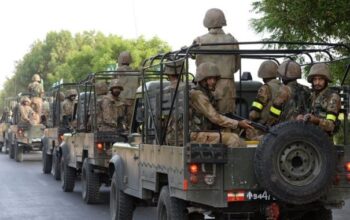
Nearly 963,000 people were registered to vote across the region’s ten districts — 566,097 men and 396,937 women. More than 17,500 security personnel were deployed across all 24 constituencies, including contingents from the Punjab Police, Sindh Police, Gilgit-Baltistan Scouts and the Pakistan Army. Of the 1,391 polling stations established by the Election Commission, 551 were classified as highly sensitive, 349 as sensitive and 488 as normal. Diamer district recorded the greatest concentration of risk, with 119 of its 174 polling stations deemed highly sensitive.
GB’s Chief Election Commissioner, Raja Shahbaz Khan, toured polling stations across Gilgit city throughout the day, meeting polling agents and inspecting security arrangements. Speaking afterwards, he said the process had concluded peacefully and praised what he described as a notably high turnout among women. “The election process has been completed in a peaceful environment,” he said. “Polling staff and security personnel performed their duties effectively.”
‘An attempt to steal the mandate’
As results began to trickle in, however, the PPP moved swiftly to challenge the integrity of the count. Nayyar Hussain Bukhari, the party’s secretary general, alleged that Form-45 — the official vote tally prepared by the presiding officer at each polling station — was being withheld from party representatives, who were also, he claimed, being asked to leave polling areas. Bukhari said he had contacted the chief election commissioner directly and raised the matter.
PPP spokesperson Shazia Marri described any delay in issuing Form-45 as “unacceptable” and raised further concerns about alterations to voter lists ahead of the poll and the overnight relocation of at least one polling station. The party alleged that a station in the Bunji area of Astore-II, which served 206 registered voters in an area described as a PPP stronghold, had been moved from a roadside location to the top of a nearby hill while voting was already underway. The party said the move had prompted local residents to block the Gilgit-Skardu Road in protest, and characterised it as “an attempt to affect the PPP’s vote bank and discourage voters from participating.”
“The PPP will not let an attempt to steal the public’s mandate succeed,” Marri said. She called on the Election Commission to honour its constitutional obligations and ensure accurate results were issued.
Qamar Zaman Kaira, another senior PPP figure, urged party workers to remain at polling stations and not to leave without receiving the forms. “The results given by the public should be reflected accurately,” he said. “The elections should not be made controversial.”
The PPP’s Nadeem Afzal Chan went further, accusing the federal government of “electoral engineering” and alleging that two federal ministers — Amir Muqam and Aleem Khan — had remained in GB during polling and were pressuring the administration to influence outcomes. “Their presence and activities go against the requirements of a fair election,” Chan said. “There are also reports that presiding officers are being pressurised not to issue Form-45, which raises a question on the election’s transparency.”
The field and the frontrunners
The PPP fielded the largest slate, with 23 candidates, followed by the PML-N with 22. The Istehkam-i-Pakistan Party entered 15, PML-Q fielded 11, Tehreek-i-Islami Pakistan and Pakistan Nazriyati Party each entered 10, and nine candidates ran under the JUI-F banner. Jamaat-i-Islami and the MQM-P each fielded six candidates, while the Awami Workers Party put up four and the ANP one.
The PTI, which won the 2020 elections, is contesting without a formal party symbol — it lost the right to one in January 2024 — and its candidates stood as independents, broadly allied with the Majlis Wahdat-i-Muslimeen in a repeat of its strategy at the 2024 national elections. The two parties together fielded 22 candidates.
The contest was widely seen as a two-horse race at the top. Advocate Amjad Hussain, president of the PPP’s GB chapter and an assembly member since 2020, was standing in GBA-1 (Gilgit-I). His principal rival for the symbolically important claim of leading party was Hafiz Hafeezur Rehman of the PML-N — a former chief minister who governed the territory from 2015 to 2020 and is contesting GBA-2 (Gilgit-II).
Rehman, who told supporters his party had held more than 200 corner meetings, 40 jalsas and 11 rallies during the campaign, campaigned on a platform of infrastructure and development, pledging construction of roads and metro buses and promising to end the chronic power cuts that have blighted the region. He apologised to supporters in areas he had been unable to visit. “I hope that your vote will be in support of progress, peace, development that has been paused since 2020,” he said.
Bilawal Bhutto-Zardari, who made several high-profile visits to the region, recorded a video appeal early on polling day urging voters to back the PPP’s “arrow” symbol. He promised constitutional rights for GB — long a contested question — and vowed to pursue its elevation to Pakistan’s fifth province. “From the riverside to the peak of the mountains, I want to make you the owner of your land,” he said.
A court order and a letter from KP
The day’s events were given an unusual legal dimension when it emerged that the GB Supreme Appellate Court had issued a formal order to the chief election commissioner instructing him to conduct the elections in a “transparent, impartial and fair manner.” The directive followed a letter from Khyber Pakhtunkhwa Chief Minister Sohail Afridi to Chief Justice Sardar Muhammad Shamim Khan, requesting equal treatment for all parties. In his response to the court, the CEC offered assurances that the process would adhere to the required standards.
‘We want our voices to be heard’
Across the territory, voters spoke of everyday frustrations — jobs, water, roads, hospitals, schools — that have remained stubbornly unresolved across successive administrations. Abbas Saleem Balti, a resident of Khaplu Valley, said he had come out to vote because he wanted representation. “We have come out to vote because we want our voices to be heard,” he said before casting his ballot, adding that he hoped the next government would create jobs and bring down inflation.
Fatima Ali, 53, said her expectations were modest but pressing. “My son is jobless and I hope the new government will provide him opportunities. That’s why I am here to vote,” she said. A 65-year-old woman who gave only her first name, Fitiambi, said she had voted in GB’s elections for decades but noticed something different on Sunday. “More women are casting votes,” she said. “Earlier, women didn’t used to take interest in the voting process. Now more women are casting their votes and this is a good omen.”
The GB caretaker interior minister, Sajid Ali Baig, said the overall environment at polling stations remained peaceful and that minor irregularities at certain locations were being addressed promptly. Caretaker information minister Ghulam Abbas said free and transparent elections were the government’s “topmost priority.”
Historically, the party that holds federal power in Islamabad has tended to perform well in GB — the PPP won in 2009, PML-N in 2015, and PTI in 2020 when Imran Khan was prime minister. With the PML-N currently leading the federal coalition, the pattern will be closely watched as results emerge.
Copyright © 2021 Independent Pakistan | All rights reserved