By Staff Reporter
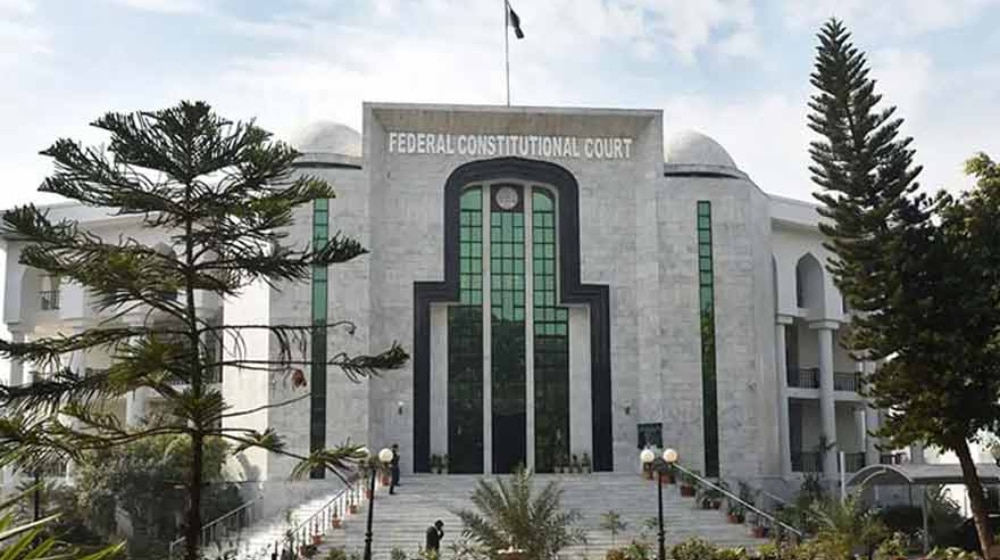
ISLAMABAD: Pakistan’s Federal Constitutional Court on Monday suspended a Lahore High Court ruling that had struck down key provisions of the Passport Rules 2021, temporarily reinstating the federal government’s authority to deactivate citizens’ passports and impose multiyear travel bans on people deported from abroad or suspected of involvement in human trafficking.
The three-judge bench, headed by Justice Syed Hasan Azhar Rizvi, issued the suspension order after hearing an urgent appeal from the Directorate General of Immigration and Passports. The move leaves the government’s passport-control powers intact while the court considers the case on its merits. No date was set for a final hearing.
The dispute centers on Farhan Ali, a resident of Vehari in Punjab province, who was deported from Iran. After his return, the Federal Investigation Agency recommended that his name be placed on the Passport Control List. The immigration authorities responded by inactivating his passport and barring him from traveling abroad for five years.
Ali challenged the action in the Lahore High Court’s Multan bench. On Dec. 23, 2025, that court ruled in his favor, declaring two provisions of the 2021 rules “ultra vires” — beyond the legal authority granted by the parent legislation, the Passport Act of 1974. The high court held that Rule 23, which empowered the government to render a passport inactive, exceeded the scope of Section 8 of the act, which authorises the cancellation, impounding or confiscation of passports but does not explicitly mention inactivation. It also found that Rule 22(2)(c), allowing travel bans of five years or longer on deportees and trafficking suspects, was “substantially ultra vires” the act.
In its appeal to the Federal Constitutional Court, the Directorate General of Immigration and Passports argued that the high court had gone further than the original petition warranted. Ali had not specifically challenged Rule 22(2)(c), yet the Lahore High Court declared it invalid, the government said. Lawyers for the immigration authorities told the court on Monday that Ali had been deported from Iran after illegally exiting Pakistan and violating Iranian immigration laws.
The Federal Investigation Agency emphasized that Pakistan, as a signatory to the United Nations Convention Against Transnational Organized Crime (2000) and the Palermo Protocol on human trafficking, has an obligation to discourage such irregular migration. “Pakistan, as a responsible state, has endorsed the United Nations Convention on Transnational Organised Crime, 2000 and signed the protocol for the UN Protocol to Prevent, Suppress and Punish Trafficking in Persons,” the government petition stated. Allowing citizens who damage the country’s international image to travel freely for employment abroad would undermine state policy, it added.
During the hearing, Justice Rizvi pressed government lawyers on whether the case involved only formal deportations or the broader category of “dunki” — a colloquial term for informal, often hazardous overland journeys used by thousands of Pakistanis seeking work in the Gulf and Europe. Additional Attorney General Chaudhry Aamir Rehman, representing the government, replied that Ali’s inclusion on the control list stemmed directly from his deportation from Iran.
The government’s petition defended the rules on several grounds. It noted that Section 11 of the Passport Act empowers the federal government to delegate rulemaking authority to the director general of immigration and passports, who issued the 2021 rules. Rule 23, it argued, was therefore legally valid. Citing Section 21 of the General Clauses Act of 1897, the petition contended that the statutory power to “cancel, impound or confiscate” a passport inherently includes the lesser power to “inactivate” one — just as the power to create something includes the power to modify or revoke it.
The appeal also recalled a 2017-18 Supreme Court human rights case in which the top court directed the government to establish standard operating procedures for blacklisting human traffickers and deportees. Those procedures included passport cancellation and placement on a blacklist for a defined period. The government argued that restricting travel for such individuals is consistent with Pakistan’s international commitments and that the constitutional right to travel abroad, protected under Article 15, is not absolute.
The petition asked the Federal Constitutional Court to set aside the Lahore High Court’s order entirely, reject Ali’s original writ petition and declare that placing a deportee’s name on the Passport Control List for five years under Rule 22(2)(c) is neither arbitrary nor beyond the government’s legal authority. The notices issued on Monday went to Ali himself, the additional director general of immigration at the Federal Investigation Agency, the deputy director of the FIA’s Multan circle and the director of the FIA’s regional office in Multan.
Copyright © 2021 Independent Pakistan | All rights reserved