By Staff Reporter
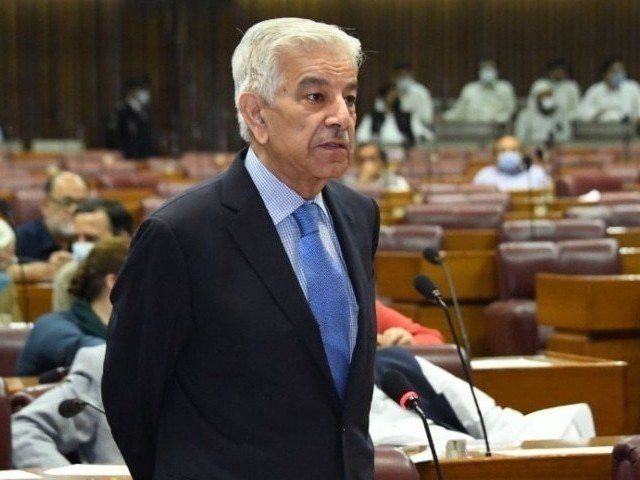
ISLAMABAD: Defence Minister Khawaja Asif delivered one of Islamabad’s most pointed public rebukes to Afghanistan in recent weeks, warning on Wednesday that the Taliban government’s refusal to stop militants from using Afghan territory to launch attacks inside Pakistan could leave “only one alternative” — open war.
Speaking on the floor of the National Assembly, Asif said Islamabad had exhausted diplomatic efforts, including multiple rounds of talks mediated by Qatar, Turkey and Saudi Arabia, only to be met with verbal promises but no written assurances from Kabul. The remarks came amid a sharp deterioration in relations between the two neighbours, fueled by a surge in deadly attacks that Pakistan attributes to the Tehreek-e-Taliban Pakistan, operating from bases inside Afghanistan.
“Then only one alternative remains. Then there will be war,” Asif said. “It will be an open war.” The defence minister’s unusually blunt language reflected mounting frustration in Islamabad, which has long accused the Afghan Taliban of sheltering TTP fighters despite repeated denials from Kabul. Afghan officials counter that militancy inside Pakistan is an internal Pakistani problem.
Asif’s address followed two recent attacks in Pakistan’s northwestern Khyber Pakhtunkhwa province, which borders Afghanistan. Days earlier, a suicide assault on a police post in the city of Bannu killed at least 14 police officers in a car bombing and ambush that Pakistani officials blamed on Afghanistan-based militants. On Tuesday, a bombing in a crowded market in the Lakki Marwat district killed at least nine people and wounded dozens more.
The minister said Pakistan had engaged Kabul directly and through third parties but had come away empty-handed. “I myself personally conducted three rounds of talks,” he said. “You cannot imagine … there were talks lasting 12 hours, 13 hours, even 19 hours with the Kabul government, but under no circumstances are they willing to put anything in writing.”
Asif went further, directly accusing the Afghan Taliban of acting as a proxy for Pakistan’s longtime rival, India. “If they are not willing to abandon the terrorists, and if they are not prepared to commit to ending support for those terrorists, then the Kabul government at this moment is acting as a proxy of India,” he said. “Hindutva is fighting its war against us through Kabul, Afghanistan,” he added, invoking the Hindu nationalist ideology linked to India’s ruling Bharatiya Janata Party.
He also referenced India’s “defeat in Marka-i-Haq last year,” saying New Delhi now lacked the capacity for direct confrontation and was instead waging its campaign through Kabul. “Whether it is the eastern border or the western, the enemy is the same,” Asif said. “There is no difference between Delhi and Kabul at the moment.”
Despite the escalation, Asif insisted Pakistan still preferred a negotiated solution. “Our wish, of course, is that there should be a difference,” he said. “That they should talk to us. That they should come to some kind of arrangement with us. So that some solution to this terrorism can be found.” The minister also used the session to acknowledge improved coordination with the provincial government in Khyber Pakhtunkhwa, which had previously been at odds with the federal authorities in Islamabad over counterterrorism strategy.
Responding to criticism from Jamiat Ulema-i-Islam-Fazl lawmaker Noor Alam Khan, who had decried the impact of rising terrorism on ordinary residents of the province, Asif said the provincial government was now “standing firmly with the Centre and the armed forces against terrorism.” “We did not have the KP government’s cooperation for a very long time, [but] now we have [it],” he said. “It is a good thing that we are all on the same page.”
Asif noted that Khyber Pakhtunkhwa and Balochistan — both bordering Afghanistan — had borne the brunt of the recent uptick in attacks. He said the federal government stood ready to support the provinces but stressed that counterterrorism required contributions from all levels of government. The broader context is a sharp rise in cross-border violence since the Afghan Taliban returned to power in Kabul in 2021. Pakistani officials say TTP sanctuaries in Afghanistan have enabled a resurgence of militancy that has claimed hundreds of lives inside Pakistan. Relations between Islamabad and Kabul have deteriorated markedly over the past year, culminating in some of the fiercest military clashes in years since late 2025.
Copyright © 2021 Independent Pakistan | All rights reserved