By Staff Reporter
KARACHI: The exhumation of a 25-year-old Karachi businessman whose body was found dumped in bushes last month was called off on Friday, after his family refused to allow a hastily reassembled medical board to carry out the procedure.
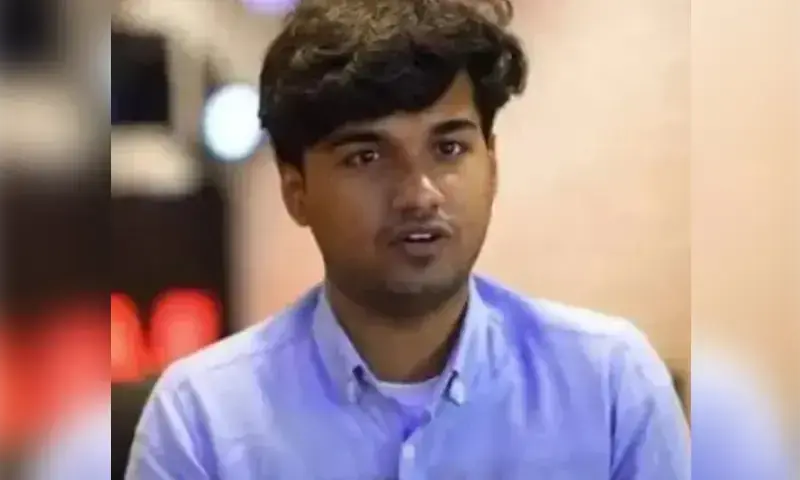
Mir Raza Ali, a graduate of the Institute of Business Administration and owner of the eatery Wafflix, had been missing for a day before his body turned up with a gunshot wound near Shahi Qila Ground in Gulistan-i-Jauhar. His family believes he was kidnapped, tortured and killed. Police, so far, have built their case around the possibility that he took his own life.
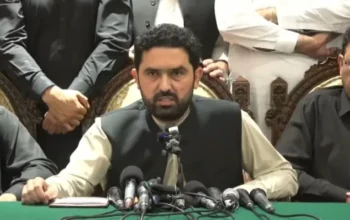
Relatives gathered on Friday at a graveyard beside Rehmania Masjid on Tariq Road, where the exhumation had been scheduled to take place. It did not go ahead. Jibran Nasir, the family’s lawyer, told reporters at the scene that he had informed the investigating officer the family would not accept an exhumation carried out by the newly constituted board “under any circumstances”.
Standing beside Ali’s father, Mir Hussain Ali Khan, Nasir laid the blame for the delay squarely on the police, the health ministry and the Sindh government, accusing them of trying to bury the facts of the case. The family, he said, could not permit an examination to be performed by a panel whose “qualifications and intentions were under question”.
A board changed overnight
According to Nasir, the Hyderabad health director general dissolved the original medical panel the previous evening and replaced it with a board containing four members drawn from Hyderabad. When that move drew a backlash, he said, the director general issued a backdated notification at around 10am on Friday — one that left the door open for further additions to the board while insisting the four Hyderabad appointees stay on regardless.
The family, Nasir said, had still not been told why the original board was dissolved in the first place. He pointed to a further complication: a separate notification had handed the Hyderabad health director general the power to constitute medico-legal boards, a function that had previously sat with the Sindh health secretary.
Nasir argued this ran contrary to the Sindh Medicolegal Act 2023, which he said gave the police surgeon sole authority over exhumations — a special law, he noted, that takes precedence over general statute. The authorities, he said, “needed to be given a lesson on law”.
He confirmed the family would not be lodging any further demands with the police. Ali’s father, he said, was instead putting his questions directly to Sindh Chief Minister Murad Ali Shah and PPP chairman Bilawal Bhutto-Zardari. Nor would the family approach the Sindh inspector general of police. “What do you ask an IG who claims that the investigation has been completed even before the exhumation and medical examination?” Nasir asked.
The family, he reiterated, trusted only the original eight-member panel. “Sindh government, they were hired by you,” he said. “And if they are not competent enough, then how were they appointed in the first place?”
Questions over missing CCTV footage
Nasir also renewed his claim that police had been selective in the CCTV evidence they had disclosed. Footage shared with the family showed a motorcycle and a rubbish picker passing the spot where the body was found — but nothing, he said, showing Ali arriving there himself, if the case really was one of suicide. “Where did that footage go?” he asked.
He raised a further question over the reaction of staff at a nearby guesthouse, who he said had panicked and fled to an adjoining property when Ali’s father came to ask about his son. Nasir wanted to know why those individuals had not been traced. He also accused police of refusing to let Ali’s father view the CCTV footage in full.
He ended his remarks on a note of guarded resolve. “If not today, then maybe we will get the exhumation done tomorrow,” he said. “We will try our best that the originally nominated doctors perform the examination, and I am sure the facts that they are going to such great lengths to bury will surface.”
‘We cannot allow them to disrespect the deceased’
Earlier in the day, Nasir had set out the family’s legal position in more detail, telling reporters that under the Sindh Medicolegal Act 2023, once a magistrate orders an exhumation, it falls to the relevant division’s police surgeon to constitute the examining board.
“I believe I am standing in Karachi division where the police surgeon is Dr Summaiya Syed,” he said, adding that she would be responsible for drawing in forensic experts from the nearest public sector university — questioning, pointedly, whether Liaquat University of Medical and Health Sciences in Hyderabad could really be considered closer to Karachi than Dow Medical College or the Jinnah Postgraduate Medical Centre.
He described the reconstituted panel as “illegal and dubious” and said it had no authority to examine the body. “We cannot allow them to disrespect the deceased and destroy evidence,” he said. He also questioned how a new notification could be issued while the previous one remained formally in place, alleging the intervention of an unnamed third party — a “stranger” to the case.
Asked about a proposal to merge the original and reconstituted boards, Nasir was unequivocal: “We will not accept any Plan C either.”
Writing on X earlier, he had accused the Sindh government of “maliciously” altering the board’s membership without explanation, and warned that the family would not permit the new panel to carry out the exhumation the following morning, “corrupt whatever evidence remains” in the process. He said the matter would be formally communicated to the authorities and that the fresh notification would be challenged through the appropriate legal channel.
Letter accuses authorities of contempt of court
Nasir also handed a formal letter to the police surgeon on Friday, setting out the family’s refusal to consent to the new board and arguing that its formation was in “complete violation and negation” of the court’s original order, with no legal standing.
The letter went further, describing the reconstituted board as carrying no binding value and amounting to nothing more than a “malicious attempt to interfere with judicial proceedings” initiated by the court. Any directive issued in support of the board, it warned, would be treated as a further attempt to “provide cover to an illegal act and sabotage fair and transparent investigation”.
Proceeding with the exhumation under the new panel, Nasir wrote, would violate the dignity of the deceased, place evidence at risk, and amount to “blatant” contempt of court. He maintained that the police surgeon remained duty-bound to carry out the procedure using the original board, and argued that the events of recent days had “fortified” the family’s suspicion that senior police officers were working to suppress the truth and manipulate the evidence toward a “pre-determined outcome” — allegedly to protect unnamed influential figures connected to the investigation.
Should the matter proceed through what he called the “illegally constituted” board, Nasir said, the family reserved the right to go to court to seek the prosecution of officers found to have “jeopardised” the investigation.
How the board came to be reconstituted
The dispute traces back to a Karachi court ruling on Thursday, which granted permission for Ali’s body to be exhumed, following an application filed by his father. The court directed the police surgeon and the Sindh health secretary to constitute a medico-legal board “at the earliest possible date and time”. The ruling followed a separate row that had broken out between the Karachi police surgeon and investigators over apparent gaps in the original post-mortem report.
In response, the Sindh health department appointed an eight-member board convened by Police Surgeon Dr Summaiya Syed. Its members included Prof Dr Naseem Ahmed of Dow University of Health Sciences, Dr Farah Waseem of Jinnah Sindh Medical University, Amir Hassan Khan of the Citizens Police Liaison Committee, Additional Police Surgeon Dr Sirichand, Dr Kamran Khan and Dr Daniyal Mirza of the Jinnah Postgraduate Medical Centre, and Dr Mohammed Yaseen, administrative in-charge of the police surgeon’s office.
That board was subsequently dissolved by a new order from the Sindh health directorate general. A notification confirming the change stated the board had been reconstituted to carry out the exhumation and medico-legal examination. Dr Syed remained as convener, but the remaining members were replaced with Prof Dr Zakiuddin of Dow University of Health Sciences, Prof Dr Kazi Akbar and Prof Dr Abid Hussain Chang of Liaquat University of Medical and Health Sciences, and Hyderabad Police Surgeon Dr Waseem Khan.
The case so far
Ali disappeared on 28 July. His body was discovered the following day, bearing a gunshot wound, in bushes near Shahi Qila Ground. A case was initially registered at Ferozabad police station under Section 365 of the Pakistan Penal Code — kidnapping or abduction with intent to secretly and wrongfully confine a person — on a complaint filed by his father.
Police say their investigation to date indicates Ali had been experiencing financial difficulties, and had asked friends for money on the night he died. He is said to have left his home in PECHS Block 2 and booked a taxi through a ride-hailing app; the driver dropped him a short distance from where his body was later found.
The case took a sharper turn on Tuesday, when Police Surgeon Dr Summaiya Syed told a private news channel that the post-mortem findings had raised a number of questions, with some observations in the report appearing inconsistent with the accompanying photographs. She said the recorded entry wound, bullet trajectory and exit wound did not line up with one another — while acknowledging it was scientifically possible for a bullet to enter through the back and exit through the front. She stressed that her comments were based solely on the report and photographs, since she had not examined the body herself.
Dr Syed noted that entry wounds are typically smaller than exit wounds in firearms cases, and observed that gunshot residue — commonly tested for on the hands in suspected suicides — had not been checked for in this instance.
Her remarks prompted a response from the police, who issued a statement warning that such observations risked adversely affecting the ongoing investigation. The statement did, however, acknowledge that exhumation could proceed on the recommendation of the medical board, for further clarification by a committee of medico-legal experts, subject to the court’s permission.
Copyright © 2021 Independent Pakistan | All rights reserved