By Staff Reporter
ISLAMABAD: Pakistan’s most powerful military commander flew to the Iranian capital Friday night, touching down amid an urgent and precarious flurry of diplomacy aimed at preventing the fragile ceasefire in the US-Iran war from unravelling entirely — and potentially averting a new round of American strikes that, by multiple accounts, Washington was actively contemplating.
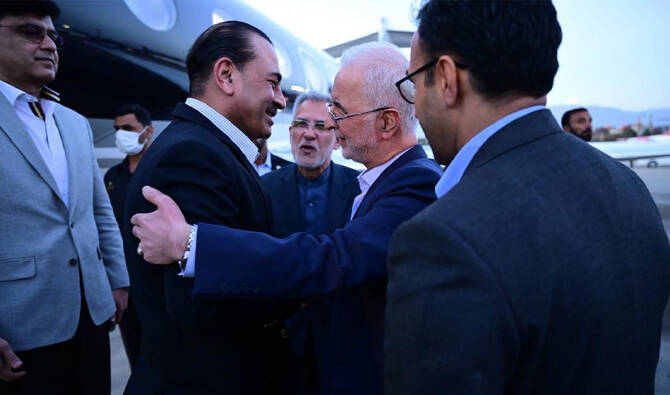
Field Marshal Syed Asim Munir, who serves simultaneously as Pakistan’s army chief and its chief of defence forces, arrived in Tehran to meet directly with Iran’s Foreign Minister Abbas Araghchi, according to a post on Araghchi’s Telegram channel. The two men talked deep into the night, exchanging views on what Araghchi described as the latest diplomatic initiatives and efforts to reduce tensions across a region still raw from nearly three months of conflict.
The visit was the highest-profile signal yet that Pakistan — which brokered the April 8 ceasefire that halted open fighting between American and Iranian forces and later hosted the first direct US-Iran talks since 1979 — believed the negotiations had reached a moment that required Munir’s direct intervention, not merely the shuttle diplomacy of lower-ranking envoys.
The stakes were hard to overstate. Even as diplomats converged on Tehran, American news outlets reported on Friday that the Pentagon and US intelligence agencies were actively weighing fresh military strikes against Iran. CBS News and Axios, citing unnamed sources, said military and intelligence personnel had been canceling Memorial Day weekend plans in anticipation of possible action. President Trump, meanwhile, abruptly announced he would not travel to attend his son’s wedding this weekend, saying circumstances pertaining to the government and his “love for the United States of America” required him to remain at the White House “during this important period of time.”
Whatever the precise nature of those circumstances, the juxtaposition — a military commander arriving in Tehran while reports of imminent strikes circulated in Washington — underscored just how volatile the situation had become.
‘Deep and Extensive’ Divisions
Iranian officials moved quickly to manage expectations. Esmaeil Baghaei, the foreign ministry spokesman, cautioned reporters that Munir’s arrival should not be read as evidence of a breakthrough. The gaps between Tehran and Washington, he said, remained “deep and extensive.” The current talks, he added, were focused narrowly on ending the war itself — not the broader nuclear questions that have defined the standoff for decades.
“We cannot necessarily say that we have reached a point where an agreement is close,” Baghaei said, according to Iran’s ISNA news agency. “Diplomacy takes time.”
Secretary of State Marco Rubio, speaking on the margins of a NATO foreign ministers’ gathering in Helsingborg, Sweden, echoed that measured tone from the American side. There had been “a little bit of movement,” he told reporters, “and that’s good.” But he was careful not to promise more. “I don’t want to exaggerate it,” he said. “We’re not there yet.”
The war began February 28, when American and Israeli forces launched coordinated strikes against Iran. Tehran retaliated with attacks on Israel and on American allies across the Persian Gulf, while simultaneously moving to close the Strait of Hormuz — the narrow waterway through which approximately one-fifth of the world’s oil and liquefied natural gas normally flows. In one of the conflict’s most consequential early blows, Iranian missiles and drones struck Qatar’s Ras Laffan facility, the backbone of that country’s LNG export economy, destroying roughly 17 percent of its capacity.
The April 8 ceasefire ended open hostilities but left in place the US naval blockade of Iranian ports and Iran’s effective stranglehold on the Strait of Hormuz — two pressure points that have since defined, and deadlocked, every round of subsequent negotiations.
Munir at the Center
Munir’s role in the crisis has been extraordinary by any measure. He was personally present in Islamabad during the April 11-12 direct talks between American and Iranian delegations — the highest-level face-to-face encounter between the two governments in more than four decades — greeting both sides and appearing publicly alongside US Vice President JD Vance in what diplomats described as a deliberate display of Pakistan’s good standing with Washington. Those talks collapsed without agreement, with Iran accusing the United States of making excessive demands.
Since then, Pakistan has pressed ahead as primary mediator, even as the talks have ground through a dispiriting cycle of reported progress and renewed impasse. Interior Minister Mohsin Naqvi made two trips to Tehran in a single week, holding meetings with President Masoud Pezeshkian, the parliament speaker and Araghchi. On Friday, Naqvi was present at the airport to receive Munir alongside Iranian Interior Minister Eskandar Momeni.
Rubio, asked about Pakistan’s role, described Islamabad’s diplomats as doing “an admirable job” and confirmed that American officials were in “constant communication” with Munir at the highest levels of government. “Pakistan remains the primary country we’ve been working with on all of this,” he said, “and that remains the case.”
Qatar Re-Enters
In a further sign of intensifying diplomatic activity, a Qatari negotiating team also arrived in Tehran on Friday. The delegation travelled, a source told Reuters, in coordination with Washington — a noteworthy development given Qatar’s complicated position in the conflict.
Doha had largely kept its distance from mediation earlier in the war, a measured calculation given that Iranian strikes had devastated Qatari territory and its most critical economic infrastructure. The decision to re-engage nonetheless reflected both Qatar’s longstanding back-channel relationships with Iranian officials — it played a similar role in brokering a 2024 ceasefire between Iran and Israel — and the acute economic pressure the Hormuz closure has placed on Doha.
Baghaei confirmed Friday that a Qatari delegation was meeting with Araghchi, describing Qatar’s supportive role in the mediation as “vital, important, and fundamental” while emphasising that Pakistan remained the official mediator.
Pakistan has also been coordinating its efforts with China, which has backed Islamabad’s push and jointly promoted a five-point peace framework calling for dialogue, a ceasefire, the protection of civilian and nuclear facilities, and the restoration of free navigation through the Strait of Hormuz.
Hormuz and the Nuclear Impasse
The two most intractable issues in the negotiations are the Strait of Hormuz and Iran’s nuclear program, and on Friday both sides staked out familiar positions.
Rubio said the United States would not accept any Iranian attempt to impose a tolling system on vessels transiting the strait — a scheme Tehran has reportedly been negotiating with Oman. “I don’t know of a country in the world that’s in favour of it except Iran,” he said. Any such move, he warned, would make a diplomatic deal “unfeasible.”
On the nuclear question, Baghaei was unequivocal: that subject was not on the table in the current talks. Iran, he said, had the right to the peaceful use of nuclear energy and would not yield its position. “There has been no nuclear threat from Iran against any actor in the region or the world,” he said.
The EU, for its part, moved Friday toward expanding the scope of its existing Iran sanctions regime to allow for travel bans and asset freezes targeting officials deemed responsible for blocking the strait — measures Brussels characterised as a response to actions “contrary to international law.”
Rubio, meanwhile, raised the possibility that European nations may need a “Plan B” to help force the waterway open if the war drags on, and acknowledged that he had raised Trump’s frustration with NATO allies — who have not backed the American campaign against Iran — as a matter requiring attention. The Strait of Hormuz, and Iran’s chokehold on it, he said, remained a central pillar of any eventual agreement.
A Deal or a Strike
Al Arabiya, the Arabic-language news network, reported Friday that a draft framework agreement was nearing completion and could be announced within hours. As described by the network, the draft would include an unconditional ceasefire across all fronts, a mutual commitment to halt attacks on military and civilian infrastructure, guarantees of free navigation in the Arabian Gulf and the Strait of Hormuz, a joint monitoring mechanism, and a commitment by both sides to begin negotiations on unresolved issues within seven days. The gradual lifting of American sanctions in exchange for Iranian compliance was also included, the network reported.
Whether such a framework exists, and whether it can bridge what both sides acknowledged on Friday, remains unclear. What was clear was that Trump’s management of the crisis had grown increasingly unpredictable. He has set deadlines for Tehran and walked them back. He indicated willingness to allow diplomacy to proceed at the war’s outset — and then ordered strikes anyway.
Earlier this week, Trump said he had called off a planned attack on Iran at the request of Gulf leaders, including the heads of state of Qatar, Saudi Arabia and the United Arab Emirates. That decision put him in open conflict with Israeli Prime Minister Benjamin Netanyahu, who has resisted any diplomatic accommodation with Tehran. An official familiar with the exchange said Trump and Netanyahu had a “dramatic” phone call Tuesday over the direction of the talks, and that Israel was furious with Washington’s push for a deal. Trump, asked about the tension, told reporters that Netanyahu “will do whatever I want him to do.”
Copyright © 2021 Independent Pakistan | All rights reserved