By Staff Reporter
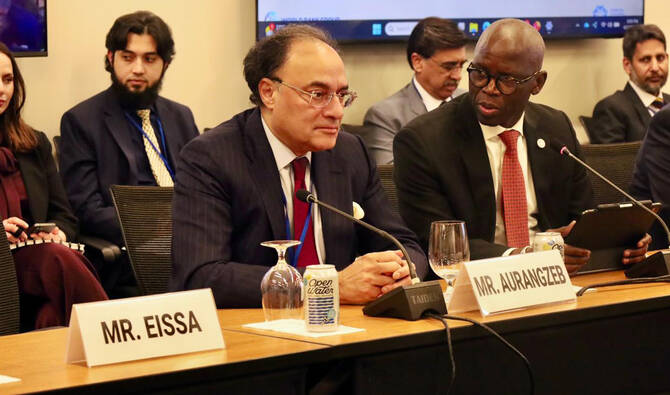
ISLAMABAD: Finance Minister Muhammad Aurangzeb held a productive meeting with Francis Brooke, deputy secretary at the US Department of the Treasury, on the sidelines of the World Bank-IMF Spring Meetings, where the two sides explored avenues for cooperation in the mineral and energy sectors as well as strengthening the anti-money laundering and countering the financing of terrorism framework.
The ministry said Aurangzeb shared an overview of Pakistan’s macroeconomic stabilization, its planned re-entry into international capital markets and its external debt management strategy. He highlighted investment opportunities in the minerals and energy sectors and briefed US Treasury officials on progress and prospects in digital and virtual asset regulation. He also reaffirmed the depth and strength of bilateral economic engagement and underscored the importance of continued US support for Pakistan’s program with the IMF.
Aurangzeb arrived in the United States on Monday for the Spring Meetings, which run from April 13 to 18 in Washington and bring together finance ministers, central bank governors, policymakers and development experts amid global economic uncertainty. He is expected to participate in more than 50 high-level engagements during the visit.
Separately, Aurangzeb met Asian Infrastructure Investment Bank President Zou Jiayi and appreciated the lender’s robust engagement in Pakistan through an ongoing portfolio of approximately $1.7 billion, with an additional $1 billion in the pipeline. He briefed her on the economic implications of the ongoing regional situation, particularly its impact on Pakistan’s energy supply chain, and highlighted the country’s recent return to international capital markets, including the launch of a Eurobond through private placement after a gap of four years.
The minister invited the AIIB to align its engagement with Pakistan’s infrastructure priorities and strategic development focus. Both sides acknowledged that Pakistan’s disbursement performance with the AIIB has lagged behind that of other multilateral partners, including the World Bank and the Asian Development Bank. Aurangzeb outlined Pakistan’s broader development frameworks, including the 10-year Country Partnership Framework with the World Bank, focused on population, climate and fiscal priorities, as well as the five-year Country Partnership Strategy with the Asian Development Bank. He reaffirmed the government’s commitment to improving institutional processes and enhancing implementation efficiency to reduce delays in project execution.
The finance minister also participated in a World Bank-organized roundtable titled “Delivering Social Protection Digitally: Lessons and Innovations from Pakistan, Middle East and North Africa.” He drew a compelling parallel between the Covid-19 pandemic, described as the largest demand shock in recent history, and the ongoing Middle East conflict, which he characterized as the largest supply shock. Countries that invested early in governance and technology were better positioned during Covid-19, he noted, and Pakistan is now reaping similar dividends from its digital infrastructure as it navigates the current energy supply shock.
His key message, according to the ministry, was that digital social protection is not merely a payment mechanism but a vehicle for financial inclusion and economic empowerment. The roundtable featured presentations on Pakistan’s Digital Public Infrastructure journey and the digital transformation of the Benazir Income Support Programme.
In a separate meeting with representatives of S&P Global Ratings, Aurangzeb said Pakistan had met its external obligations in a timely manner, including the repayment of $1.4 billion on its Eurobond during the current month. He noted that Pakistan had successfully re-entered international capital markets with the launch of a Eurobond through private placement after a gap of four years, priced at just under 7 percent, reflecting renewed investor confidence in the country’s macroeconomic trajectory.
Aurangzeb highlighted additional financial support from the Kingdom of Saudi Arabia, including a $3 billion facility and the extension of an existing $5 billion deposit from an annual rollover to a three-year term through 2028, further strengthening the country’s external position. He outlined Pakistan’s medium-term Global Medium Term Note strategy, which envisages diversified issuances across multiple instruments, including Eurobonds, Sukuk and rupee-linked, dollar-settled bonds, aimed at broadening the investor base and mitigating foreign-exchange risks. Regulatory submissions have been made for Pakistan’s inaugural Panda bond issuance, with approval from the National Association of Financial Market Institutional Investors awaited.
The minister expressed confidence that Pakistan’s improved macroeconomic fundamentals and continued reform momentum presented a strong case for a rating upgrade, even as the government manages the immediate economic impact from the evolving regional situation through measures to secure energy supply chains, optimize pricing and logistics, and provide targeted digital subsidies to vulnerable segments of the population.
Aurangzeb also held a constructive meeting with representatives of Citibank, where he appreciated the bank’s detailed and structured capital-markets strategy and advised the team to maintain close coordination with Pakistan’s Debt Management Office to support ongoing and future market engagements. He expressed a strong desire to further reinvigorate and deepen the longstanding partnership.
On the same sidelines, State Bank of Pakistan Governor Jameel Ahmad told senior executives from leading global financial and investment institutions—including JP Morgan, Barclays, Citibank, Jefferies and Franklin Templeton—as well as major credit rating agencies such as Fitch, Moody’s and S&P Global that Pakistan’s key macroeconomic indicators have improved faster than anticipated at the beginning of the fiscal year.
While the ongoing conflict in the Middle East has introduced new risks and increased uncertainty, the economy is relatively better positioned compared with previous crisis episodes to manage these challenges, Ahmad said. He emphasized that prudent monetary and fiscal policies had helped bring down and stabilize inflation within the target range while strengthening fiscal and external buffers.
Inflation averaged 5.7 percent during the first nine months of the fiscal year, the external current-account balance remained in surplus, and SBP foreign-exchange reserves strengthened to $16.4 billion, mainly due to purchases from the interbank market. With continued purchases and realization of official inflows, including under fresh bilateral arrangements, reserves are expected to reach around $18 billion by June 2026, he said.
Real GDP registered a broad-based acceleration to 3.8 percent in the first half of fiscal 2026, compared with 1.8 percent in the same period a year earlier. Ahmad noted that the staff-level agreement with the IMF for the third review of the Extended Fund Facility and the second review of the Resilience and Sustainability Facility, along with recent credit-ratings reaffirmations, underscored the government’s and central bank’s commitment to macroeconomic stability and the reform agenda.
The governor also engaged with the Pakistani diaspora and global stakeholders at a Remittances and Roshan Digital Account roadshow. He highlighted that RDA inflows have surpassed $12.4 billion across more than 917,000 accounts and outlined recent enhancements to the regulatory framework, including the inclusion of non-resident entities, to further integrate Pakistan into global financial markets.
Copyright © 2021 Independent Pakistan | All rights reserved