By Staff Reporter
ISLAMABAD: US Defense Secretary Pete Hegseth said on Saturday that an unlikely and deepening partnership has taken hold between the United States and Pakistan, crediting Prime Minister Shehbaz Sharif and army chief Field Marshal Asim Munir with helping steer Washington and Tehran toward a fragile but still-tenuous peace.
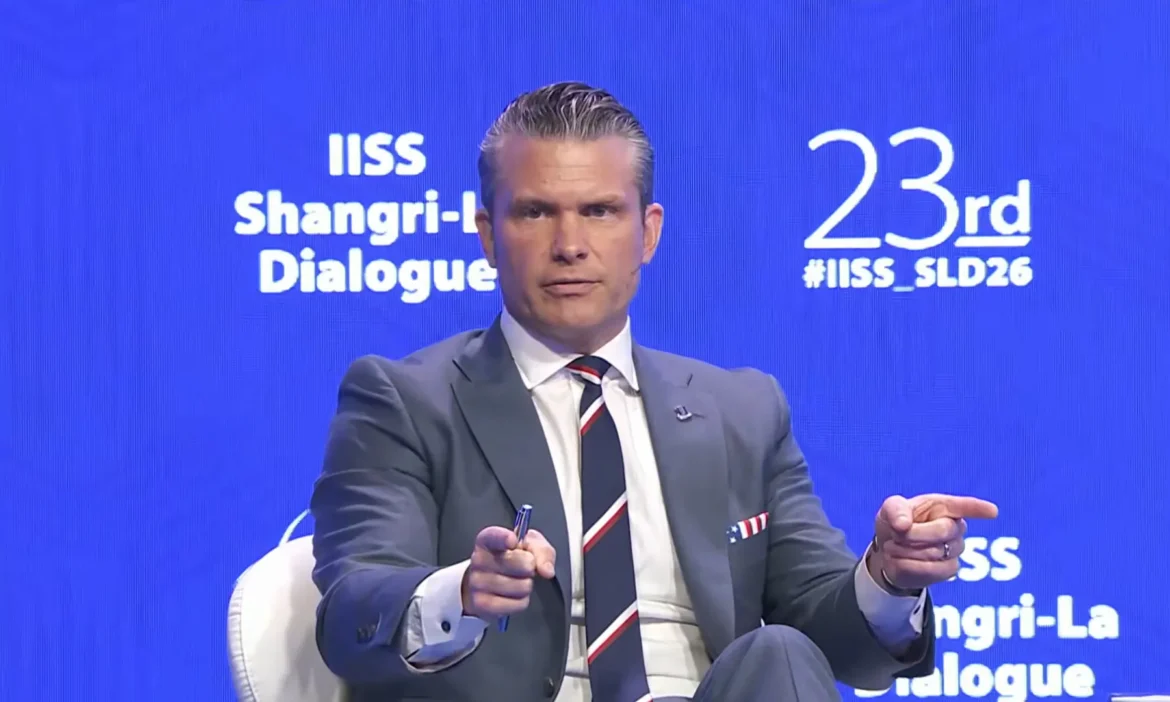
Speaking at the Shangri-La Dialogue, the annual security summit held in Singapore, Hegseth offered some of his most effusive public praise yet for Islamabad’s diplomatic role — and signaled that the relationship, long defined by suspicion and transactional necessity, had evolved into something Washington regards as genuinely consequential.
“I mentioned India here, but I very easily could have mentioned Pakistan and the role that the field marshal and the prime minister are playing in peace negotiations,” Hegseth said, departing from prepared remarks that had focused heavily on India as a “critical anchor” of US strategy in the Indo-Pacific. “I think an unexpected development and a true friendship developing there, which I think is important.”
The remarks came as Pakistani-brokered diplomacy remains the central pillar of American efforts to end a conflict that erupted in late February, when the United States and Israel launched coordinated strikes against Iran. Tehran responded by targeting American military installations across the region and effectively closing the Strait of Hormuz, sending shockwaves through global energy markets.
Pakistan brokered an initial two-week ceasefire on April 8 and subsequently hosted the first direct talks between American and Iranian delegations in roughly 47 years — a development that Islamabad has positioned as a validation of its renewed strategic value to Washington. Though those talks ended in a deadlock, with Washington and Tehran unable to bridge their differences over the Hormuz strait, Iran’s nuclear program, and its ballistic missile capabilities, Pakistan continued pressing for an extension of the ceasefire and has remained the principal go-between.
Iranian President Masoud Pezeshkian, in a post to his official account on X on Friday, thanked Pakistan for its “initiative and effective efforts to reach an agreement” with the United States — remarks made after separate phone calls with both Sharif and Malaysian Prime Minister Anwar Ibrahim.
The path toward a final settlement, however, remains uncertain. A White House official told the news agency AFP on Friday that President Trump would only conclude a deal with Iran if Tehran met all of his conditions, which include a permanent renunciation of nuclear weapons and the reopening of the Strait of Hormuz. Trump attended a two-hour meeting in the White House Situation Room that day without reaching a decision. Iranian state media, meanwhile, pushed back on Trump’s public characterizations of the negotiations, with sources describing his recent remarks as a combination of accurate and misleading claims.
Hegseth’s comments at the forum added another chapter to what has become a strikingly public American courtship of Pakistan’s military and civilian leadership. Trump has called Sharif “great” and described Munir — whom Pakistan elevated to the rank of field marshal in recognition of his role during last year’s brief but intense military confrontation with India — as “fantastic” and, on at least one occasion, “my favorite field marshal.” At the inaugural meeting of the U.S.-led Board of Peace in February, Trump had called Munir a “tough man” and a “serious fighter.”
That India-Pakistan conflict, which involved exchanges of drone, missile, and artillery strikes between the two nuclear-armed neighbors before a ceasefire took hold in May 2025, became an early test of the relationship. Pakistan publicly credited Trump with brokering an end to the fighting — Sharif went so far as to nominate Trump for the Nobel Peace Prize — while India’s government flatly rejected the characterization, maintaining that Prime Minister Narendra Modi’s government resolved the standoff on its own terms. The discrepancy has quietly irritated the Trump White House.
Hegseth, who had spent much of his Saturday address at Shangri-La extolling American defense partnerships across Southeast Asia and singling out India for particular praise, addressed the question of South Asian nuclear dynamics with notable care. Asked whether former Director of National Intelligence Tulsi Gabbard’s warnings about Pakistan’s future missile capabilities represented a threat to the United States — and whether India’s Agni-VI long-range ballistic missile program warranted similar concern — he declined to place either country in Washington’s crosshairs.
“Both sides are going to see understandable threats coming from the other, maybe some of which we see differently, and countries are going to want to develop ICBM-range threats,” he said. “But we’re not pointing fingers, at least from our view right now, at either country and calling them a threat to us.”
He added that the United States was “grateful for, in each of their lanes, the benefits they’ve given to peace around the world.”
The comments reflect a careful American effort to manage what Secretary of State Marco Rubio, in November, described as an opportunity to deepen the US strategic relationship with Pakistan — without, Rubio was careful to add, doing so at the expense of Washington’s ties with New Delhi.
Copyright © 2021 Independent Pakistan | All rights reserved