By Staff Reporter
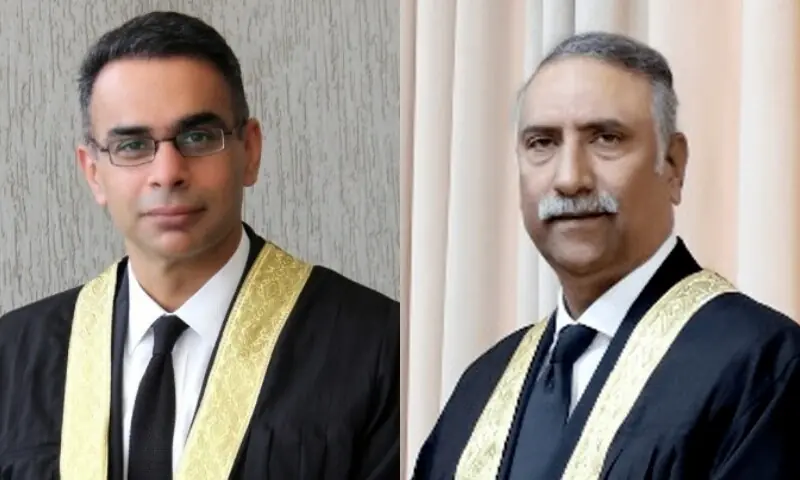
ISLAMABAD: A judge on Islamabad High Court has issued a blistering critique of the court’s leadership, accusing Chief Justice Mohammad Sarfraz Dogar of eroding judicial independence, transparency and institutional norms in a letter that lays bare deep divisions within the judiciary.
Justice Babar Sattar presented the charge sheet on Tuesday, highlighting what he called “judicial ills plaguing the high court” as the new judicial year began with a full court meeting convened by Justice Dogar and attended by all judges.
Officials said the chief justice has scheduled another full court session for 2 p.m. today, issuing formal notices directing all IHC judges to attend. The detailed agenda has not been made public, but such meetings are typically held at the start of the judicial year to review the court’s performance, discuss administrative affairs and set priorities for the coming months. The session, to be chaired by Justice Dogar, will bring together all serving judges for collective deliberations on judicial and administrative matters. Sources said judges have sought revisions to the agenda, voicing strong reservations about the IHC’s operations and proposing remedial measures. The letters were shared among the judges.
In his letter, reported by Dawn newspaper, Justice Sattar described the full court meeting as a “long overdue but welcome step towards correcting the illegalities that have seeped into the administration of Islamabad High Court,” adding that the problems began under the previous chief justice. “I am writing to you in request inclusion of the matters listed below for discussion in the full court meeting. I have only included here brief explanations or questions to articulate their relevance, but I am sure you’ll get my drift,” he wrote. “Some might counsel that this is an exercise in futility in view of the egregious disregard for judicial independence, institutional norms and the principle of comity amongst judges that has been witnessed in our midst since your transfer to Islamabad High Court. But one must never lose hope in the innate capacity of human beings to assume control of their agency and do the right and decent thing.”
Justice Sattar raised several concerns, starting with the IHC’s waning role as a guardian of fundamental rights. He said the judiciary’s core duty in a rule-of-law system is to shield constitutionally guaranteed rights from state abuse. He asked whether IHC judges believe the court is fulfilling that “pivotal constitutional duty” and whether citizens view them as defenders of those rights.
On oversight of the subordinate judiciary, Justice Sattar questioned if the IHC is meeting its Article 203 obligation to supervise lower courts so judges can work without fear. “Should the Islamabad District judiciary continue to look like a game of musical chairs played predominantly by deputationists or does IHC have the responsibility to develop district judiciary as an independent institution possessed of integrity and efficiency?” he wrote.
He criticized a lack of transparency in case assignments and rosters, saying Justice Dogar has sidelined senior judges, including the senior puisne judge, from leading division benches. “Should fixation of cases rest on the whims of the CJ or should there be transparency in who hears what case, while matching expertise of judges to the work they are asked to do? We write in our judgments every day that public officials aren’t kings and their administrative powers are neither unfettered nor should be exercised in a colorable manner. The cause lists issued under your watch reflect that cases are mostly marked to transferred judges and additional judges, leaving out permanent judges of IHC who found your transfer to IHC disagreeable. While exercising the administrative powers of IHC should one not remember that judges, including the CJ, are public officials too and not kings?”
Justice Sattar accused the chief justice of wielding administrative powers to weaken judicial independence. Under Justice Dogar’s tenure, he wrote, the court office has defied judicial orders by withholding cause lists, transferred cases without authority and issued rosters that stripped two judges — including himself — of their dockets, rendering them “dysfunctional.” Such tactics may sideline judges, he said, echoing “malevolent practices” from Pakistan’s authoritarian eras, but he questioned if this “subversion of judicial independence” is defensible.
On committee composition, Justice Sattar said Justice Dogar has excluded senior judges from key panels. “You’ve excluded the two senior-most judges of IHC from the Administration Committee in breach of IHC rules and entrenched institutional norms abided by all high courts, including the LHC from where you’ve come. “Do you think manning IHC committees with additional judges appointed earlier this year and judges transferred from other provinces along with you strengthen IHC as an Institution and promote collegiality amongst judges?”
He faulted the chief justice for turning his office into a “monocracy,” citing a circular requiring judges to obtain no-objection certificates for international travel — effectively placing them on an exit control list. Neither the constitution nor law grants such authority to “lord over his peers,” Justice Sattar wrote. “The draft rules circulated for consideration during the full court meeting also seek to concentrate all administrative powers in the office of the chief justice. You might have read Lord Acton’s words that power tends to corrupt and absolute power corrupts absolutely. Will transforming the office of chief justice into an autocracy, in an effort to reduce the judiciary to a regiment, bolster judicial independence essential for the discharge of our adjudicatory duties?”
On judge evaluations and judgment reporting, Justice Sattar said judges, as the highest-paid public officials, must face rigorous public accountability, but he called for an objective framework. “Under your watch IHC has issued skewed statistics regarding discharge of judicial work at IHC. These statistics are designed to cultivate an impression that some judges work super efficiently, while others don’t work at all. What if a curious researcher were to investigate the nature (and number) of cases marked to the ‘performing’ judges versus others, and the nature, quality and length of orders that make up their disposal figures? Should we not put together a consensual performance-evaluation criteria as well as guidance for which judgments are to be reported, to earnestly seek to enhance our performance and hold ourselves to account, instead of engaging in deceptive advertising?”
In closing, Justice Sattar wrote: “You will appreciate that it takes decades to build institutions, but they can be destroyed exponentially. We have seen this happen to Islamabad High Court in the last couple of years. “While I may be accused of letting hope trump experience in writing to you to encourage and facilitate intra-institutional debate to stem the rot that is reducing this judicial organ into nothingness, I am partial to Rousseau’s opinion regarding the capacity of human beings for virtue. History doesn’t remember kindly those who only make hay while the sun shines. And history also reminds us that all good (and bad) times come to an end sooner rather than later.” He hoped Justice Dogar would “appreciate the spirit in which it is written” and apologized if it caused offense: “We are all grown adults who should be able to speak candidly about the state of our institution’s disrepair. Without honest identification and admission of our failings, there can be no corrective action.”
Justice Sattar has previously written to Justice Dogar on issues like IHC rule amendments and committee formations. Recently, the chief justice formed a division bench to clear a backlog of nearly 2,000 tax references, with Justice Sattar as a member. The IHC administration has transferred all cases from the dockets of Justice Sattar and Justice Sardar Ejaz Ishaq Khan to other judges.
Copyright © 2021 Independent Pakistan | All rights reserved