By Monitoring Desk
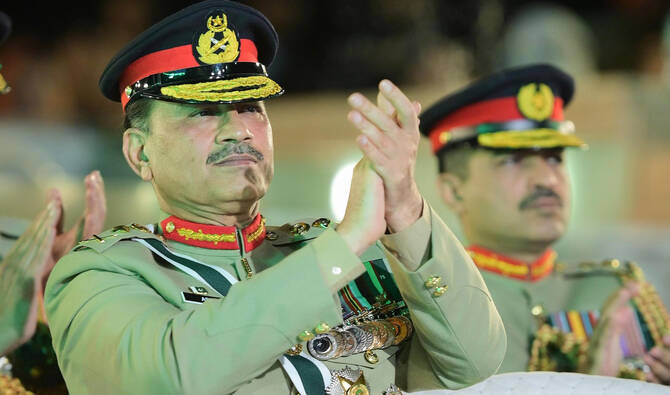
KARACHI: As Pakistan’s military consolidates unprecedented control under Field Marshal Asim Munir, the general now confronts a pivotal dilemma: whether to heed pressure from Washington and commit troops to a contentious stabilisation force in Gaza, a step that could inflame domestic unrest in a nation already roiled by political and militant tensions, Reuters reported on Wednesday.
Munir, who has amassed authority rivalling the most dominant figures in Pakistan’s turbulent history, is poised to visit Washington in the coming weeks for his third encounter in six months with President Donald J. Trump, according to two sources, including one engaged in the general’s economic outreach.
The agenda is expected to emphasise the Gaza mission. The proposal stems from Trump’s 20-point blueprint for Gaza, which seeks contributions from Muslim-majority countries to form a force overseeing reconstruction and economic revival in the devastated territory, following more than two years of intense Israeli military operations.
Central to the plan is the demilitarisation of Hamas, the Islamist militants who have long dominated the enclave. Nations have approached the idea with caution, concerned that participation might entangle them in the protracted conflict and provoke outrage among publics that harbour strong pro-Palestinian sentiments and antipathy toward Israel.
Munir, however, has forged a personal connection with the volatile Trump, aiming to rebuild trust eroded over years between the two allies. That effort culminated in June with a private White House lunch, marking the first instance of an American president hosting Pakistan’s army chief without accompanying civilian representatives.
Pakistan stands out as the world’s only Muslim nuclear power, its forces seasoned by three full-scale wars against India, a fleeting skirmish this summer, and persistent campaigns against insurgents in its borderlands, including a grinding confrontation with militants allegedly sheltered in Afghanistan. Such capabilities heighten the stakes for Munir. “There is a greater pressure on Munir to deliver his capacity,” observed Ayesha Siddiqa, a defence analyst and author, told Reuters. Neither Pakistan’s military nor its foreign and information ministries responded to requests for comment. The White House also offered no reply.
Foreign Minister Ishaq Dar suggested last month that Pakistan might entertain a peacekeeping role, but drew a firm line: disarming Hamas “is not our job.” Munir’s ascent reached new heights this month when he was named chief of defence forces, extending his command over the army, air force and navy through 2030. Last month’s constitutional amendments, advanced by the civilian administration, conferred upon him the perpetual rank of field marshal and enduring immunity from prosecution.
“Few people in Pakistan enjoy the luxury of being able to take risks more than Munir. He has unbridled power, now constitutionally protected,” said Michael Kugelman, a senior fellow for South Asia at the Atlantic Council in Washington. “Ultimately, it will be Munir’s rules, and his rules only,” he added. Declining to join the force carries its own perils. “Not contributing could annoy Trump, which is no small matter for a Pakistani state that appears quite keen to remain in his good graces — in great part to secure U.S. investment and security aid,” Kugelman noted.
In recent weeks, Munir has held discussions with military and civilian counterparts from Indonesia, Malaysia, Saudi Arabia, Turkey, Jordan, Egypt and Qatar, as detailed in military communiqués — exchanges that Siddiqa interprets as deliberations on the Gaza undertaking. Yet the gravest risks lie within Pakistan’s borders, where dispatching soldiers to a US-endorsed operation in Gaza might reignite fervour among Islamist groups hostile to both Washington and Israel, factions with proven ability to summon vast crowds in protest.
In October, authorities proscribed a virulent anti-Israel Islamist organisation notorious for its aggressive defence of Pakistan’s severe blasphemy laws. Officials described a sweeping clampdown, including the detention of its leaders and over 1,500 adherents, alongside the forfeiture of assets and financial holdings. Even as the group is formally dissolved, its doctrines endure. Adding to the volatility is the party aligned with Imran Khan, the former prime minister now imprisoned, whose backers claimed the largest bloc in the 2024 elections and retain substantial grassroots loyalty, nursing deep resentments toward Munir.If the mission encounters complications on the ground, the fallout could cascade rapidly, warned Abdul Basit, a senior associate fellow at the S. Rajaratnam School of International Studies in Singapore. “People will say ‘Asim Munir is doing Israel’s bidding’ — it will be foolhardy of anyone not to see it coming.”
Copyright © 2021 Independent Pakistan | All rights reserved