By Staff Reporter
ISLAMABAD: The interior ministry on Friday declared the religiopolitical party Tehreek-i-Labbaik Pakistan a proscribed organisation, accusing it of links to terrorism and citing a history of violent protests that have repeatedly disrupted the country and led to deaths.
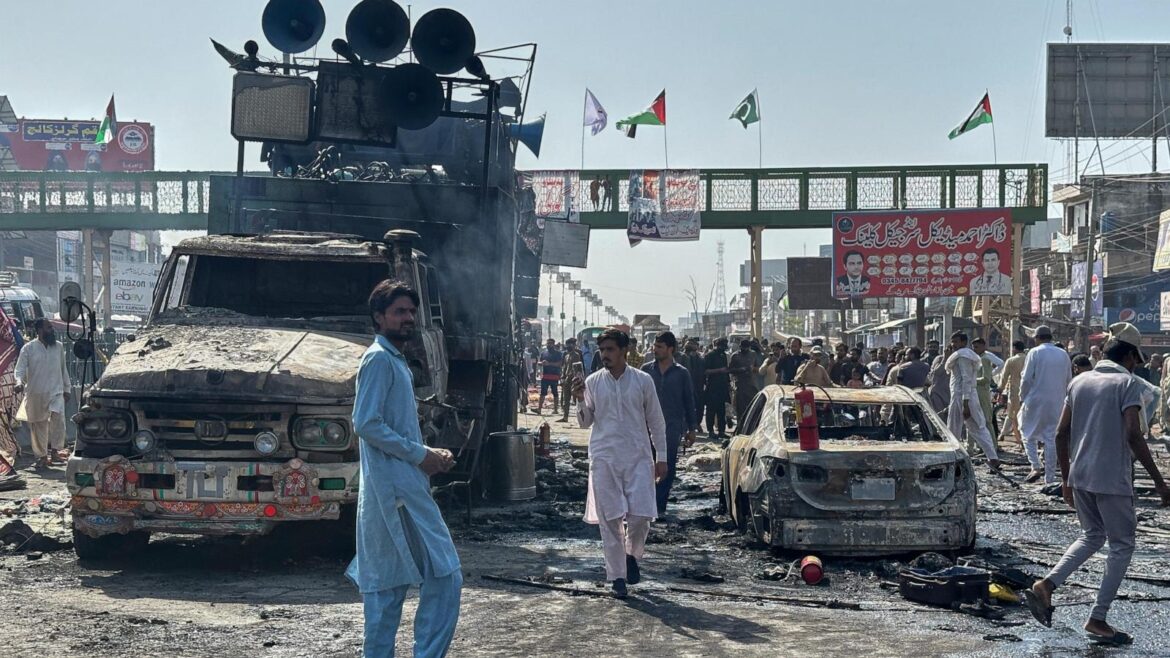
The move, announced in a notification, came days after clashes between the party’s supporters and law enforcement officers during nationwide demonstrations in solidarity with Palestinians in Gaza. Those protests paralyzed major highways and city roads from Lahore to Islamabad, claiming the lives of several protesters and police officers.
“The federal government has reasonable grounds to believe that TLP is connected with and concerned in terrorism,” the notification said. “In exercise of the powers conferred by Section 11B(1)(a) of the Anti-Terrorism Act, 1997 (XXVII of 1997), the federal government hereby orders TLP to be a proscribed organisation for the purpose of the Act and list the aforesaid organisation in the first schedule to the said Act.”
The ban followed a unanimous decision by the federal cabinet on Thursday, during a meeting chaired by Prime Minister Shehbaz Sharif. The proposal originated with the Punjab government, the country’s most populous province, where much of the recent violence unfolded. A statement from the prime minister’s office described the cabinet’s approval as unanimous and said the interior ministry had briefed members on the party’s “violent and terrorist activities,” emphasizing its role in inciting unrest across Pakistan. “In the past, security personnel and innocent bystanders have been killed in violent protests and rallies by the TLP,” the statement said.
The interior ministry informed the cabinet that a previous ban on the party, imposed in 2021, had been lifted after six months based on assurances that it would avoid violence. Officials said the group had since reneged on those commitments.
The clashes that prompted the ban began earlier this month when thousands of party supporters marched toward Islamabad, intending to stage a sit-in outside the United States Embassy to show solidarity with Gaza. The party described the march as peaceful, but officials said demonstrators attacked police with batons, rocks and guns, leading to violent confrontations on the outskirts of Lahore. Five people were killed, including two policemen, and more than 100 officers and dozens of protesters were injured. Authorities are now searching for the party’s leader, Saad Rizvi, who went into hiding after the violence erupted on Oct. 13.
This is not the first time the government has moved against the Tehreek-i-Labbaik Pakistan. The federal government outlawed the group in April 2021 under the same Anti-Terrorism Act, after violent anti-France protests that left several police officers dead. The ban was lifted in November 2021 after negotiations ended a march toward the capital. Under Pakistan’s legal framework, the National Counter-Terrorism Authority maintains lists of proscribed persons and groups. Those designated face travel bans, financial sanctions and potential monitoring under the Fourth Schedule of the Anti-Terrorism Act. Historically, such designations have targeted groups like the Tehreek-i-Taliban Pakistan, Hizbut Tahrir, Lashkar-i-Jhangvi, Jaish-i-Mohammad and the Baloch Liberation Army.
The T.L.P., led by Saad Hussain Rizvi, has built a reputation for street mobilization and confrontational politics, often staging mass sit-ins and marches to Islamabad since its rise in 2017. Previous protests have turned violent, causing extended clashes with police and disrupting traffic on key highways for days. The party has its ideological roots in Barelvi Islam, a mainstream sect traditionally viewed as moderate but for which blasphemy is a red line.
It was founded in 2015 by Rizvi’s father, Khadim Hussain Rizvi, who was known for his fiery speeches and harsh criticism of political opponents and was confined to a wheelchair. The group gained prominence in 2016 by protesting the execution of Mumtaz Qadri, a bodyguard who assassinated the Punjab governor over his stance on blasphemy. It transitioned from a movement to a political party in 2016. In the 2018 national elections, the TLP secured 2.2 million votes, mostly from eastern Punjab, and won two provincial seats in southern Sindh. It emerged as the third-largest party in Punjab, behind Imran Khan’s Pakistan Tehreek-e-Insaf and Nawaz Sharif’s Pakistan Muslim League-Nawaz.
Copyright © 2021 Independent Pakistan | All rights reserved