By Staff Reporter
ISLAMABAD: A general framework of understanding between Iran and Oman over the Strait of Hormuz has been agreed, an Iranian official said on Friday, though the full text will not be published until it clears approval from senior figures in Tehran.
Hassan Ghashghavi, spokesperson for the Iranian parliament’s National Security Commission, told the state news agency IRNA that the outline of the arrangement had been finalised. “The general framework of the understanding with Oman has been determined, and the final text and details will be announced soon,” he said. But he was careful to add a caveat that has hung over the talks for weeks: “Of course, the final decision must be made at higher levels.”
The announcement, reported by Al Jazeera, marks the clearest sign yet that Tehran and Muscat are closing in on a deal to partially unblock the world’s most important oil chokepoint, five weeks after a US-brokered agreement to reopen it collapsed. But it falls well short of resolving the wider standoff between Iran and Washington, which has kept the strait an unpredictable and often deadly stretch of water since the war began in February.
A framework, not a fix
Iranian officials have been at pains to stress that agreement with Oman does not, on its own, mean ships can move freely again. Esmaeil Baghaei, spokesperson for Iran’s foreign ministry, said this week that the reopening of the strait remains contingent on Washington lifting its naval blockade and halting strikes on Iranian territory. “An understanding with Oman cannot, in itself, mean that the strait has become safe for passing vessels,” he said, “because the factors creating insecurity in the Strait of Hormuz — particularly the US naval blockade and other actions against Iran and its interests — remain in place.”
Deputy Foreign Minister Kazem Gharibabadi has given the fullest account yet of what the Iran-Oman arrangement actually contains. The two sides have agreed on the geographical coordinates of proposed inbound and outbound shipping routes, he said, along with technical arrangements covering security, sovereignty and a joint coordination centre to manage maritime traffic. Under the proposal, existing temporary routes near Iran’s Larak Island and through Omani waters would be closed and replaced with the new corridors — one entering the Gulf through Iranian-controlled waters, the other exiting through a route controlled by Oman.
A US official, speaking on condition of anonymity, insisted that any temporary routes agreed would be free of Iranian oversight. “Any temporary routes will be without any impediments — meaning no approvals or permissions and no tolls or charges,” the official said. “The Strait of Hormuz is an international waterway, and no party controls the lanes or the ability to transit through them.” That framing sits uneasily with Tehran’s own account of the deal, and with Iranian MP Ahmad Bakhshayesh Ardestani’s claim that Iran considers the “vast majority” of the strait to fall within its sovereign waters, entitling it to the lion’s share of any transit fees eventually collected.
Washington’s reluctance to negotiate directly is, in Bakhshayesh Ardestani’s telling, precisely why Oman has been drawn into the process. “The United States does not want to accept direct responsibility, so it has pushed Oman forward,” he told the Didban Iran news outlet.
Shipping still a trickle
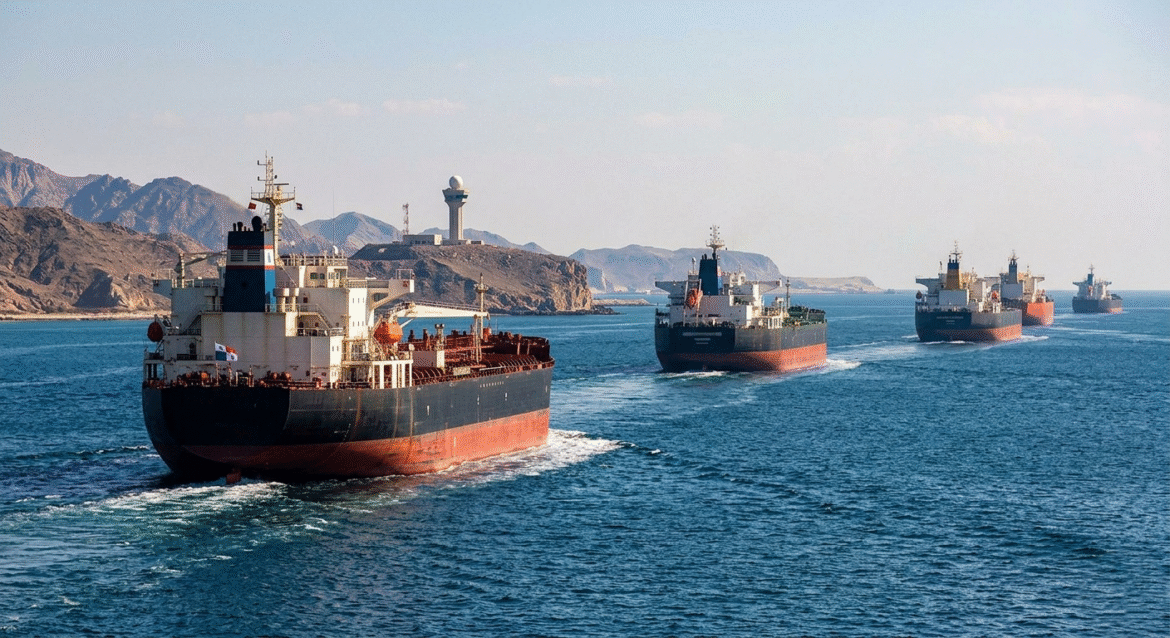
Whatever the diplomatic language, the numbers moving through the strait tell their own story. Vessel traffic fell to just 33 ships between Monday and Thursday this week, down from 50 the week before, according to data from the tracking firm Kpler. Only six crude oil tankers left the strait over the same period, against 21 that entered — most via the Iranian route. Before Iran shut the waterway at the end of February, roughly 130 to 140 ships would typically pass through in a comparable window.
Chinese and Indian refiners have reportedly been circling this week, tempted by steep discounts on Iraqi Basrah crude — Iraq’s state marketer SOMO has cut prices by close to $30 a barrel for August cargoes — but shipowners remain too wary of the strait to commit vessels. Separately, the Financial Times reported that no tankers have loaded at Kharg Island, Iran’s principal oil export terminal, for at least a week. Satellite imagery reviewed by the maritime intelligence firm Windward showed all three loading berths standing empty, with just 16 vessels anchored nearby on Tuesday — the lowest count since the previous month. Nearly 90 per cent of Iran’s crude exports normally move through the island.
Richard Bronze, head of geopolitics at the consultancy Energy Aspects, said the blockade Washington reimposed in mid-July was doing what it was designed to do. “The blockade is effective, in the sense that there is not a lot of tanker movement in or out,” he said. But he doubted it would force Tehran’s hand. “It is pretty clear the Iranians feel they have the upper hand when it comes to Hormuz and they are willing to tolerate a lot of economic pain to press their advantage.”
Trump says Iran wants a deal
President Donald Trump used an interview with Punchbowl News, released on Friday, to insist that Iranian officials are eager to reach an accommodation with Washington. “Look, it’s obvious they don’t want to be hit. They want to make a deal. So, we’ll see,” he said.
It is a claim he has made repeatedly this week. Asked by reporters at the White House on Thursday whether a deal to reopen the strait had already been struck, Trump was equivocal. “I don’t want to say it has been,” he said. “It’s sort of open right now. You know, we have a thing called the blockade, headed up by the US Navy, and we control it.” He went on to describe the lingering threat posed by mines: “They can always shoot something. They always have something, or drop a mine, and if you have one mine sitting out there, you sort of mess things up because people don’t want to take their billion-dollar boats and accidentally get hit by a mine.” Of the negotiations themselves, he said only: “I’m involved in the negotiation. I think we’re doing fine. It could be soon.”
Iran’s chief negotiator was rather less generous about the president’s approach. Mohammad Bagher Ghalibaf, speaker of Iran’s parliament, accused Washington of “theatre diplomacy on loop” in a post on X, mocking what he characterised as a recurring pattern of threatened strikes followed by climbdowns. “‘Massive attack coming … wait, never mind, they want to negotiate.’ That’s theatre diplomacy on loop,” he wrote, adding that bullying, broken promises and “fake news” amounted to a “failed strategy”. “Acknowledge the facts and fulfil your commitments,” he said. “We don’t need more theatre.”
Six months in, no exit in sight
The framework talks are unfolding against the backdrop of a war now in its sixth month, one Trump originally suggested would be over within weeks. Analysts say he is increasingly boxed in: escalate further and risk a drawn-out crisis with no guarantee of success, or accept an interim arrangement that hands Iran a degree of control over the strait it never held before the war began.
Aaron David Miller, a former US Middle East negotiator, put it starkly. “It’s a menu of bad options but Trump may have come to the realisation that he can’t let this war go on endlessly,” he said. “Something has to give, and that may be recognition of a new Iranian reality in the strait.” Secretary of State Marco Rubio has continued to insist publicly that the strait must remain open, uncontrolled by Iran and free of tolls, though Trump has previously undercut his own officials’ framing of the war and could do so again.
Iranian commentary this week has focused almost entirely on the calendar. Deputy Foreign Minister Gharibabadi told IRNA that even after a shipping agreement is reached, it would take a further two to four months before talks could move to the far more contentious question of Iran’s nuclear programme — a timeline that would push any resolution well past November’s US midterm elections. Getting there, he said, would require sanctions relief, an end to the US blockade, the unfreezing of Iranian assets and fresh commitments on non-aggression.
That drawn-out sequencing is widely read in Tehran as a deliberate strategy: keep Trump entangled in the conflict for as long as possible, in the hope of inflicting lasting political damage before Americans vote. Jason Brodsky of United Against a Nuclear Iran, a group that has backed the war, said the approach all but guarantees continued friction. “This raises the very likely scenario of continued cycles of conflict between the US and Tehran over the strait,” he said. “There won’t be any true quiet before the midterm elections. Tehran has no interest in giving this to the Trump administration. It will continue to play games.” Not every voice in Tehran agrees that patience is the right strategy — Nasser Hadian, a professor of international relations at Tehran University, has argued Iran should press its advantage now rather than wait for a weakened Trump who might feel he has less to lose.
Violence continues on multiple fronts
The diplomatic manoeuvring has done nothing to slow the bloodshed elsewhere in the region. In Yemen, the Houthi movement claimed responsibility for what its military spokesman, Yahya Saree, called a “large-scale” operation against Saudi-backed forces, involving a heavy barrage of ballistic missiles and drones against camps in Al-Ruwaik, Al-Abr and Al-Thaniyah. The Yemeni military said 17 soldiers and officers were killed in the attack, which it said targeted forces working against terrorism, organised crime and weapons-smuggling networks tied to the Houthis. The country’s leadership has ordered a “deterrent response”, without giving further detail.
Separately, Houthi shelling of residential neighbourhoods and displacement camps in the government-held city of Marib killed at least two civilians and injured 14 others, according to Health Minister Qasim Buhaibeh. A Houthi drone strike on the nearby Harib area killed three members of government forces and wounded four more, a military source told AFP. Yemeni air defences said they had shot down a number of Houthi drones over Marib on the same day.
On the political bureau of the Houthi movement, Hizam al-Assad used a post on X to warn Saudi Arabia and its allies that “there is no security for the invading Saudi forces, nor for their mercenaries, nor for their camps on our land.” Saudi Arabia, for its part, has told allies it is bracing for coordinated attacks from Iraqi militias in the north and Houthi forces in the south, a senior Saudi official told Reuters.
Questions over the toll on Israeli and US operations
Away from the front lines, questions are mounting over the effectiveness of covert efforts to weaken Iran’s government. Israeli broadcaster Channel 12 reported that Mossad chief Roman Gofman had dismissed two senior officials — the recently appointed head of the intelligence directorate and the chief of the agency’s Iran division — after a plan to help topple the Iranian government failed to get off the ground. The broadcaster said the plan had reportedly been developed in coordination with the US and aimed to support opposition movements inside Iran, but stalled before reaching an operational stage. There has been no official Israeli comment.
In Washington, Trump has ordered fresh investigations into leaks concerning the state of Pentagon munitions stockpiles, according to the Wall Street Journal, after reports suggested the war had significantly depleted US weapons reserves. White House press secretary Karoline Leavitt said the US retains “more than enough firepower” for any mission the president might authorise, and warned that anyone found to have leaked classified details about stockpiles could face prosecution. Trump himself dismissed concerns about ammunition levels this week, telling reporters the US has “literally massive amounts of ammunition” stored around the world. Behind the scenes, the Journal reported, he has held discussions with Defence Secretary Pete Hegseth and other senior officials about accelerating munitions production.
Economic strain
Iranian President Masoud Pezeshkian used a televised address to acknowledge the scale of the damage inflicted by US and Israeli strikes, saying attacks on power plants had disrupted nearly 230 million cubic metres of daily gas production. He said Iran had held energy reserves of 1.2 billion litres when his government took office — reserves officials warned would last only until November — and credited “national unity” and reduced public consumption with helping the country avoid widespread blackouts. “Although they struck our power plants and nearly 230 million cubic metres of our daily gas production, the public witnessed very few power outages,” he said.
Pezeshkian also conceded that sanctions were limiting Iran’s ability to sell oil and earn foreign currency, calling it a source of continuing economic difficulty, though he said Tehran was compensating by deepening ties with neighbouring states. He said one aim of the recent conflict had been to stir unrest in Iran’s northwestern and southeastern regions, but claimed neighbouring countries had helped prevent it.
Copyright © 2021 Independent Pakistan | All rights reserved