By Staff Reporter
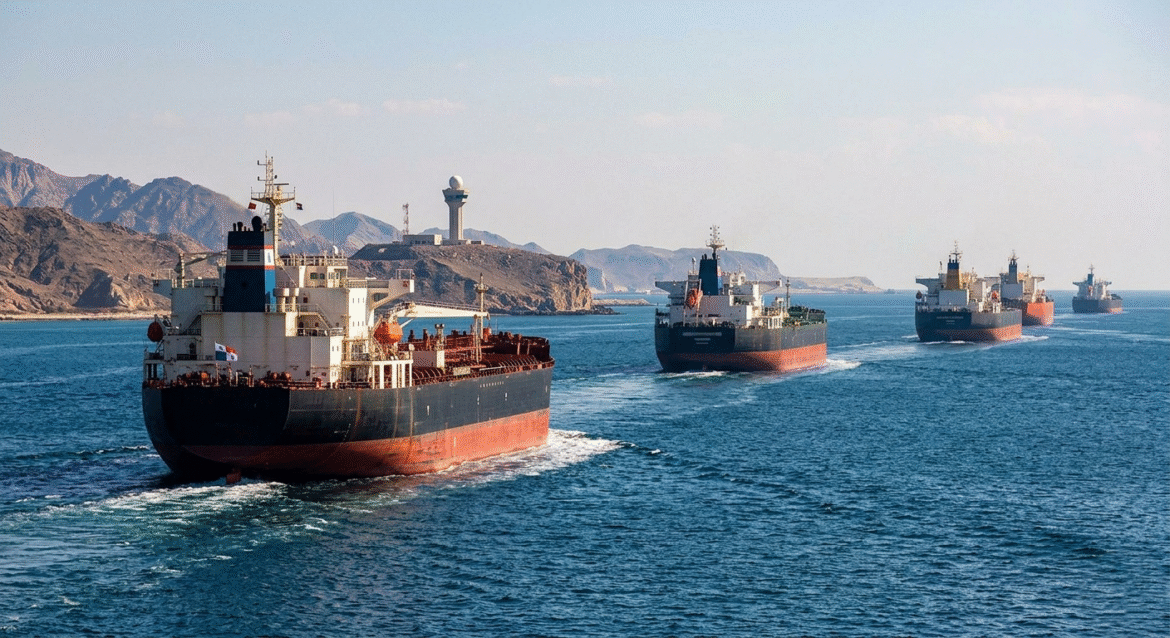
The images are haunting in their familiarity: merchant vessels idling in the Persian Gulf, their crews numbering in the tens of thousands, waiting for safe passage through the narrow choke point that carries one-fifth of the world’s oil and liquefied natural gas. On Saturday, Iran once again declared the Strait of Hormuz under “strict military control,” reversing a fleeting reopening announced barely 24 hours earlier. President Trump responded with characteristic bluntness, insisting that Tehran could not “blackmail” the United States by closing the waterway. Shipping officials reported at least two vessels — including Indian-flagged ships — coming under fire. The fragile two-week ceasefire that had offered a glimmer of de-escalation now hangs by a thread, set to expire on Wednesday.
This is not abstract geopolitics. It is a live-wire confrontation in which miscalculation, domestic posturing and the raw economics of energy have collided with terrifying speed. The war that began on Feb. 28 with a joint American-Israeli strike on Iran has already claimed more than 3,400 lives inside the Islamic Republic, according to its own official count of ‘martyrs.’ It has spilt into southern Lebanon, where Israeli forces responded to Hezbollah’s entry into the fighting. And it has sent oil prices surging, inflation ticking upward, and political pressure mounting on a White House that must defend narrow Republican majorities in the November midterms. What makes the current impasse so dangerous is not merely the closure of the strait itself, but the chain of events that produced it — a textbook case of how premature announcements, internal power struggles and clashing narratives can unravel even modest diplomatic progress.
The trouble began Friday when Iran’s foreign minister, Abbas Araghchi, posted on X that, in line with a separate US-brokered 10-day ceasefire between Israel and Lebanon, the strait would be “completely open” to commercial vessels along coordinated routes. Oil prices dropped $12 a barrel in minutes. Pakistan, which had spent days in Tehran mediating preconditions for direct talks, welcomed the move. President Trump, eager for any sign of momentum, thanked Iran publicly and appeared to interpret the statement as a broader concession — including, inexplicably, on the export of Tehran’s stockpile of highly enriched uranium. Within hours, the backlash inside Iran was ferocious. State media outlets close to the Islamic Revolutionary Guard Corps called the post incomplete or misleading. Hardline newspapers demanded its withdrawal. Even sympathetic voices suggested the announcement should have come through official channels rather than social media. By Saturday morning, Iran’s armed forces command and the Supreme National Security Council had reimposed “strict management” of the strait, citing continued American “piracy” in the form of a naval blockade of Iranian ports. Tehran insisted that any passage would require transit certificates, designated routes and payment of fees for security, safety and environmental services. The deputy foreign minister, Saeed Khatibzadeh, was categorical: no framework of understanding had yet been agreed upon, and Iran would not accept being treated as an “exception” to international law.
The episode reveals deeper fractures. Iran’s parliamentary speaker, Mohammad Bagher Ghalibaf — effectively the lead negotiator — has been at pains to project strength. In a national address, he declared Iran “victorious in the field,” insisted the United States had accepted Iranian demands in accepting the ceasefire, and described a tense confrontation in Islamabad in which Iranian officials warned that any further movement by an American minesweeper would be met with force. The vessel, he said, turned back. Such narratives play well with hardliners and the IRGC, which retains decisive influence over foreign policy and appears deeply wary of any concessions that might be spun as weakness. Ghalibaf himself stressed that the strait’s status is a military matter, not a subject for presidential Truth Social posts.
But Iran’s position is not monolithic. The disclosure that Tehran is reviewing ‘new proposals’ put forward by the United States — delivered via Pakistan’s army commander as mediator — suggests at least some appetite for continued engagement. A senior Iranian official spoke of hoping for a preliminary agreement in the coming days. Pakistan, for its part, is quietly assembling a ladder of confidence-building steps: the Lebanon ceasefire, a limited reopening of the strait, perhaps the release of frozen Iranian assets. Each rung was meant to make the next one easier to climb. On the American side, the picture is equally complicated. President Trump has repeatedly emphasised that preventing Iran from acquiring a nuclear weapon “supersedes everything else.” He has made clear that the naval blockade of Iranian ports will remain in force until a comprehensive deal is reached. At the same time, he has signalled openness to “very good conversations” and, on Friday, spoke of “some pretty good news” without elaboration. His impatience is understandable — American voters are feeling the pain at the gas pump — but it has produced a pattern of overinterpretation that Tehran has exploited to justify retrenchment. The result is a dangerous feedback loop: American triumphalism meets Iranian defiance, and the strait closes again.
The risks are immediate and severe. Hundreds of vessels and 20,000 seafarers remain stranded. Even limited incidents of fire — as reported with the Indian ships — raise the spectre of accidental escalation into direct naval confrontation, something both sides have so far avoided. Iranian officials have warned of renewed missile strikes on Israel if the Lebanon ceasefire continues to fray. And the broader economic fallout — higher energy prices feeding inflation — could reshape the political landscape in Washington just as Republicans fight to hold Congress. Yet amid the gloom, there are narrow paths forward, if both capitals can summon the discipline to take them. First, the two sides must stop negotiating through social media and duelling press statements. The Araghchi episode demonstrated how a single ill-timed post can erase days of quiet mediation. Serious talks require quiet channels and carefully calibrated public messaging. Pakistan’s role as intermediary offers a face-saving venue; the fact that Tehran is reviewing new American proposals is evidence that back-channel work continues even when headlines scream impasse. Second, the core disagreements must be sequenced rather than solved simultaneously. Iran has made clear it will not compromise on what it sees as its sovereign rights over the strait or its insistence on treatment consistent with international law. The United States will not yield on the nuclear question. A preliminary framework of understanding — one that perhaps addresses limited, monitored passage through the strait in exchange for verifiable steps on enrichment and sanctions relief — could buy time until a fuller agreement is negotiated within the 60-day window some mediators have floated. Third, both governments must reckon with the human and strategic costs of renewed war. Iran has paid a terrible price in lives lost. The United States has seen its regional alliances strained and its domestic political capital eroded. Neither side can claim victory if the strait remains a theatre of intermittent violence and the region lurches back into open conflict. Iran’s legal argument, articulated by the lawyer Reza Nasri, deserves serious consideration even if one rejects its conclusion. An international strait earns its special status through its role as a neutral passage for peaceful navigation. When one coastal state turns that waterway into a platform for military operations aimed at another, the legal character of the passage changes. That does not give Tehran carte blanche to impose fees or selective closures indefinitely; it does underscore why treating the strait as an extension of the battlefield is both dangerous and destabilising.
The same principle applies in reverse. A permanent American blockade that prevents all commerce with Iranian ports while claiming to enforce international norms risks undermining the very legal order Washington seeks to uphold. Hypocrisy cuts both ways, as Iran’s foreign ministry spokesperson was quick to remind European critics. The clock is unforgiving. The ceasefire expires on Wednesday. Without a credible framework of understanding in place, the risk of resumed airstrikes — or worse, a naval clash in the strait — grows acute. But the very fact that Pakistan has managed to keep channels open, that new proposals have been exchanged, and that both sides continue to speak of negotiation rather than outright victory suggests that diplomacy is not yet exhausted. History is littered with conflicts that spiralled because leaders mistook tactical advantage for strategic wisdom. The Strait of Hormuz has become the latest proving ground for that perennial truth. Tehran believes time is on its side and that control of the waterway remains its strongest card. Washington believes its military and economic leverage will eventually force concessions. Both calculations may prove correct in the short term. In the longer term, they risk a wider war that neither can afford and the world cannot contain. The alternative is prosaic but essential: patient, discreet diplomacy that respects the red lines of both sides while steadily widening the zone of possible agreement. It will not satisfy the hardliners in Tehran or the maximalists in Washington. But it may spare the region another catastrophic chapter and allow the tankers now stranded in the Gulf to resume the quiet commerce upon which global prosperity still depends.
Copyright © 2021 Independent Pakistan | All rights reserved