By Staff Reporter
ISLAMABAD: A ceasefire between Israel and Hezbollah came into effect on Friday afternoon after a morning of deadly fighting in Lebanon threatened to collapse the diplomatic architecture of the most significant Middle East peace effort in a generation.
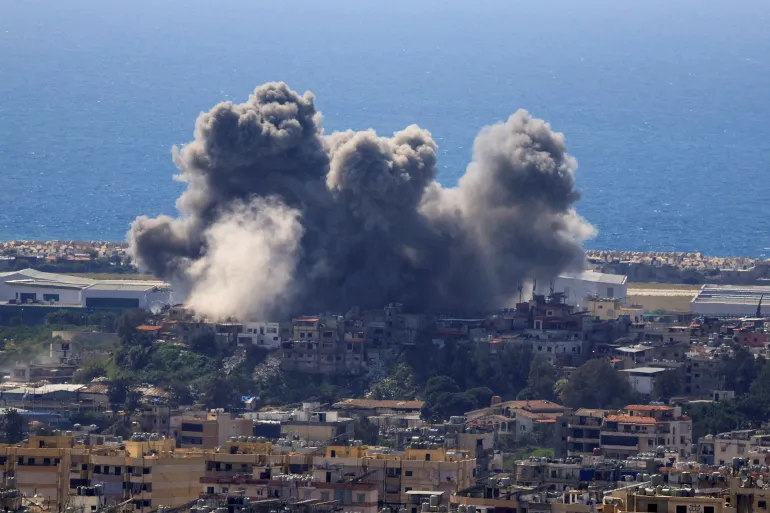
The announcement, made shortly before 4pm Beirut time by a senior US official speaking on background, came just hours after Israeli airstrikes killed at least 15 Lebanese civilians and Hezbollah retaliated with an attack that left four Israeli soldiers dead. A total of 18 people died in the day’s exchanges before the guns fell silent.
“We understand that after the exchange of fire earlier today, Israel and Hezbollah are now in a ceasefire,” the official said, adding that American and Qatari negotiators had brokered the agreement with Iranian assistance.
The violence had already claimed a casualty of a different kind. Scheduled talks between American and Iranian delegations in the Swiss mountain resort of Bürgenstock were called off, and Vice President JD Vance abandoned plans to fly to Geneva. Switzerland’s foreign ministry confirmed the postponement in a terse statement, saying the planned meeting involving the US, Iran, Qatar and Pakistan had been deferred without offering a new date. “Switzerland remains ready to facilitate these talks,” it added. “The relevant preparatory work at Bürgenstock is continuing.”
The collapse of Friday’s meeting exposed just how precarious the week’s apparent diplomatic breakthrough remained. On Monday, the two governments had agreed a 14-point framework — formalised as the Islamabad Memorandum of Understanding, signed by both presidents — that laid out terms for ending a war now nearly four months old. The conflict, which erupted on 28 February with coordinated US and Israeli strikes on Iran, has killed at least 7,000 people, sent global energy markets into convulsions and disrupted nearly a fifth of the world’s crude oil and liquefied natural gas supply by choking off the Strait of Hormuz.
The accord extended a tenuous ceasefire by at least 60 days and set a framework for negotiations on Iran’s nuclear programme, sanctions relief and the lifting of a US naval blockade on Iranian ports. But it required, as a condition of its survival, a “permanent termination” of the war in Lebanon — and Israel, pointedly left out of the talks, showed little sign of honouring that requirement.
A ceasefire in danger from the start
Hassan Fadlallah, a Hezbollah member of Lebanon’s parliament, told Reuters on Friday that Iran had communicated directly to the group that negotiations with Washington could not resume without a comprehensive ceasefire on all fronts. His comments underscored how tightly the diplomatic track and the military situation on the ground had become intertwined — and how easily events in Lebanon could unravel an agreement painstakingly assembled in Islamabad.
Iran’s foreign ministry spokesman Esmaeil Baghaei said the Friday meeting had become unnecessary given that the memorandum had already been signed digitally, and that future negotiations would depend entirely on whether the terms already agreed upon were actually implemented. The ministry also noted that Iran held the United States “directly responsible” for Israeli strikes on Lebanon — a significant assertion that complicated any American effort to present itself as a neutral guarantor of the peace framework.
French Foreign Minister Jean-Noël Barrot called on Israel to halt its operations and urged Washington to apply pressure on its ally. France, he said, was still working to convene an international conference to mobilise support for the Lebanese army. Israel, for its part, said on Thursday it would not rule out operations beyond its self-declared military control zone in southern Lebanon — a direct challenge to the accord’s terms.
A deal under pressure from all sides
Iran’s chief negotiator Mohammad Bagher Qalibaf, the parliament speaker, set a combative tone in remarks published by the official IRNA news agency. Describing his country as “steadfast in fulfilling the conditions and red lines set”, he added in language that left little room for ambiguity: “If the enemy seeks to be excessive, we have proven that our fingers are on the trigger and we have no hesitation in giving a crushing response.”
Those remarks followed a notable intervention by Supreme Leader Ayatollah Mojtaba Khamenei, who confirmed he had approved the deal despite having a “different view” on the matter — without explaining what that view was. In a message read out on state television, he said that direct engagement with the United States “will not mean accepting the enemy’s point of view,” a formulation evidently designed to reassure domestic hardliners rather than to encourage the Americans. President Masoud Pezeshkian and Foreign Minister Abbas Araghchi both issued statements in similar register, pledging adherence to Iran’s red lines and the defence of national dignity.
The deal offered Iran substantial economic inducements: relief from crippling sanctions, the unfreezing of assets worth tens of billions of dollars, and immediate US waivers allowing renewed exports of Iranian oil. In return, Iran restated its longstanding assertion that it does not seek nuclear weapons, agreed to onsite “down-blending” of its highly enriched uranium stockpile under international inspection, and accepted International Atomic Energy Agency oversight as an NPT member state — while rejecting Washington’s demand that the material be physically removed from the country.
Those terms drew fierce criticism in Iran from the conservative establishment. Hossein Shariatmadari, editor of the ultraconservative Kayhan newspaper, said on state television that the Americans had never honoured a single commitment they had made. “The Strait of Hormuz,” he said pointedly, “is the way to get compensation.” Ebrahim Rezaei, spokesman for parliament’s national security commission, demanded the government deny reports of possible IAEA inspections of Iranian nuclear facilities and warned that parliament would “stand up to lawlessness and disobedience” if they proved true.
Trump’s unfinished war
In Washington, the White House sought to project calm, with a spokesman describing the postponement of the Swiss meeting as a logistical matter. “The logistics of these negotiations have never been simple or predictable,” the statement read. “We look forward to beginning technical talks as soon as possible.”
But the administration faced uncomfortable questions from within its own political coalition. Some of Donald Trump’s Republican allies in Congress questioned openly whether the president had made too many concessions to secure an end to a conflict that has grown deeply unpopular with American voters ahead of November’s midterm elections. Trump had repeatedly promised that the war would end only with Iran’s “unconditional surrender.” The Islamabad memorandum delivered something considerably more modest.
When the US and Israel launched their campaign in late February, Trump’s stated objectives included the destruction of Iran’s nuclear capabilities, the dismantling of Tehran’s network of regional proxies, and — at various points — regime change in Tehran. None of those goals had been achieved when he put his signature to the agreement. Iran’s nuclear programme remained intact. Hezbollah, though battered, remained an armed force in Lebanon. And the Islamic Republic’s government was negotiating with the United States as a sovereign equal.
Iran, meanwhile, appeared to have emerged from the conflict with its leverage enhanced in certain respects. It had demonstrated the ability to close the Strait of Hormuz, one of the world’s most critical shipping chokepoints. It retained control over the waterway in partnership with Oman and announced that once the 60-day moratorium expired, it intended to charge ships transit fees — a new imposition that did not exist before the war began.
US officials insisted that the negotiations ahead could still produce a strong agreement on Iran’s nuclear programme, potentially surpassing the 2015 accord that Trump tore up during his first term. Oil prices eased on Friday as tankers began moving again through the partially reopened Strait, a tangible sign that some aspects of the agreement were already taking effect.
The costs of the conflict were meanwhile coming into sharper focus. The Pentagon told lawmakers it required $80 billion to cover war expenditures along with other outstanding bills, according to the Wall Street Journal. And across Lebanon, more than a million people remained displaced, living in the shadow of a ceasefire that, as Friday had made brutally plain, remained fragile.
Pakistan’s Deputy Prime Minister Ishaq Dar said the formal signing ceremony for the Islamabad MoU had been completed remotely, after earlier plans for a ceremony in Geneva hosted by Prime Minister Shehbaz Sharif were quietly shelved. Iran’s foreign ministry had previously indicated it considered such a ceremony unnecessary.