By Staff Reporter
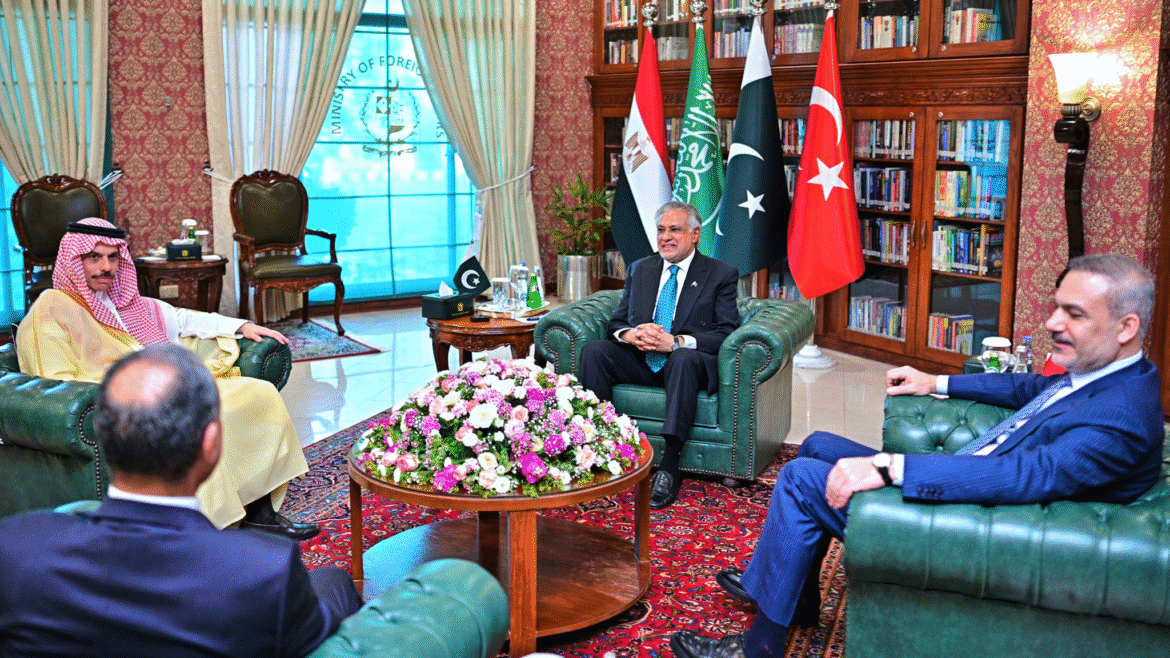
ISLAMABAD: The deputy prime minister and foreign minister Ishaq Dar is to travel to Egypt on Saturday for the fourth ministerial meeting of the R-4 group — a fast-emerging diplomatic bloc comprising Egypt, Saudi Arabia, Türkiye, and Pakistan that has positioned itself as one of the region’s most active mediating forces since the outbreak of war between the United States and Iran.
Egypt’s foreign minister, Badr Abdelatty, will host his counterparts in the Mediterranean city of Alamein on Sunday, Cairo’s foreign ministry has confirmed, with the session to be followed by an expanded round of talks and a joint press conference. Islamabad’s Foreign Office said Dar had accepted the invitation from Abdelatty and would hold bilateral consultations on the sidelines, including a separate meeting with Egyptian President Abdel Fattah El-Sisi to discuss bilateral relations and regional developments.
The gathering comes at a pivotal moment. Three previous ministerial sessions — in Riyadh on 19 March, Islamabad on 29 March, and Antalya on 18 April — were held within the space of thirty days, a cadence that analysts have described as marking a decisive shift from adhoc coordination to something far more structured. Cairo now hosts the fourth.
None of the three earlier sessions produced a communiqué, a joint statement, or any document formally acknowledging the formation’s existence. Yet the quartet has become, in effect, a set of institutionalised channels giving its members indirect reach into the US-Iran nuclear track, the Hormuz shipping dispute, and ceasefire mediation — negotiations from which most of them are formally absent.
Pakistan has been the axis around which much of the group’s activity has turned. Islamabad maintained longstanding ties with Tehran while simultaneously managing close relations with Gulf states and Washington, making it uniquely placed as a go-between. FM Dar said at the Islamabad meeting in March that all participants expressed confidence in Pakistan’s role as a facilitator, adding that China “fully supports” the initiative.
Since then, the regional landscape has shifted considerably. On Monday, the Us and Iran had agreed a 14-point framework — formalised as the Islamabad Memorandum of Understanding, signed by both presidents — that laid out terms for ending a war now nearly four months old. The conflict, which erupted on 28 February with coordinated US and Israeli strikes on Iran, has killed at least 7,000 people, sent global energy markets into convulsions and disrupted nearly a fifth of the world’s crude oil and liquefied natural gas supply by choking off the Strait of Hormuz. The accord extended a tenuous ceasefire by at least 60 days and set a framework for negotiations on Iran’s nuclear programme, sanctions relief and the lifting of a US naval blockade on Iranian ports.
The R-4 framework is not a defence alliance — none of its members have proposed anything of the sort — but its significance lies precisely in what it is not required to be. The foreign ministers of Türkiye, Pakistan, Saudi Arabia, and Egypt have convened on multiple occasions to co-ordinate responses to an increasingly dangerous and chaotic security environment, finding common cause without the formal commitments that tend to paralyse larger multilateral bodies.
At earlier sessions, the ministers exchanged assessments of the conflict’s impact on the global economy and discussed ways to mitigate disruptions to international shipping, supply chains, food security, energy security, and oil prices. Gaza is expected to feature prominently in Alamein as well, with Egypt — which shares a border with the territory and has served as a principal mediator in ceasefire negotiations — bringing particular weight to those discussions.
Islamabad’s Foreign Office was careful to frame the meeting in terms that went beyond crisis management. It said the ministers would “discuss regional developments and exchange views on issues related to peace, security, and stability,” and would build on the outcomes of previous sessions to “further strengthen co-operation in areas of shared interest.” The FO also reaffirmed that Pakistan “attaches great importance to its relations with Egypt, Saudi Arabia, and Türkiye,” describing the R-4 framework as reflecting the four countries’ “shared commitment to consultation, co-operation, and co-ordinated efforts in support of regional peace and prosperity.”
Copyright © 2021 Independent Pakistan | All rights reserved