By Staff Reporter
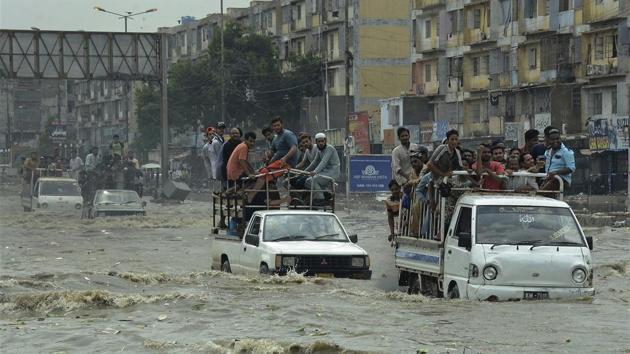
ISLAMABAD: Pakistan’s monsoon death toll climbed to 252 on Wednesday, with 10 more fatalities reported amid relentless rains that have unleashed flooding, landslides, and house collapses nationwide, the National Disaster Management Authority (NDMA) said.
Punjab, the worst-affected province, has recorded 139 deaths and 477 injuries, followed by Khyber Pakhtunkhwa with 60 and Sindh with 24. Balochistan (16), Islamabad (6), Gilgit-Baltistan (5), and Azad Kashmir (2) have also reported losses.
The NDMA attributes the majority of deaths to house collapses (143 fatalities), with flash floods (41), drowning incidents (36), lightning strikes (13), electrocution (12), and landslides (4) accounting for the rest. As rescue operations struggle against rising waters and blocked roads, authorities warn that the worst may be yet to come.
A cloudburst at Babusar Top triggered a flash flood that killed five people, including four tourists, and left 15 missing. A family trying to save three-year-old Abdul Hadi was swept away, along with Dr. Mishal, who leapt into the torrent to help. Rescue teams are combing the area despite hazardous conditions.
The flooding and landslides have also severed vital transportation links, closing the Karakoram Highway and stranding thousands of travelers. Vehicles bound for Gilgit-Baltistan remain stuck at Oshaar Nala Dasu, immobilized on both sides of the route.
Prime Minister Shehbaz Sharif, expressing grief over the mounting toll, has ordered authorities to hasten rescue efforts and restore access to the highway and Babusar-Chilas routes. “Shelter and food must be arranged for stranded travelers,” he directed, according to a statement from his office.
In nearby Diamer, residents whose mud houses were destroyed by the Babusar Thak Nala flood have faced profound losses. Yet, despite their own struggles, they have joined police and district officials in aiding rescue efforts, providing food and temporary shelter to stranded tourists.
In Punjab, urban flooding has overwhelmed cities and towns. Jhelum’s cricket stadium turned into a pond under heavy rainfall, while Attock saw stormwater surge into homes. In Hafizabad, authorities ordered residents to evacuate with their livestock as the Chenab River threatened to breach its banks. Lahore, grappling with 108 millimeters of rain, saw its drainage systems buckle under the strain, leaving streets submerged.
Azad Kashmir has not been spared, with flash floods and landslides cutting off access to areas like Samahni, Jhelum Valley, Neelum Valley, Leepa, Bagh, Poonch, Bhimber, and Sudhnoti. A cloudburst caused two rivers to overflow, sweeping away a bridge and isolating entire communities.
In Islamabad, a father and son remain unaccounted for after a flash flood swept them away. Only fragments of their vehicle have been recovered, and rescue operations, initially focused on a local housing society drain, have expanded to Kak Pul. Rising water levels in the River Sawan and ongoing rain have complicated the search. Meanwhile, local media reported that efforts persist to locate a father and daughter whose car was carried off by a flash flood in the city’s upscale Defense Housing Authority neighborhood.
The Pakistan Meteorological Department (PMD) issued a grim forecast on Wednesday, predicting continued torrential rains, flash floods, and landslides across northern and central Pakistan. “Heavy rains may generate flash floods in local streams of Chitral, Dir, Swat, Shangla, Mansehra, Kohistan, Abbottabad, Buner, Charsadda, Nowshera, Swabi, Mardan, Murree, Galliyat, Islamabad, and Rawalpindi,” the PMD warned. “Urban flooding is also likely in low-lying areas of major cities including Gujranwala, Lahore, Faisalabad, Sialkot, Nowshera, and Peshawar.”
The agency highlighted an escalating risk of glacial lake outburst floods (GLOFs) in high-altitude regions, driven by accelerated ice melt linked to global warming. It urged the public to avoid mountainous areas in Khyber Pakhtunkhwa, Gilgit-Baltistan, Azad Kashmir, and Murree, citing the heightened danger of landslides.
The monsoon, which delivers 70 to 80 percent of South Asia’s annual rainfall from June to September, is a lifeline for Pakistan’s agriculture. But it also exposes the country’s frail infrastructure, inadequate drainage systems, and limited investment in climate resilience. Pakistan, home to over 7,000 glaciers, ranks among the world’s most climate-vulnerable nations, despite contributing less than 1 percent of global greenhouse gas emissions.
Recent years have brought increasingly erratic weather—record heatwaves, droughts, and storms. In 2022, unprecedented monsoon rains and glacial melt submerged nearly a third of the country, killing over 1,700 people, displacing 8 million, and causing $30 billion in damages, prompting calls for global climate reparations.
Copyright © 2021 Independent Pakistan | All rights reserved