By Staff Reporter
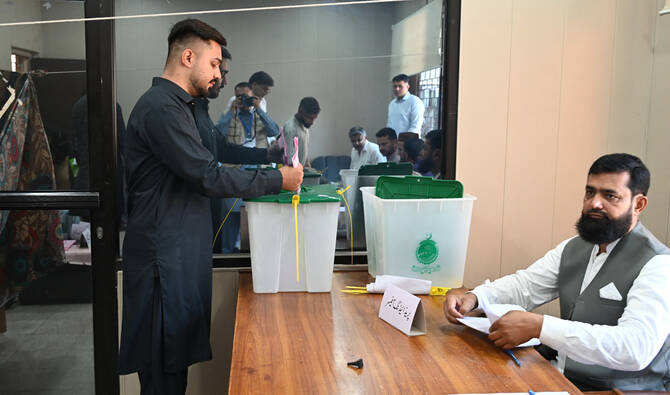
BAGH: Voters across Azad Jammu and Kashmir’s Poonch division delivered one of the biggest shocks of this year’s assembly election on Monday, unseating a political dynasty that had held power for four decades, as polling in four constituencies was overshadowed by allegations of rigging, outbreaks of violence and the suspension of voting at several stations.
Sardar Attique Ahmed Khan, president of the Muslim Conference and a former prime minister of the territory, lost his seat in LA-14 (Dhirkot) — a constituency his family had won in every election since 1985. Khan, along with his uncle and father before him, had represented the seat across nine consecutive polls, making his defeat one of the most significant results of the entire election cycle and a stark marker of how far his party has fallen since the rise of the PML-N in 2010, when the Muslim Conference was the territory’s dominant political force.
He was beaten by Sajid Iqbal Abbasi, a political newcomer standing for the little-known Awami Dast-o-Bazu Party, who won by a margin of more than 21,000 votes according to unofficial, unverified counts from 213 of the constituency’s 214 polling stations. Those following the race said Abbasi’s victory owed less to party machinery than to years of personal groundwork: locals credited him with funding welfare and development projects in the area from his own pocket, building a support base that ultimately outweighed Khan’s long political pedigree. The PML-N and PPP candidates trailed well behind, with 3,000 and 2,800 votes respectively.
Three other Poonch constituencies also went to the polls on Monday, each delivering results that were, by nightfall, still shifting. In LA-17 (Haveli), incumbent prime minister Faisal Mumtaz Rathore was locked in a tight race with PML-N’s Chaudhry Mohsin Aziz, whose early lead narrowed as results from roughly two dozen polling stations remained outstanding. Independent candidate Khawaja Tariq Saeed — once tipped for a strong second-place finish — fell well back.
In LA-15 (Bagh Central), Jamaat-i-Islami’s Dr Mohammad Khan, a retired brigadier, briefly looked to be heading for victory before the contest narrowed into a straight fight between the PML-N’s Mushtaq Ahmed Minhas and the PPP’s Sardar Ziaul Qamar. Late unofficial counts put Qamar roughly 2,000 votes clear. Former AJK prime minister Sardar Tanveer Ilyas, standing for the Istehkam-i-Pakistan Party after winning the seat on a PTI ticket in 2021, appeared to be out of contention.
The PML-N’s only clear success in the division came in LA-16 (Bagh East), where the party’s Sardar Mir Akbar led the PPP’s Sardar Qamaruz Zaman — a former AJK minister and father of the PPP candidate contesting the neighbouring LA-15 seat — by roughly 14,900 votes to just under 11,000, with results from 14 polling stations still to come.
Rigging claims dog third phase
The Poonch vote formed the third phase of AJK’s staggered assembly election, and, as in the previous two rounds, was accompanied by a bitter public dispute between the PPP and PML-N — rivals in the territory despite sitting together in the federal coalition in Islamabad. The PPP, which has accused the PML-N of manipulating results throughout the campaign, repeated those claims on Monday, detailing a string of specific complaints it said it had lodged with the Election Commission.
Among them: that roads to the Banni Marasira area had been blocked while PML-N supporters illegally stamped ballots at a dozen polling stations in LA-15; that its polling agents had been forcibly removed from stations in Makhdoom Kot and Bani Maldhara, allowing unsupervised stamping to continue; and that Jamaat-i-Islami workers had massed to seize control of 26 polling stations after police assigned to guard them were withdrawn. The party also alleged its agents were blocked from two stations in LA-16 while ballots were stamped in their absence, and accused individuals linked to the PML-N of opening fire at a polling station in Kot Chinalla, disrupting voting there. In LA-17, it said its agents had been driven out of a polling station in Kahuta city.
PPP vice president Sherry Rehman said the reports from LA-16 raised “serious questions” about the integrity of the process and called for presiding officers to explain themselves, while also demanding action over the alleged removal of the party’s agent in LA-15. Secretary-general Nayyar Bokhari went further, accusing the PML-N of sustained rigging and complaining that the Election Commission’s response to his party’s complaints had amounted to insisting nothing was wrong. Commission secretary Raja Mohammad Shakeel rejected that characterisation, saying every complaint received had been acted upon and that the Quick Response Force had been deployed in response.
The PML-N dismissed the allegations outright. Rana Sanaullah, the prime minister’s adviser on political affairs, told reporters in Islamabad that the PPP had produced no proof, and pushed back on the suggestion that unusually high turnout in some areas pointed to fraud, arguing instead that AJK’s tribal and family structures naturally drive relatives to the polls together. He acknowledged isolated incidents — an attempt to seize documents from polling agents in Haveli, and efforts by what he described as PPP workers to halt voting at three stations in Bagh — but said the QRF had resolved both without further disruption. Kashmir affairs minister Amir Muqam argued the PPP would be better off examining its own rally turnout than alleging rigging, insisting the party lacked genuine support in the territory.
Sanaullah also disputed the PPP’s objection to the phased election format, saying the party had raised no concerns when the schedule was first agreed, and claimed it had specifically asked for the 12 refugee seats to be folded into the second phase — a move he suggested was designed to stop results from those seats, cast elsewhere in Pakistan, from dragging down the PPP’s AJK numbers. He said he expected the unrest that has accompanied the vote to subside once the third phase concludes, while warning that those who had “taken up arms” against the process would face legal consequences. A PML-N government, he said, would address protesters’ “valid demands” once formed.
Notably, PML-N AJK secretary-general Tariq Farooq broke from his party’s line to criticise Rathore directly, describing allegations of rigging, coercion and fake voting in the prime minister’s own constituency as a matter going beyond an electoral dispute into “a serious question of constitutional governance”. Writing on X, Farooq said he found it hard to believe the prime minister of Azad Kashmir could consider himself above the law “merely to secure his own election,” though he offered no further detail.
A dynasty and two former premiers on the line
Monday’s vote carried personal stakes for three men who have each led the territory’s government. Rathore, the sitting prime minister, was fighting to hold his seat against Aziz — whose father held it at least three times before him and who draws support from the area’s large Gujjar community — and against Saeed, a former ally turned rival after Rathore asked him to step aside from an earlier seat-sharing arrangement once he became prime minister. Rathore’s constituency was itself the subject of separate allegations, after two presiding officers were removed from election duty following complaints, though Shakeel said the specific claims of vote manipulation made against them on social media had not been substantiated.
Former prime minister Tanveer Ilyas, having briefly threatened to boycott the third phase before resuming his campaign, argued that a win in LA-15 could position the constituency to secure “either the presidency or prime ministership.” Sardar Attique, meanwhile, had represented Dhirkot continuously since 2006 — the year he first became prime minister — but ultimately lost to a challenger from within his own tribe.
Across the four constituencies, 803 polling stations and 1,254 booths served an electorate of 238,664 men and 221,707 women, with 82 candidates in total contesting the seats. LA-14 drew the largest field, with 30 candidates, while LA-17 had the fewest, with nine.
Security operation, and a postponed vote in Bagh and Sudhnoti
The scale of the security operation reflected the tension surrounding the vote. Officials had braced for clashes, and the Election Commission classified most of the 803 polling stations as sensitive or highly sensitive. “Apart from the regular police of both districts, we have dispatched an additional 10,300 troops to maintain law and order and provide a fear-free atmosphere to voters,” Shakeel said ahead of polling.
The third phase had originally been intended to cover the whole of Poonch division — 11 constituencies spanning Bagh, Haveli, Poonch and Sudhnoti districts — but the commission announced last week that voting would proceed as scheduled only in Bagh and Haveli, citing law-and-order concerns. Polling in Bagh and Sudhnoti districts, due to take place on Monday, was postponed, with the commission indicating the remaining seven seats could go to the polls around 20 or 21 August.
Confusion over unofficial results portal
As counting got under way, further confusion emerged over the source of the results being reported. A private website calling itself “Pakistan’s Election Portal” published figures throughout the day, and was picked up by several television channels, newspapers and journalists who appeared to assume it was the Election Commission’s own platform. Shortly before 11pm, as disputes intensified over three constituencies, Shakeel moved to clarify that the site had no connection whatsoever to the AJK Election Commission or the Election Commission of Pakistan, describing it as an unverified third-party operation, and urged media organisations and political workers to publish results only once they had been confirmed by the relevant returning officer.
Separately, the count in LA-17 was further complicated by a boycott affecting 10 polling stations in Chitra Topi, whose results the commission opted to withhold pending resolution. PML-N’s Minhas said re-polling at those stations was among the options under consideration.
With the third phase now split across two dates and seven constituencies still to vote later this month, the PML-N maintains it is on course to form the next AJK government, having already secured 24 seats — nine from Mirpur’s July 27 poll and 15 from the Muzaffarabad division and refugee-seat count in the second phase — against 10 for the PPP so far.
Copyright © 2021 Independent Pakistan | All rights reserved