By Staff Reporter
PESHAWAR: Pakistani federal and provincial authorities on Friday denied granting permission for a military operation in the Tirah Valley of Khyber district, telling a high court bench that no such approval had been given amid allegations the action violated constitutional rights and displaced local residents.
The denials came during a hearing at the Peshawar High Court before Justices Wiqar Ahmad and Mohammad Faheem Wali, who were considering a petition filed by Barrister Saud Javed Dawar, a member of the National Democratic Movement.
Khyber Pakhtunkhwa Advocate General Shah Faisal Uthmankhel and Additional Attorney General Sanaullah informed the court that their respective governments had not authorised the military to launch any operation in the valley.
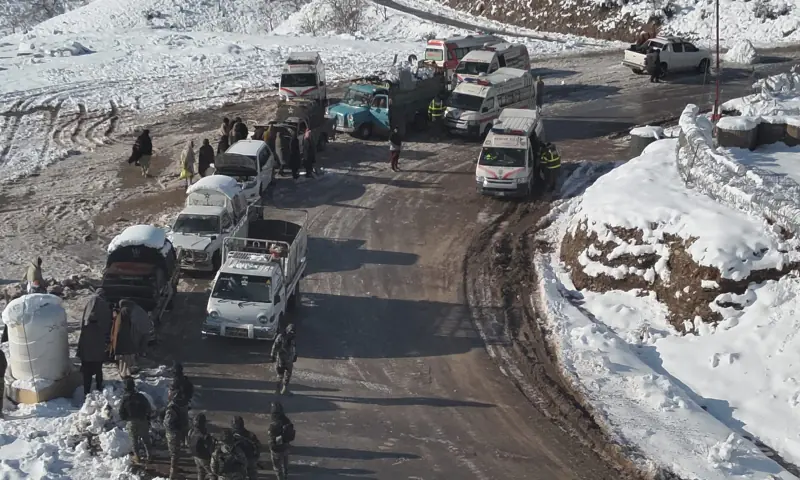
The bench directed the Provincial Disaster Management Authority to extend all possible relief to people displaced from Tirah Valley. It also summoned representatives of the internally displaced persons to appear at the next hearing on Feb. 12 to verify government claims of providing financial and material support. Additionally, the court ordered the authority to submit a report within a week detailing the facilities offered to the displaced.
Dawar, who appeared alongside his counsel Mohammad Yaseen Orakzai, sought several forms of relief from the court. These included a declaration that any order or action to launch the Tirah military operation was unconstitutional, unlawful and in violation of fundamental rights.
The petitioner further urged the court to direct the respondents, including federal and Khyber Pakhtunkhwa authorities, to submit records on the mechanism, protocol and guidelines for the protection, safety, rehabilitation and repatriation of internally displaced persons, as well as the financial policies and packages for them.
Dawar argued that without a resolution passed by the Khyber Pakhtunkhwa Assembly under Article 232 of the constitution and subsequent approval by parliament, no military operation could be initiated.
Uthmankhel told the court that while the provincial government had not approved any military operation, it was taking steps to provide relief to those who had left their homes in Tirah. He said the government had approved 4 billion rupees for this purpose. The advocate general added that he would file a detailed reply on the constitutionality of starting any military operation without provincial approval.
A one-page response from the interior secretary was also submitted to the court. It stated that the deployment of armed forces for internal security was governed by Article 245 of the constitution, which empowers the federal government to employ the armed forces in aid of civil power.
According to the response, security operations in the Tirah area fell within the federal government’s constitutional authority and were conducted in line with the constitution. “The Ministry of Interior and Narcotics Control has not initiated, directed, commanded or operationally supervised any such operation, nor has it issued any formal order, directive or requisition in this regard,” the interior secretary said.
On the petitioner’s contention that a provincial assembly resolution was required for a proclamation of emergency under Article 232, the ministry clarified that the constitutional framework drew a clear distinction between emergency powers under Article 232 and the deployment of forces under Article 245. “Deployment under Article 245 does not require a proclamation of emergency, a resolution of the provincial assembly or approval of either House of Parliament,” the reply said. “Matters concerning the protection, rehabilitation, repatriation, financial assistance, health, education, shelter and welfare of Internally Displaced Persons (IDPs) are primarily managed by the Provincial governments, NDMA, PDMA and other relevant civilian departments.”
Dawar contended that since Chief Minister Sohail Afridi had explicitly denied approval from himself or his government for the Tirah operation, the federal government’s action in launching it was unconstitutional.
Copyright © 2021 Independent Pakistan | All rights reserved