By Staff Reporter
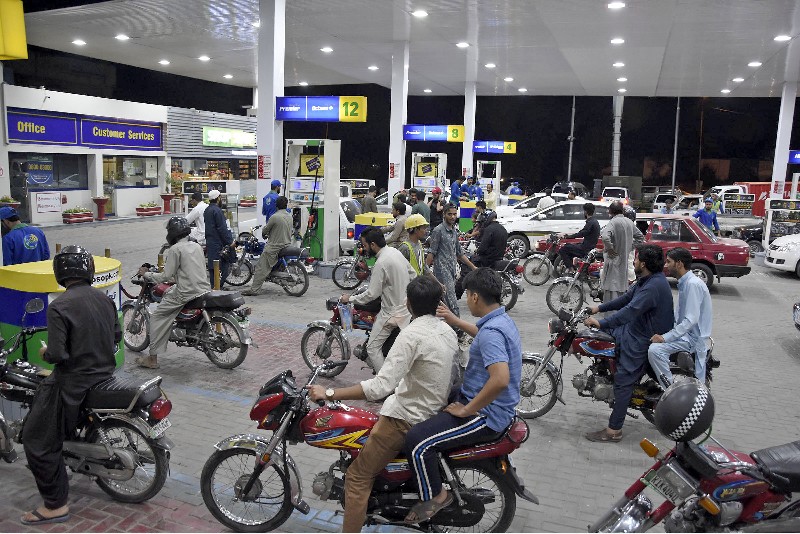
ISLAMABAD: Pakistan cut retail fuel prices for a second consecutive session, as easing global crude benchmarks gave the government room to extend relief to motorists under a new daily pricing mechanism introduced three weeks ago in response to war-driven market volatility.
The Oil and Gas Regulatory Authority lowered the price of petrol by 3.39 rupees a liter and high-speed diesel by 4.07 rupees, according to a notification from the Ministry of Energy’s Petroleum Division. The new rates take effect Wednesday and hold for a day.
Petrol will now sell for 328.56 rupees a liter, down from 331.95 rupees. Diesel drops to 385.86 rupees from 389.93 rupees. The government continues to collect 110 rupees per liter in taxes and duties on petrol and 96 rupees on diesel, unchanged in the latest revision.
The cut follows a reduction announced Monday, when the government lowered petrol by 4.08 rupees and diesel by 2.45 rupees — the second straight session of relief under a pricing system that now updates rates every day rather than every week or fortnight.
Prime Minister Shehbaz Sharif’s cabinet approved the shift to daily reviews on July 17, ending the weekly system introduced earlier this year and handing responsibility for fixing fuel prices to Ogra. Pakistan had already moved from fortnightly to weekly reviews following earlier oil-price shocks tied to the Iran-US conflict, before settling on the daily mechanism to respond more quickly to swings in international markets.
Under the new framework, Ogra publishes daily Platts reference prices, with the rate based on a seven-day weekly average of international benchmarks to align with global standards. Ogra discloses not only the benchmark rates but also the breakdown of components — including taxes, levies and freight costs — that make up the final price consumers pay at the pump, so that “people know why these prices are unavoidable”, officials said.
The move follows nearly six months of volatility in global oil markets. The United States and Israel attacked Iran on February 28, 2026, killing Supreme Leader Ali Khamenei and targeting nuclear and military infrastructure. Shipping through the Strait of Hormuz, a chokepoint that before the war carried roughly a quarter of the world’s seaborne oil trade, has been largely blocked since the war’s outbreak, with Iran’s Revolutionary Guard Corps warning ships away from the strait, boarding vessels and laying sea mines. A conditional ceasefire, mediated by Pakistan, took hold on April 8, and a further memorandum of understanding reached in June sought to reopen the strait and end the war, but Iran has since fired on multiple ships, including three commercial vessels on July 6 and 7, testing the limits of that agreement, and the broader ceasefire collapsed in early July as both sides resumed strikes over the Hormuz standoff.
Wednesday’s reduction tracks a retreat in international crude prices. West Texas Intermediate fell 3.5% to $77.23 a barrel, while Brent crude dropped 2.76% to $81.46. Pakistan’s petrol price touched a record 458.41 rupees a liter on April 3, before beginning its retreat through a series of government relief measures — a decline that roughly tracks the temporary calm brought by April’s ceasefire and June’s memorandum.
Petrol and diesel remain Pakistan’s dominant fuel products by volume, with combined monthly sales of roughly 700,000 to 800,000 tonnes, dwarfing kerosene demand of about 10,000 tonnes a month. Diesel underpins freight transport, agriculture and power generation, while petrol fuels the country’s fleet of motorcycles and passenger cars, making both products closely watched barometers of consumer costs and inflation for a population still absorbing the fallout from a war entering its sixth month with no durable settlement in sight.
Copyright © 2021 Independent Pakistan | All rights reserved