By Staff Reporter
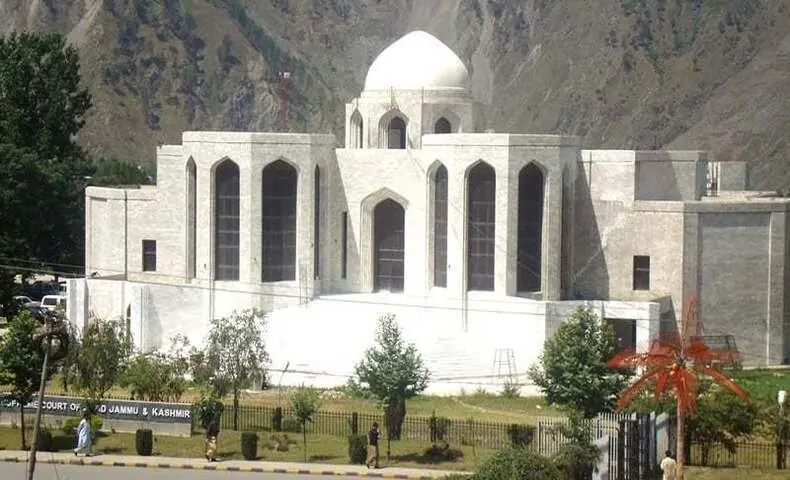
MUZAFFARABAD: The Supreme Court of Azad Jammu and Kashmir has delivered a pointed constitutional rebuke to a banned protest movement demanding the abolition of reserved seats for Kashmiri refugees, ruling that the twelve contested places in the region’s legislative assembly enjoy full constitutional protection and can be removed only through formal parliamentary amendment — not through street agitation or political pressure.
The advisory opinion, dated 6 June and issued in response to a presidential reference filed under Article 46-A of the Interim Constitution Act, 1974, arrived as the region braced for demonstrations planned by the recently proscribed Joint Awami Action Committee (JAAC) on 9 June. It amounted to a sweeping endorsement of the government’s position on one of the most divisive questions in Azad Kashmir’s political life.
Chief Justice Raja Saeed Akram Khan, writing for the court, declared that the AJK constitution was “the supreme law” of the state and its provisions “the property of the people of Azad Jammu and Kashmir and of the whole Kashmiri people.” The amendment of that constitution, he held, was “a solemn constitutional act, not a concession to be wrested from a government under duress.”
The opinion was unambiguous on the limits of protest: “Any demand seeking abolition of any constitutional provision through coercion, brute force, threats of mass public obstruction, or other extra-constitutional means is devoid of constitutional sanction, legally unenforceable, and wholly incompatible with the principles of constitutional supremacy and the rule of law.”
The twelve seats at the centre of the dispute are reserved in the legislative assembly for refugees from Indian-administered Jammu and Kashmir who settled in mainland Pakistan after Partition in 1947. The JAAC and its supporters have long argued that the seats serve as a mechanism through which mainstream Pakistani political parties exert disproportionate influence over the formation of governments in Muzaffarabad — a charge that has fuelled periodic unrest in the territory.
The court traced the constitutional lineage of the seats through legislation stretching back to 1960, 1964 and 1970, concluding that they are rooted in historical legal arrangements that predate the current interim constitutional framework and are embedded in Article 22 of the 1974 constitution. Altering, reducing or abolishing them requires a constitutional amendment enacted strictly in accordance with Article 33 — a process that demands a full parliamentary mandate, deliberation, consultation and consensus-building. “It can only be accomplished through the process the constitution itself prescribes,” the opinion stated, “by an assembly possessed of the full democratic mandate of the people.”
The court also held that while peaceful protest is a constitutional right, actions that disrupt ordinary life do not enjoy constitutional protection, and that no individual’s exercise of rights can serve as a justification for depriving fellow citizens of theirs.
The advisory opinion was sought by acting AJK President Chaudhry Latif Akbar after the JAAC placed abolition of the refugee seats at the centre of its campaign ahead of legislative elections scheduled for 27 July. The reference posed five questions, covering the constitutional status of the seats, the legislature’s competence to introduce a fundamental amendment at this stage, the limits of the rights of assembly and association, and the state’s obligation to protect the electoral process from extra-constitutional demands.
On the question of timing, the court was firm: elections must proceed within the constitutional timeframe, and neither political disputes nor ongoing protests can be used as grounds for delay. “The constitution endures,” the opinion read, “because its guardians — the government, the legislature, the judiciary, and ultimately the people — stand firm in its defence.” The court was equally clear that the constitution “is not a document to be honoured when convenient and discarded when inconvenient.”
The court also endorsed the government’s position that the remaining unanswered constitutional questions should be left to the incoming elected assembly, stressing that the decisive force in Azad Kashmir is “not street agitation but the supremacy of the constitution.”
The opinion lands at a moment of heightened political tension. The AJK government proscribed the JAAC on Saturday, just days before the group’s scheduled 9 June protests, prompting the authorities to advise visitors to postpone travel to the region until 20 June, citing security concerns.
The chief election commissioner of AJK, retired Justice Ghulam Mustafa Mughal, announced the election schedule on the same day, confirming that the refugee seat contests — previously conducted under judicial supervision — would henceforth be overseen by officials of the Election Commission of Pakistan following the judiciary’s withdrawal from the process. He cautioned that prolonged agitation risked disrupting the electoral timetable.
The advisory opinion was preceded by parallel moves in the territory’s political institutions. An All Parties Conference held at the Prime Minister’s Secretariat in Muzaffarabad rejected the demand to abolish the refugee seats and affirmed that constitutional reform is the exclusive prerogative of elected representatives. The AJK Legislative Assembly separately passed a resolution retaining the seats, acknowledging that any reforms designed to remove electoral complications could be pursued through the assembly in due course — but through mandate, not coercion.
Copyright © 2021 Independent Pakistan | All rights reserved