By Staff Reporter
ISLAMABAD: Pakistan on Saturday dismissed Indian criticism of its recent airstrikes inside Afghanistan as “absurd and unwarranted,” accusing New Delhi of longstanding involvement in sponsoring terrorist groups operating from Afghan territory and flouting international law.
The pointed rebuttal from Pakistan’s Foreign Office came a day after India’s Ministry of External Affairs expressed concerns over Islamabad’s military operations, which targeted suspected militant hideouts inside Afghanistan. India’s statement described the strikes as “yet another act of aggression by the Pakistani establishment that remains hostile to the idea of a sovereign Afghanistan,” urging full respect for Kabul’s territorial integrity.
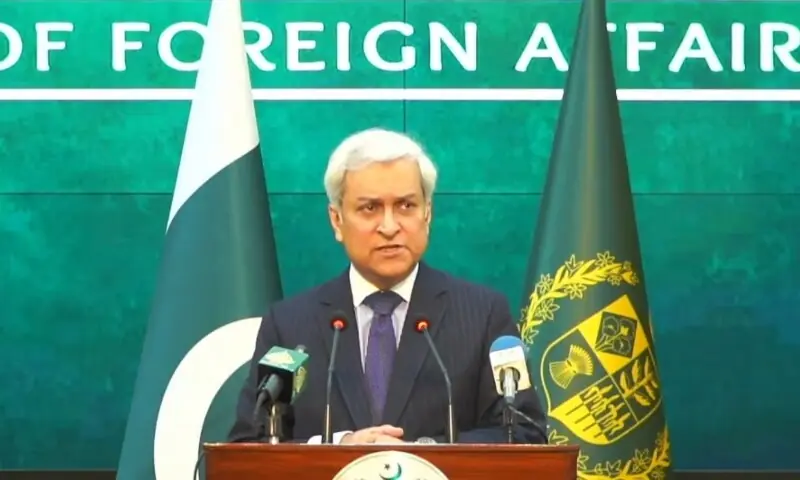
Pakistan’s Foreign Office spokesperson Tahir Hussain Andrabi dismissed India’s concerns over the operations as hypocritical and rooted in frustration over the disruption of what he described as New Delhi’s “terrorist franchise” in the region.
“The remarks by the spokesperson of the Ministry of External Affairs of India regarding Pakistan’s legitimate, targeted and precise actions against terrorist hideouts and support bases inside Afghanistan are not only absurd and unwarranted but also shamefully hypocritical,” Andrabi said in a statement responding to media queries.
He pointed to India’s “active support and sponsorship” of groups such as Fitna-al-Khawarij — a term Pakistani authorities use to refer to the Tehrik-e-Taliban Pakistan (TTP), an outlawed militant outfit responsible for numerous attacks inside Pakistan — and Fitna-al-Hindustan, which Islamabad applies to the Balochistan Liberation Army (BLA), a separatist group operating in Pakistan’s restive Balochistan province.
“India’s active support and sponsorship of terrorist groups operating from Afghan soil… are well known,” Andrabi said. “Therefore, India’s frustration at the destruction of its terrorist franchise in Afghanistan, as reflected in such statements, is quite understandable.”
The exchange underscores the deepening rift between the two nuclear-armed rivals, whose relations have been strained by decades of conflict over Kashmir, cross-border militancy and competing influences in Afghanistan.
The latest exchanges mark the most intense phase yet of fighting that erupted in late February and has shown no sign of abating despite repeated mediation attempts by China, Turkey and other regional powers. On Friday, Pakistani forces intercepted several rudimentary drones launched from Afghanistan, but falling debris injured two children in the southwestern city of Quetta and two other civilians elsewhere in the country. The same day, a roadside bomb targeting Pakistani police in the northwestern district of Lakki Marwat killed seven officers.
Pakistan has long accused the Taliban government of harbouring TTP militants who slip across the border to stage attacks, a charge Kabul has repeatedly denied. Tensions spiked dramatically after a Feb. 16 suicide assault on a joint security post in Bajaur district near the Afghan frontier. Eleven Pakistani soldiers were killed, along with a young girl; seven others, including women and children, were wounded when the blast damaged a nearby residential building. Pakistani investigators identified the bomber — a member of the Afghan Taliban’s special forces from Balkh province — and the TTP claimed responsibility.
Five days later, on Feb. 21, a lieutenant colonel and a sepoy died in another suicide attack during an intelligence-based operation in Bannu district of Khyber Pakhtunkhwa province. Pakistan’s military, in a statement, said the perpetrators were operating from Afghan soil in violation of the holy month of Ramadan and vowed unrelenting operations “irrespective of their location.”
Pakistan’s military has conducted several airstrikes in recent years targeting suspected Taliban splinter groups and other militants along the porous border, actions that have drawn protests from the Taliban government in Kabul and, increasingly, rhetoric from India.
Pakistan’s operations in Afghanistan, described by Andrabi as “legitimate, targeted and precise actions against terrorist hideouts,” follow a pattern of cross-border strikes last year, when Islamabad targeted TTP positions in Afghanistan’s Khost and Paktika provinces, killing hundreds of Pakistani Taliban militants.
Andrabi broadened the critique to India’s domestic policies and regional conduct, labeling New Delhi a “serial violator of human rights and international law.” He accused New Delhi of being a “serial violator of human rights and international law,” highlighting its continued occupation of Indian Illegally Occupied Jammu and Kashmir (IIOJK). “India… continues to illegally occupy [IIOJK] in violation of the UN Charter and relevant UN Security Council resolutions, and has been responsible for perpetrating state terrorism in the occupied territory.”
The Kashmir issue, a flashpoint since the 1947 partition of British India, has fueled three full-scale wars between the neighbors and remains a core grievance in bilateral ties.
Further escalating the rhetoric, Andrabi invoked India’s ruling Bharatiya Janata Party’s
The spokesperson also lambasted Prime Minister Narendra Modi’s ruling Bharatiya Janata Party’s embrace of “Hindutva extremist ideology,” saying it has led to the systematic marginalisation of minorities, the spread of Islamophobia and even the “weaponisation” of shared water resources in violation of treaty obligations under the 1960 Indus Waters Treaty.
“India has not only played the role of a spoiler in Afghanistan, but also in the entire region,” Andrabi said, portraying New Delhi as an obstacle to stability across South Asia. “With such shameful credentials, India is in no position to make such statements and must instead focus on refraining from stoking terrorism inside Pakistan from Afghan soil.”
Pakistan, for its part, remains steadfast in its approach, Andrabi said. “Pakistan remains determined to take all appropriate actions in self-defence and to protect its citizens in accordance with international law, including the UN Charter.”
The back-and-forth statements highlight how Afghanistan has reemerged as a proxy battleground in the India-Pakistan rivalry, with New Delhi strengthening ties to the Taliban regime since its 2021 return to power — including a high-level ministerial visit in October 2025 — while Islamabad grapples with surging TTP attacks from across the border.
Copyright © 2021 Independent Pakistan | All rights reserved