By Staff Reporter
ISLAMABAD: Pakistan summoned Afghanistan’s deputy head of mission and issued a strong demarche over a deadly terrorist attack in the northwestern Bajaur district that killed 11 soldiers, accusing the Taliban government in Kabul of failing to curb militants operating from its soil, the foreign ministry said on Thursday.
The demarche, delivered on Wednesday afternoon, condemned the vehicle-borne suicide attack followed by a fire raid on military and law enforcement posts in Bajaur on Feb. 16, which was carried out by the banned Tehreek-i-Taliban Pakistan (TTP), referred to by Pakistani authorities as Fitna al Khawarij. “Pakistan condemned in the strongest possible terms the vehicle-borne suicide terrorist attack followed by a fire raid on Pakistan military and law enforcement agencies’ posts in Bajaur, carried out by Fitna al Khawarij [or] the TTP,” the foreign office said in a statement.
The ministry expressed serious concern that the TTP, whose entire leadership is based in Afghanistan, “operates with impunity from Afghan soil.” It reiterated that Pakistan had received repeated assurances from the Afghan Taliban regime on taking action against such groups, “but, regrettably, with no visible or concrete actions.” “The Afghan Taliban regime has been told to take immediate, concrete and verifiable measures against all terror groups operating from its territory, including their leadership,” the statement added.
The foreign office also “categorically informed” the Afghan side that Pakistan “reserved the right to respond and eliminate any khawarij belonging to the group as well as their affiliates,” wherever they are located, “to ensure [the] safety of its soldiers, civilians and territorial boundaries.”
Pakistan’s military said the attack involved an explosive-laden vehicle ramming into the wall of a checkpost manned jointly by security forces and law enforcement agencies, killing 11 security personnel and one civilian. Security forces retaliated, killing 12 militants in the ensuing exchange of fire, according to the Inter-Services Public Relations (ISPR).
Defence Minister Khawaja Asif, speaking during a visit to Berlin on Wednesday, said Islamabad would not hesitate to launch air operations inside Afghanistan to combat militancy, describing the current instability as the “price we are paying” for decisions made during the 1980s and after the Sept. 11 terrorist attacks. Asif accused the Afghan Taliban regime of conducting a “proxy war” alongside India against Pakistani interests and said military action would remain on the table until Kabul offered meaningful “assurances of peace.” “Pakistan won’t hesitate to conduct new strikes on Afghanistan, unless someone in Kabul can underwrite peace,” Asif told France 24.
He accused India of waging a “proxy war” against Pakistan via militant attacks, saying New Delhi and Kabul, as well as militant outfits, “are on the same page.” Pakistan alleges that surging attacks in its territory are carried out by militants based in Afghanistan and facilitated by the Taliban government there. Kabul denies the allegations and has urged Islamabad to address its own security challenges without assigning blame.
The latest demarche follows a similar protest issued to Afghanistan in late December over its failure to rein in terrorist organisations after a deadly attack on a military camp in North Waziristan. Pakistan has seen a rise in cross-border terrorist incidents since the Taliban regained control of Afghanistan in 2021, with the provinces of Khyber Pakhtunkhwa and Balochistan, which border Afghanistan, particularly affected.
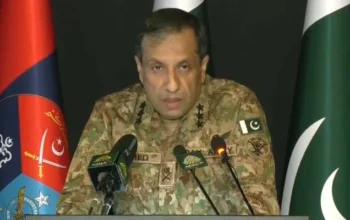
Earlier this year, ISPR Director General Lieutenant General Ahmed Sharif Chaudhry said law enforcement agencies conducted 75,175 intelligence-based operations (IBOs) across the country in 2025, including 14,658 in Khyber Pakhtunkhwa, 58,778 in Balochistan, and 1,739 in the rest of the country. He reported 5,397 terrorism incidents nationwide during the year, with 3,811 in Khyber Pakhtunkhwa, 1,557 in Balochistan, and 29 in other parts. Some 2,597 terrorists were killed in counterterror operations, and Chaudhry noted that civilians and soft targets had been deliberately targeted, with Afghan militants involved in all 10 major attacks detailed.
Islamabad and Kabul engaged in border clashes last October after the Afghan Taliban and militants launched unprovoked attacks on Pakistan’s border posts, resulting in the deaths of over 200 Taliban and affiliated militants and 23 Pakistani soldiers. Pakistan conducted “precision strikes” deep inside Afghanistan, targeting terrorists in Kandahar province and Kabul, but despite multiple rounds of talks, no ceasefire was reached due to the Afghan Taliban regime’s reluctance to act against terrorist outfits.
Asif said some “friendly countries” had tried to mediate between Pakistan and Afghanistan amid rising tensions, “but these attempts did not really produce any results.” Addressing the broader security situation, including a recent bombing of a mosque in Islamabad, Asif claimed that “almost all the franchises of terrorism” are present in Pakistan “because of the non-seriousness of the Kabul government towards curbing terrorism,” adding that complicity would be a better word. Pakistan also alleges that militant groups carrying out attacks in its territory are supported by arch-rival India, a charge New Delhi rejects. Islamabad and New Delhi have not been in direct or indirect contact since the May 2025 armed conflict between the two nuclear-armed neighbours, Asif said, emphasising that war with India remained “a possibility.”
Copyright © 2021 Independent Pakistan | All rights reserved