By Staff Reporter
ISLAMABAD: Pakistan’s finance minister told the International Monetary Fund that the government’s austerity-driven overhaul is delivering results, capping a Washington visit in which he also pressed US officials for a $10 billion currency backstop that Treasury has yet to publicly address.
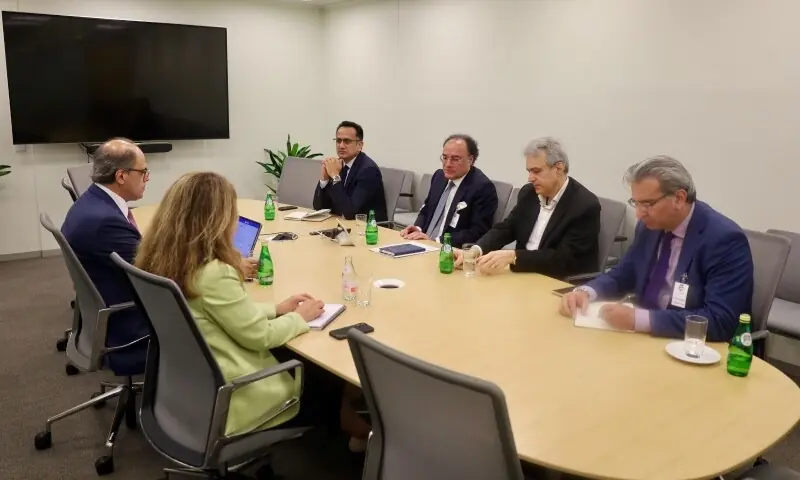
Muhammad Aurangzeb met a succession of senior IMF officials — First Deputy Managing Director Dan Katz, Deputy Managing Director Nigel Clarke, Middle East and Central Asia Department Director Jihad Azour, and Mission Chief for Pakistan Iva Petrova — to review the country’s standing under the Fund’s $7 billion Extended Fund Facility and its Resilience and Sustainability Facility, according to a statement from Pakistan’s finance ministry on Thursday. The meetings covered the full sweep of the IMF-backed program: tax and energy reforms, privatisation, tariff rationalisation, debt management, and Pakistan’s push to diversify its financing sources and return to international capital markets.
Aurangzeb pointed to improved fiscal and external balances, revenue targets met, stronger reserves, record remittances and a better current account position as evidence the program is working. He thanked the Fund for what the ministry described as recognition of Pakistan’s “strong programme ownership and reform progress,” and reaffirmed the government’s commitment to fiscal discipline and structural change. The two sides also discussed longer-term priorities — human capital development, women’s economic participation, demographic pressures and export-oriented growth — that fall outside the Fund’s immediate lending conditions but shape how Washington and the IMF view Pakistan’s trajectory.
The IMF review is the clearest test yet of whether Pakistan’s compliance with a politically costly adjustment program is translating into the kind of credibility that unlocks additional support elsewhere — support Aurangzeb spent the rest of his Washington trip trying to secure.
On Tuesday, Aurangzeb asked Treasury Secretary Scott Bessent to approve a $10 billion bilateral Exchange Stabilization Support Facility with a maturity of up to five years, according to Reuters. A Treasury statement issued after the meeting backed Pakistan’s reform push and its ambition to return to capital markets but made no mention of the facility itself; people briefed on the matter told Reuters Aurangzeb raised it directly. The mechanism, typically drawn from the US Treasury’s Exchange Stabilization Fund, is distinct from the standing dollar swap lines the Federal Reserve maintains with major central banks — it functions as a one-off backstop for reserves and currency stability rather than a permanent liquidity channel. If granted, it would ease pressure on the rupee and reduce Islamabad’s reliance on IMF disbursements and rollover financing from China and Saudi Arabia.
That reliance was on stark display in April, when Pakistan repaid roughly $3.5 billion — about a fifth of its reserves — to the United Arab Emirates, with Saudi Arabia stepping in with $3 billion in fresh support to help cover the gap. Pakistan’s central bank said in January it expects reserves to approach $20 billion by the end of 2026, nearing the record last set in 2021.
Also on Wednesday, Aurangzeb met US Export-Import Bank President and Chairman John Jovanovic to discuss financing for long-term projects and expanding trade in cotton, soybeans and hydrocarbons. He welcomed the bank’s proposal to build a framework for prioritising projects and establishing a multi-year transaction pipeline; both sides agreed to identify near-term deals and designate points of contact, with a strategic framework expected to be finalised on the sidelines of the UN General Assembly in September. In a separate meeting, Aurangzeb discussed a plan with Honeywell Technologies to modernise and expand Pakistan’s refinery sector.
The Washington trip unfolds against continuing tariff negotiations between the two countries. The Trump administration imposed a 29% tariff on Pakistani exports in April 2025 under the International Emergency Economic Powers Act; a Pakistani delegation secured a reduction to 19% during a visit that July.
Pakistan’s outreach to Washington has extended into less conventional channels as well. The country signed a stablecoin agreement for cross-border payments with an affiliate of World Liberty Financial, the crypto venture tied to President Trump’s family, and is pursuing a memorandum of understanding to redevelop the shuttered PIA-owned Roosevelt Hotel in New York with the US government. Islamabad has also courted American mining investment, including at the Reko Diq copper-gold project, where the US Export-Import Bank has pledged $1.2 billion in financing.
Fitch Ratings said in April that Pakistan’s adherence to the IMF program has helped sustain its funding access, and that rebuilt reserves offer some cushion against shocks from Middle East tensions — though the agency warned that rising energy costs and potential supply disruptions could quickly erode that buffer. Pakistan’s credit rating remains firmly speculative-grade, keeping borrowing costs elevated and market access limited, while foreign direct investment stays thin, held back by recurring balance-of-payments crises, security concerns and a narrow export base.
Copyright © 2021 Independent Pakistan | All rights reserved