By Staff Reporter
ISLAMABAD: Pakistan’s said on Monday that the Indus Waters Treaty governing the sharing of river waters with India remains legally binding and cannot be revoked or amended by either side unilaterally, as tensions over water rights between the nuclear-armed neighbours continued to simmer more than a year after New Delhi suspended the accord.
Information Minister Attaullah Tarar, addressing a joint news conference with Climate Change Minister Musadik Malik in the capital, said the 1960 treaty remained in force and that Pakistan’s rights to the Indus river system were enshrined in what he called a legally enforceable agreement accepted by both countries.
“Legally, Pakistan’s stance has garnered support internationally, as the IWT cannot be unilaterally revoked, abolished or amended,” Tarar told reporters, adding that the treaty had laid out a clear framework that remained implemented.
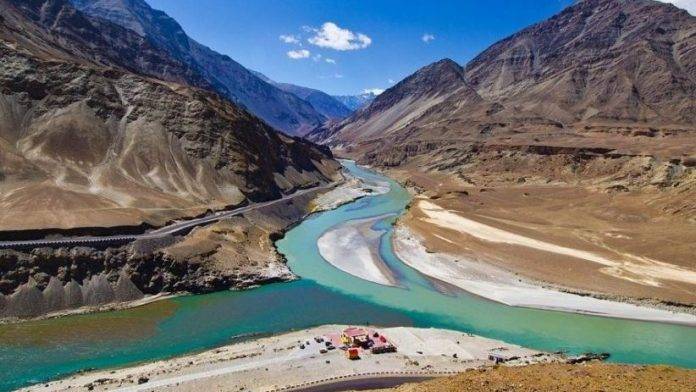
The treaty, brokered by the World Bank in 1960, divides the Indus river system between the two countries. Under its terms, India has primary rights to the three eastern rivers — the Ravi, Beas and Sutlej — while Pakistan holds rights to the three western rivers, the Indus, Jhelum and Chenab, which supply roughly four-fifths of the water used by its agricultural economy.
India placed the treaty in abeyance in April 2025, days after an attack in Indian-occupied Kashmir’s Pahalgam area killed 26 tourists, an assault New Delhi blamed on Pakistan-based militants without producing public evidence. Islamabad denied involvement and called for an independent investigation. The diplomatic rupture deepened after a brief military confrontation between the two countries the following month.
India’s water resources minister, C.R. Patil, said more recently that his government was working to ensure that not a single drop of water would reach Pakistan, a position New Delhi has tied to demands that Islamabad end what it describes as cross-border support for militant groups — an accusation Pakistan rejects. Pakistan has said any move to alter or block the flow of the shared rivers would be treated as an act of war.
Tarar said Prime Minister Shehbaz Sharif and military chief Field Marshal Asim Munir had repeatedly described water as both Pakistan’s lifeline and its red line. He said international legal and water experts had increasingly sided with Islamabad’s position in global forums, an outcome he characterised as a victory in what he called the narrative domain. India, he said, had failed to gain acceptance for its position at any international forum.
The minister said Pakistan would host the first seminar of its kind in Islamabad on Tuesday, bringing together water and legal experts from around the world to raise awareness of the country’s rights under the treaty.
Malik, addressing the same news conference, said Pakistan was seeking to elevate the dispute beyond a bilateral disagreement with India into a broader question of international justice and the rights of downstream nations generally. He said Pakistan’s position had already been endorsed at the Permanent Court of Arbitration, the international body that adjudicates disputes arising under the treaty.
While climate change accounted for some of the disruption to seasonal water flows, Malik said, it was not the only factor at work. He said control over the river system now effectively rested with a neighbouring government that had vowed to withhold water from Pakistan entirely.
Malik said between 40% and 50% of Pakistan’s population depended on agriculture for their livelihoods, with the sector contributing roughly 20% to 25% of the country’s economic output, and that food security, employment and economic stability were all bound up in the availability of water from the shared rivers.
He framed Tuesday’s seminar as an examination of whether any upper riparian state had the right to restrict water flowing to a downstream neighbour, noting that water continued to flow between many countries under informal convention even without a binding treaty. Pakistan and India, by contrast, were bound by a formal agreement, he said, raising the question of how its terms could be set aside.
Malik also acknowledged that Pakistan needed to improve its own water management, including by expanding storage capacity through new dams, saying the purpose of such infrastructure was not simply storage but the ability to regulate flows so farmers received water when crops required it. Responding to a question on the politics of dam construction, he said he expected a cross-party consensus to emerge on the need for new reservoirs, calling it a matter unlikely to draw significant political dispute.
The treaty has come under sustained pressure since last year’s rupture. In June 2025, the Permanent Court of Arbitration issued a supplemental ruling finding that India could not unilaterally place the treaty in abeyance. Pakistan said a further supplemental ruling issued by the court last month, arising from a design dispute over the Ratle and Kishenganga hydroelectric projects in Indian-administered Kashmir, placed substantive limits on India’s capacity to control water flows on the western rivers by addressing the maximum volume of water that could be held in upstream reservoirs, a measure known as pondage. Pakistan’s government said the ruling found that India could not justify expanded storage capacity through unsubstantiated assumptions about reservoir operations or compliance with treaty release limits.
Earlier this month, Deputy Prime Minister and Foreign Minister Ishaq Dar said at least 17 Indian projects on rivers covered by the treaty would give New Delhi what he described as tools for hydro-hegemony over the river system.
Indian broadcaster CNBC-TV18 has reported that construction is due to begin on August 1 on a proposed tunnel project linking the Chenab and Beas rivers in the northern state of Himachal Pradesh, intended to divert surplus water between the two basins. The Indian news agency ANI put the project’s cost at $315 million.
Asked about the project at a weekly briefing this month, Pakistani Foreign Office spokesperson Tahir Andrabi said Islamabad had seen the tender documents published by the Indian government, which he said sought bids for a tunnel intended to transfer 1.9 million acre-feet of water annually from the Chenab into the Beas system. He described the project as a grave violation of the treaty and of broader international water law, including the Vienna Convention on the Law of Treaties and principles reflected in a 1997 United Nations convention on the use of international watercourses.
The dispute over the Indus river system has persisted as one of the most fraught points of contention between the two countries even as it has, for six decades, been considered among the more durable instruments of cooperation between them, having survived previous wars and crises since its signing.
Copyright © 2021 Independent Pakistan | All rights reserved