By Staff Reporter
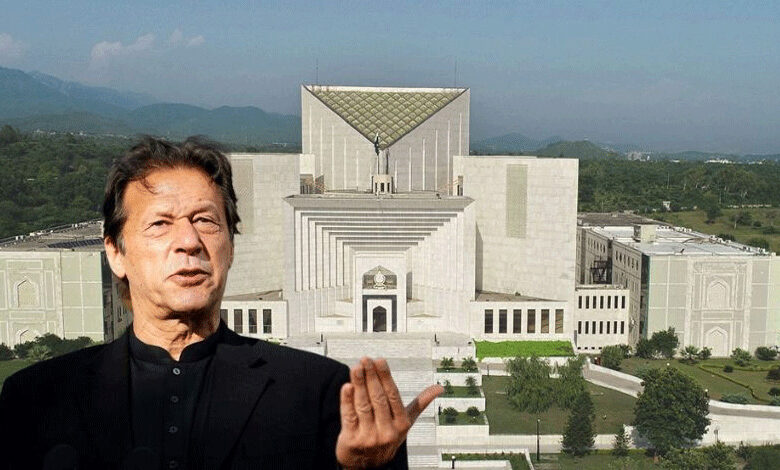
ISLAMABAD: The Supreme Court of Pakistan is set to resume hearing appeals by former prime minister Imran Khan against the denial of bail in cases linked to violence on May 9, 2023, court officials said on Saturday.
The three-judge bench, headed by Chief Justice Yahya Afridi and including Justices Muhammad Shafi Siddiqui and Miangul Hassan Aurangzeb, will take up the matter on August 12, after adjourning previous proceedings due to the unavailability of Khan’s senior counsel, Salman Safdar.
Khan, the founding chairman of the Pakistan Tehreek-e-Insaf (PTI) party, remains incarcerated and has challenged a June 24 decision by the Lahore High Court (LHC) rejecting his post-arrest bail in eight cases related to the May 9 violence. The incidents include attacks on Askari Tower at Liberty Chowk, PML-N offices in Model Town, Shadman police station, the burning of police vehicles near the Lahore corps commander’s residence, and violence at Sherpao Bridge.
In his appeals, Khan argued that he was in the custody of the National Accountability Bureau (NAB) at the time of the alleged offences, making his involvement “impossible”. The appeals reminded the court that the Supreme Court had already held that the case of an abettor who was not present at the scene of occurrence stands on a lower legal footing than that of a principal accused.
Khan claimed he had been subjected to an “unprecedented campaign of political victimisation” since his ouster as prime minister in 2022. The cases were yet another attempt by the state and the police to “implicate” him in a criminal matter, based solely on “vague and unsupported allegations of abetment” as the prosecution had no “convincing” evidence connecting him to the alleged offence, according to the appeals.
Khan moved the LHC after an anti-terrorism court denied bail in the eight cases on November 27, 2024. After his “unlawful and invalid” arrest from the premises of the Islamabad High Court on May 9, 2023, multiple FIRs were registered in Lahore and Islamabad, the appeals contended, adding that none of the complaints contained any specific allegations or details regarding the purported conspiracy.
At a later stage, the prosecution introduced supplementary statements by police officials in an apparent attempt to “falsely implicate” Khan, it added. If, as per the prosecution’s claim, the police allegedly knew about the conspiracy to orchestrate violence as early as May 7, why did they not take any action to prevent the attacks, the appeal questioned. This was “highly illogical” and further exposed the “malafide and politically motivated nature of the proceedings”, it claimed.
The appeal alleged Khan had been “maliciously implicated” in these cases as part of a “calculated and politically motivated design to prolong his incarceration”, harass him and tarnish his public image. Khan’s arrest was “never genuinely required” in cases pertaining to May 9 violence, it pleaded, adding that police took no action to arrest him for over five months even after his bail applications were dismissed by an anti-terrorism court in Lahore.
Despite knowing Khan’s whereabouts, Adiala jail where he was confined, the police “made no meaningful attempt to effect his arrest”, it argued. “This lack of urgency or interest on part of the investigating agency strongly supports the inference that the arrest was not necessitated by the merits of the case, but rather was a tool of oppression, thereby further justifying the grant of post-arrest bail,” the appeal said.
According to the appeal, the LHC decision to deny bail to Khan was based on “engineered and fabricated evidence” comprising stale, discredited, and delayed statements of police officials recorded long after the occurrence, without any plausible explanation for the inordinate delay. It argued that the LHC while rejecting the bail plea also failed to appreciate that the prosecution has been consistently shifting its stance like a pendulum, by introducing materially improved versions of the case narrative. Each new version was introduced only after the preceding one failed to withstand before the courts of law, thereby rendering the prosecution’s case doubtful and entitling the petitioner to the benefit of further inquiry, the appeal pleaded.
These material contradictions and afterthoughts clearly made out a case falling within the ambit of Section 497(2) of the criminal procedure code, warranting the grant of bail, the Supreme Court was requested.
Copyright © 2021 Independent Pakistan | All rights reserved