By Staff Reporter
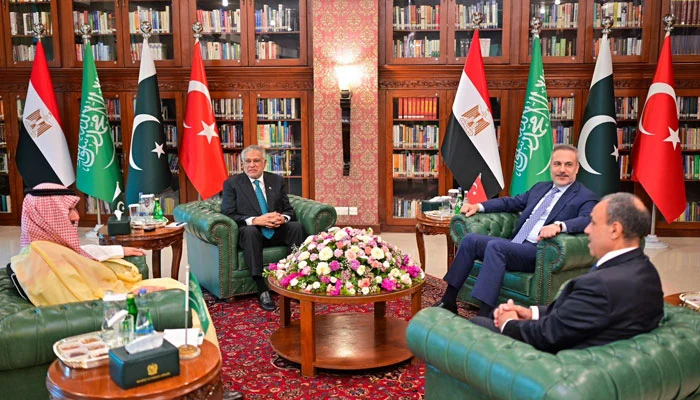
The bombs fell again on Friday, this time on two of Iran’s largest steel plants, a power station and civilian nuclear sites that Tehran insists have nothing to do with its military program. Israel also struck universities, according to Iranian officials. These were precisely the kinds of attacks on non-military targets that Pakistani diplomats had warned would kill any chance of talks. Yet even as the smoke rose over Iran’s industrial heartland, Islamabad was still trying to keep the door open. Prime Minister Shehbaz Sharif spoke for more than an hour with President Masoud Pezeshkian. Foreign ministers from Turkey, Egypt, Saudi Arabia and Pakistan are gathered in Islamabad on the Middle East crisis. And Pakistan’s de facto leader, Field Marshal Asim Munir, continues to shuttle messages between Washington and Tehran.
It is an improbable role for a country that is neither Arab nor Persian, that hosts no American bases, and that has spent decades balancing relations with Washington, Riyadh and Tehran. But it is also, for the moment, the only serious diplomatic channel left in a war that began barely a month ago and already threatens to redraw the Middle East. Whether Pakistan can actually pull the two sides toward a deal depends on whether the deepest obstacles — profound mistrust, clashing core demands and the risk of spoilers — can be managed before the fighting renders negotiation impossible.
The outlines of the divide are stark. Iran wants more than a pause in the bombing; it wants a guarantee that the war is over. That means credible assurances against future American or Israeli strikes, an end to what it calls aggression, and, most controversially, retention of its effective control over the Strait of Hormuz — the narrow chokepoint through which a fifth of the world’s oil passes. Tehran has made clear it will not sit face-to-face with American officials; any talks must remain indirect, with Pakistani intermediaries moving between separate rooms. It has rejected the American 15-point proposal relayed through Islamabad and offered its own five-point framework instead. Iranian officials, including Foreign Minister Abbas Araghchi, have pointedly noted that Washington has bombed Iran twice in the past year, even while talks were supposedly underway. The recent strikes on civilian infrastructure, they argue, only confirm that pattern.
The Trump administration, for its part, insists that Iran “wants a deal so badly” and has portrayed Tehran’s decision this week to let several Pakistan-flagged tankers pass through the strait as a meaningful gesture — a “present,” in the president’s words. Yet Secretary of State Marco Rubio has already dismissed Iran’s Hormuz demand as unacceptable, even as Trump himself has floated the idea of some form of joint administration. The Pentagon is meanwhile preparing to send thousands more troops to the Gulf: 7,000 ground forces are already en route, and the Wall Street Journal has reported discussions of an additional 10,000. That buildup, combined with Israeli strikes that continue even after Trump announced a 10-day pause to allow diplomacy a chance, makes Iranian scepticism understandable.
Into this breach steps Pakistan, a country whose very limitations have suddenly become advantages. It is not a player in the Middle East’s sectarian wars. It has no American military bases on its soil. Its ties with Tehran have improved markedly in the past two years, with intelligence cooperation against Baloch separatists and smugglers along their 900-kilometer border. At the same time, Field Marshal Munir — whom Trump has called his “favorite field marshal” — enjoys direct access in Washington. Pakistani officials believe the gap between the two sides’ positions is bridgeable if both genuinely want a deal. They have proposed that Vice President JD Vance represent the United States, an idea Tehran has welcomed because it views him as more sceptical of the war than other Trump envoys. Indirect talks, they argue, with Pakistan shuttling proposals and its air force even providing secure transport for Iranian officials if needed, could gradually build the minimal confidence required.
Still, the obstacles are formidable. The first is trust. Maleeha Lodhi, a former Pakistani ambassador to Washington, says the hardest part for Iran is believing Trump’s word. “He is not a rational player. He’s completely whimsical.” Past experience — two rounds of American strikes during previous diplomatic windows — has left Tehran convinced that Washington uses negotiations as cover for military preparation. The second obstacle is Israel. Pakistani officials see Jerusalem as the most likely spoiler. The Friday strikes on steel plants and civilian nuclear sites were, in their view, exactly the sort of escalation designed to make talks untenable. As long as Israel feels free to strike Iranian infrastructure at will, any American promise of restraint will ring hollow in Tehran. Then there is Pakistan’s own precarious position. Last year Islamabad signed a mutual defence pact with Saudi Arabia that defines an attack on one as an attack on both. Riyadh has been repeatedly targeted by Iranian missiles and drones; an Iranian strike late Friday on Prince Sultan Air Base in Saudi Arabia wounded American troops. Pakistani officials are acutely aware that the pact could drag their country into a conflict it desperately wants to avoid. Pakistan shares a long, restive border with Iran, is home to the world’s second-largest Shia population (some 40 million people) and has already seen deadly unrest after Israel’s assassination of Iran’s former supreme leader, Ayatollah Ali Khamenei, at the start of the war. Public sympathy for Tehran runs deep, fed by widespread anti-American and anti-Israeli sentiment. At the same time, Pakistan’s economy is fragile, its energy imports flow through the Gulf, and its military is already stretched by insurgencies in the west and renewed fighting with the Taliban.
That domestic reality helps explain why Islamabad has moved so aggressively into the mediator’s seat. Success would burnish Pakistan’s image as a serious diplomatic actor — a country that once helped Henry Kissinger reach China and later facilitated talks between the United States and the Taliban. It would also strengthen ties with Washington at a moment when the military establishment craves validation. But failure could leave Pakistan exposed: accused by Iran of complicity in American delay tactics, distrusted by Washington if it is seen as too sympathetic to Tehran, and potentially forced to choose sides in a Saudi-Iranian clash it cannot afford.
The way forward, if there is one, must begin with small, verifiable steps that address the trust deficit. A genuine, mutually observed pause in strikes on civilian and energy infrastructure is essential — one that both sides can monitor and that Israel does not undermine. Pakistan’s suggestion of Vice President Vance as the American face of the talks is worth pursuing; his reported scepticism could give Tehran a negotiating partner it finds credible. The four-nation meeting convening in Islamabad — Turkey, Egypt, Saudi Arabia and Pakistan — offers a chance for regional Muslim powers to coordinate pressure on all parties to keep diplomacy alive, even if Saudi Arabia’s private preference for continued bombardment complicates matters.
On substance, the Hormuz question cannot be wished away. Iran’s demand for control reflects its fear of being permanently blockaded; the American rejection reflects concern over global energy security. Trump’s own hint of joint administration suggests a possible compromise, perhaps an international oversight mechanism or phased arrangements that allow Iran a role while guaranteeing open passage. Iran’s five-point demands for an end to aggression and reparations will need to be matched by American offers of sanctions relief and security guarantees that go beyond the 15-point framework already on the table. Neither side will get everything it wants, but both must be given enough to sell a deal at home. Pakistan cannot force the parties to agree. It can only keep the channel open, provide logistical support and use its unique relationships to urge restraint. Its success or failure will turn on whether Washington and Tehran decide that the costs of continued war — a global energy crisis, regional instability that could yet draw in Pakistan itself — outweigh the domestic political price of compromise.
Copyright © 2021 Independent Pakistan | All rights reserved