By Staff Reporter
ISLAMABAD: Pakistan is moving to establish its first deep-conversion greenfield refinery, a $4.5 billion project in the coastal industrial district of Hub that its developers say could reshape the country’s energy import profile and anchor a broader petrochemical buildout along its southwestern coast.
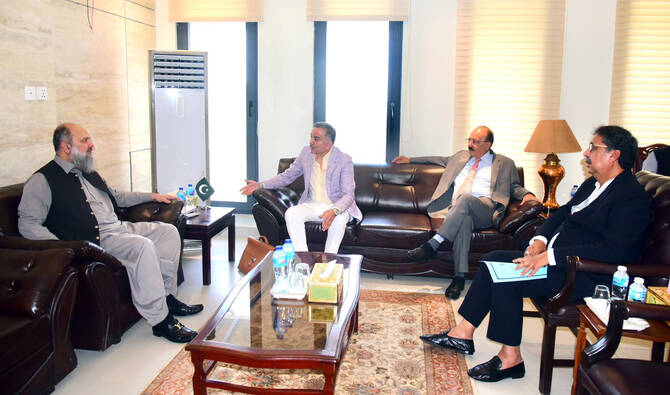
SPEC Refinery Pvt Ltd, the Karachi-based company behind the proposal, briefed Commerce Minister Jam Kamal Khan in Islamabad on Wednesday on the project’s progress and its broader strategic ambitions, according to a ministry statement. The delegation was led by the company’s chairman, Zafar Sheikh, who told the minister that site preparation had begun and that implementation plans were being finalized.
The refinery, to be built under Pakistan’s Greenfield Refinery Policy — a framework designed to channel investment into technologically advanced domestic processing capacity — would use deep-conversion technology to extract maximum yields of high-value refined products from a wide range of internationally sourced crude grades. That capability distinguishes it from Pakistan’s existing refining fleet, most of which relies on older, less efficient hydroskimming configurations that produce a higher proportion of lower-value fuel oil and struggle to meet modern fuel specifications.
Pakistan currently imports substantial volumes of refined petroleum products despite operating several domestic refineries. The gap between domestic output and consumption has long weighed on the country’s current account, and successive governments have tried, with limited success, to attract investment in more sophisticated processing capacity. The Greenfield Refinery Policy was introduced specifically to address that shortfall by offering incentives to developers willing to build from scratch.
SPEC’s project, if completed, would represent the largest single investment in Pakistan’s downstream energy sector in recent memory. Sheikh told the minister the facility was expected to generate roughly 2,000 direct and indirect jobs during construction and operations, concentrated in Hub and the surrounding areas of Balochistan — a province that has historically lagged Pakistan’s economic center of gravity despite sitting astride major transport corridors and holding significant mineral and energy resources.
The company also outlined plans for associated petrochemical facilities that would produce industrial feedstocks and value-added products for Pakistan’s manufacturing sector, with potential to generate export revenues. The petrochemical component is significant: Pakistani manufacturers currently import large quantities of basic chemical inputs that a domestic complex could supply, and regional demand for such products has been growing.
Jam Kamal framed the project in terms of Pakistan’s wider economic positioning, citing the country’s geography at the junction of South Asia, Central Asia, the Middle East and western China as an underutilized asset for energy and logistics investment. Pakistan’s domestic market of more than 250 million people and its expanding network of trade corridors — anchored in part by the China-Pakistan Economic Corridor — provided additional commercial rationale for large-scale industrial bets, he said.
The delegation asked the government to accelerate remaining regulatory approvals, including those pending with the Federal Board of Revenue, and to support implementation of the Greenfield Refinery Policy’s provisions. The minister said the government was committed to facilitating investments that advance import substitution, industrial modernization and export growth.
Whether SPEC can bring the project to financial close will depend in part on its ability to secure long-term financing for a capital-intensive asset in a market that has historically struggled to attract large-scale foreign direct investment in the energy sector. The $4.5 billion figure places it among the largest proposed private investments in Pakistan’s history, and developers have yet to publicly disclose the composition of the financing package or identify anchor equity partners.
Hub’s existing industrial estate, which hosts cement plants, power projects and other manufacturing facilities, provides some infrastructure foundation for the refinery site. Balochistan’s provincial government has in recent years positioned the Hub corridor as a priority industrial zone, in part to address longstanding underdevelopment grievances in the province.
Copyright © 2021 Independent Pakistan | All rights reserved