By Staff Reporter
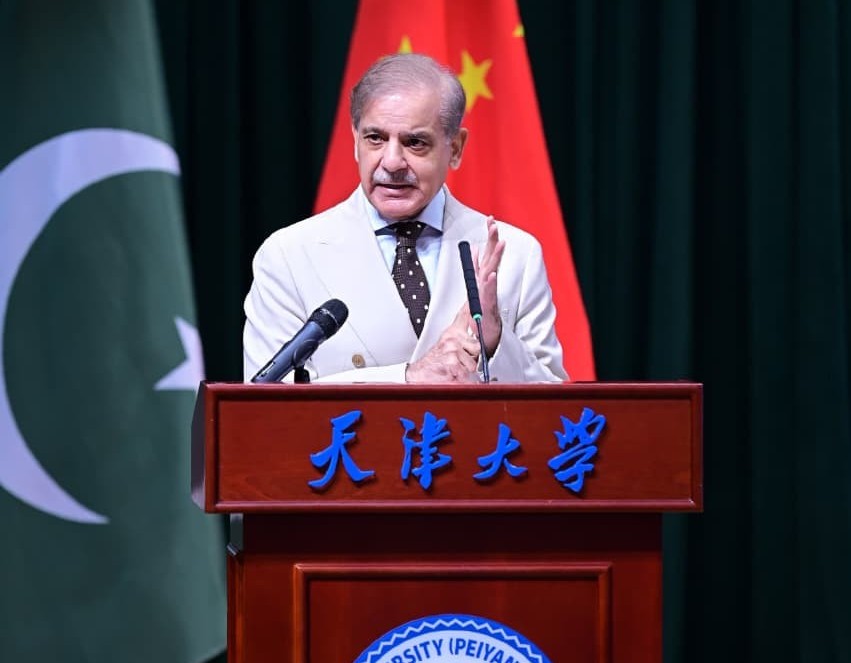
ISLAMABAD: Prime Minister Shehbaz Sharif on Sunday lauded Chinese President Xi Jinping’s leadership as a model for multilateralism and shared prosperity, aligning his government’s initiatives with Xi’s philosophy during a speech at Tianjin University.
Sharif, who arrived in China on Saturday for a two-day summit of the Shanghai Cooperation Organization’s Council of Heads of State, urged Pakistani students studying in the country to acquire cutting-edge knowledge and technology through dedication and effort. His address, broadcast on national television channels, underscored the deepening ties between the two nations amid broader regional engagements.
“Pakistan fully supported President Xi’s philosophy and vision,” Sharif said, noting that China’s leadership demonstrated “inspiring” strategic long-term planning focused on national progress and public welfare.
“President Xi’s visionary leadership conveyed to the entire globe that long-lasting friendship could be achieved through multilateralism and not through unilateralism, while shared progress and prosperity could be conceived through joint teams’ work and not through exclusive rights,” he added.
The prime minister highlighted China’s achievement in lifting 800 million people out of poverty as a landmark accomplishment under Xi’s guidance, praising the president’s commitment to building a shared destiny. He described the enduring Pakistan-China friendship as one that has withstood historical challenges, rooted in mutual trust established by previous generations.
“It withstands owing to commitment and clear vision in our minds; together to find a shared destiny,” Sharif said, emphasizing that attempts to divide the two countries have been thwarted by their unified actions and understanding.
He traced the bonds back to ancient connections, including religious ties between Gandhara, Taxila and Beijing, and noted historical milestones such as Pakistan being the first Muslim country to recognize the People’s Republic of China and the inaugural direct flight by Pakistan International Airlines from Karachi to Beijing about 60 years ago.
Sharif commended China’s transformation into the world’s second-largest economy and a military powerhouse, attributing it to the hard work and sincerity of its leadership and people. “Pakistan felt pride over the achievement of its friend,” he said.
Turning to his own administration, Sharif asserted that Pakistan’s current government is dedicated to combating corruption and poverty, claiming that “not a single corruption case had emerged” during its tenure.
“We have a shared destiny with China and should learn from the knowledge imparted by the Chinese universities to bring economic [and] agricultural prosperity to the people of Pakistan,” he told the audience, which included members of his delegation, ambassadors and officials.
Sharif expressed satisfaction that more than 200 Pakistanis from various regions are enrolled at Tianjin University, which he called “a cradle of great learning.” He urged the students, whom he described as ambassadors of Pakistan, to return home as “architects for their future” and “torch bearers of Pakistan-China friendship.”
The prime minister noted that about 60 percent of Pakistan’s population consists of youth, presenting “a huge challenge,” and stressed the need to harness this demographic potential through collaboration with China. He mentioned that his government has sent 1,000 agriculture graduates to China for training in modern techniques and that approximately 30,000 Pakistani students are receiving education and training there. Vocational training, he added, is essential for developing the youth across Pakistan.
The speech came as Sharif leads Pakistan’s delegation to the SCO summit, which includes member states China, India, Russia, Pakistan, Iran, Kazakhstan, Kyrgyzstan, Tajikistan, Uzbekistan and Belarus. An additional 16 countries participate as observers or dialogue partners, with leaders from Mongolia, Armenia, Azerbaijan, Cambodia, Nepal, Turkiye, Egypt, the Maldives, Myanmar and others attending in an expanded format. Representatives from the United Nations and various regional and international organizations are also present.
According to Pakistan’s Foreign Office, Sharif will reaffirm his country’s commitment to multilateralism, regional security and sustainable development during the summit. He is expected to hold bilateral meetings with other SCO leaders and invited members to bolster diplomatic relations.
Sharif is scheduled to meet with Xi and Chinese Premier Li Qiang to discuss various aspects of Pakistan-China cooperation. “He would also attend the military parade with President Xi and other world leaders being held in Beijing to commemorate the 80th anniversary of the World’s Anti-Fascist War,” the Foreign Office said in a statement.
Additionally, Sharif plans to engage with Chinese business leaders on trade, economic and investment ties, including addressing a Pakistan-China B2B Investment Conference in Beijing.
The visit underscores ongoing high-level exchanges between the two countries, aimed at strengthening their “All Weather Strategic Cooperative Partnership,” reaffirming support on core issues, advancing the second phase of the China-Pakistan Economic Corridor (CPEC) and maintaining dialogue on regional and global matters, the Foreign Office stated.
Last week, Pakistani officials announced that Sharif’s trip would formally launch CPEC-II, emphasizing industrial cooperation after a roughly five-year delay.
On the sidelines of the SCO gathering in Tianjin, Sharif met with Turkish President Recep Tayyip Erdogan to review bilateral relations. The leaders expressed satisfaction with the upward trajectory in ties, including political, economic, defense and security cooperation.
Erdogan extended condolences for lives and property lost in recent floods across Pakistan, affirming Turkiye’s solidarity and stating that his country “stood shoulder to shoulder” with Pakistan during the crisis.
Copyright © 2021 Independent Pakistan | All rights reserved