By Staff Reporter
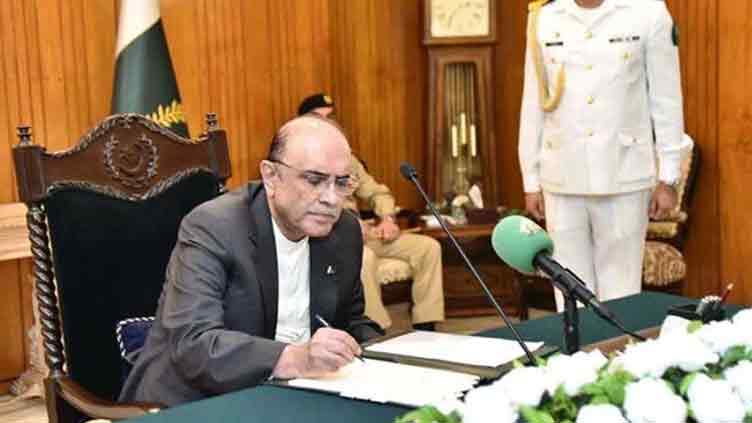
ISLAMABAD: President Asif Ali Zardari has signed into law a controversial amendment to the country’s anti-terrorism statute that grants security forces sweeping powers to detain suspects for up to three months without formal charges, a move his office described as essential for bolstering counterterrorism efforts amid surging militant violence.
The Anti-Terrorism (Amendment) Bill, 2025, which cleared both houses of parliament earlier this month, aims to provide a legal framework for preventive detentions, replacing what the government has called informal practices that have drawn widespread criticism. Zardari’s assent, announced Sunday, comes as Pakistan grapples with intensified insurgencies in its restive northwestern and southwestern provinces.
“President Asif Ali Zardari has assented to the Anti-Terrorism (Amendment) Bill, 2025,” the president’s official account on X posted. “The law strengthens security agencies’ ability to counter terrorism, ensures transparency in detentions with a 3-year sunset clause, and introduces judicial oversight & safeguards.”
The measure amends Section 11EEEE of the Anti-Terrorism Act, empowering the government, armed forces or civil armed forces to issue detention orders “for a period not exceeding three months and after recording reasons thereof,” based on “credible information or reasonable suspicion.” It applies to individuals suspected of involvement in terrorism, threats to national security, target killing, kidnapping for ransom or extortion, or those “against whom sufficient grounds exist of his having been so concerned, for [the] purpose of inquiry.”
Detentions must adhere to Article 10 of Pakistan’s constitution, which outlines safeguards against arbitrary arrest, and enforcement in provinces requires approval from local governments. Detainees can appeal to federal or provincial review boards composed of Supreme Court and high court judges. If the armed forces or civil forces initiate a detention, investigations will be handled by joint interrogation teams (JITs) including officials from police, intelligence agencies and other law enforcement bodies, with inquiries led by officers no lower than the rank of superintendent of police.
Law Minister Azam Nazeer Tarar, defending the bill during parliamentary debates, said it establishes “a lawful framework for preventive detention that would strengthen counterterrorism operations.” The government has argued that the law will address grievances from families of “missing persons” by curbing illegal detentions and providing transparency.
The statement of objects and reasons accompanying the bill emphasized the need for a “robust response that goes beyond the existing legal framework” given the country’s security challenges. It called for reinserting provisions from a previous amendment to “empower the government, Armed Forces and Civil Armed Forces with the necessary authority to detain individuals who pose a significant threat to national security.” Such powers, the statement said, would allow agencies to disrupt terrorist plots preemptively and enable JITs to “conduct comprehensive inquiries and gather actionable intelligence.”
Opposition lawmakers, particularly from former prime minister Imran Khan’s Pakistan Tehreek-e-Insaf (PTI) party, fiercely contested the bill in the Senate, arguing it risks abuse against political dissenters. Khan remains imprisoned on various charges, and his supporters have long accused the government of weaponizing security laws.
The legislation arrives against a backdrop of longstanding allegations of enforced disappearances in Pakistan, especially in Balochistan, where a separatist insurgency has simmered for decades. Families and human rights groups in the southwestern province frequently blame state institutions for arbitrary arrests and extrajudicial killings, claims that authorities have consistently rejected. The practice has fueled domestic unrest and drawn scrutiny from international organizations.
Pakistan’s military and civilian leadership maintain that development initiatives in Balochistan — including health, education and infrastructure projects — are designed to uplift the local population, countering accusations from ethnic Baloch separatists that Islamabad exploits the province’s natural resources while marginalizing its people.
The country faces parallel security threats in Khyber Pakhtunkhwa, where militant attacks have escalated since a ceasefire with the Pakistani Taliban collapsed in November 2022. The twin insurgencies have strained resources and prompted calls for tougher measures, even as critics warn that expanded detention powers could erode civil liberties.
Zardari’s office framed the new law as a balanced step toward maintaining law and order, with built-in checks like the three-year sunset clause requiring parliamentary renewal. Under Pakistan’s procedures, bills passed by the National Assembly and Senate become law only upon presidential approval, a formality that Zardari fulfilled after the measure’s passage earlier this month.
Copyright © 2021 Independent Pakistan | All rights reserved