By Staff Reporter
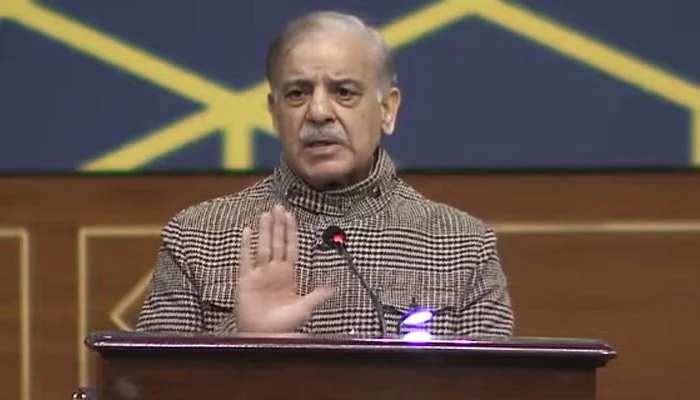
ISLAMABAD: Prime Minister Shehbaz Sharif urged religious scholars on Wednesday to help stamp out militancy and sectarianism, warning that the nation’s progress hinges on fostering unity amid a spike in extremist violence that has plagued the border regions.
Speaking at the National Ulema Convention in the capital, Sharif called on the clerics to take an active role in building harmony across sects, as attacks by groups like the Balochistan Liberation Army and the Tehreek-e-Taliban Pakistan continue to target police and security forces in the northwestern Khyber Pakhtunkhwa and southwestern Balochistan provinces.
“I believe that the most important thing agreed upon in this gathering today should be this that unless we establish an atmosphere of unity and cohesion among the nation in general, this country cannot progress,” Sharif told the assembly. “If this country is to progress, the elimination of terrorism is absolutely essential,” he said. “To protect this country, the political and military leadership together has worked tirelessly.”
Sharif also demanded an end to sectarian divisions, accusing Afghanistan of dispatching militants who kill Pakistani civilians and troops. “Pakistani soldiers were being killed everyday in KP and Balochistan,” he said. The prime minister emphasised that sustainable economic growth is impossible without eradicating terrorism, extremism and sectarianism. He pressed the scholars to discourage divisions and promote brotherhood among all schools of thought, arguing that national cohesion is vital for prosperity and advancement.
On the economic front, Sharif said Pakistan stands on the cusp of rapid expansion after averting default through joint efforts by political and military leaders. He pledged to drive prosperity through austerity and collective action, fulfilling the vision of founder Muhammad Ali Jinnah. “National unity was indispensable for addressing all challenges facing the country and for achieving long-term stability and development,” Sharif said.
The event drew top officials, including Deputy Prime Minister and Foreign Minister Ishaq Dar, Chief of Defense Staff Field Marshal Asim Munir, ministers, parliamentarians and scores of religious leaders from diverse traditions.
Sharif hailed what he described as a divine triumph over India in a recent conflict, crediting the armed forces’ skill and the nation’s prayers. “Allah had blessed Pakistan with a great victory in the Maarka-e-Haq against India,” he said, pointing to the professionalism and bravery of the military. He singled out Munir for leading the effort with “courage and unwavering resolve,” and noted equal contributions from the army, air force and navy. The world, Sharif added, recognises Pakistan’s achievements, with Muslim nations voicing pride in the outcome — though he lamented that “certain elements continued to spread propaganda against the armed forces.”
Turning to ongoing threats, Sharif condemned “khawarij” for assaults on innocents and security personnel. He recounted meetings with families of fallen soldiers, who expressed pride in their loved ones’ sacrifices.
In his own remarks at the convention, Munir hailed a new defence accord with Saudi Arabia as a landmark in their longstanding ties. The Strategic Mutual Defense Agreement, inked in September, bolsters cooperation on intelligence, counterterrorism and regional security, building on years of Pakistani military presence in the kingdom. “The defence agreement [with Saudi Arabia] is historic,” Munir said. He underscored the singular bond between the nations: “Among all Muslim countries, Allah has given Pakistan the honor of helping safeguard the Haramain,” a nod to the holy sites in Mecca and Medina.
Munir cautioned against extremism, asserting that only the state can authorise jihad, a clear rebuke to outfits like the TTP, which invoke religion to justify violence against civilians and forces. “When nations abandon knowledge and the pen, disorder takes hold,” he said, imploring scholars to foster unity and expand societal horizons.
Munir also took aim at India, labeling terrorism as “India’s habit, not Pakistan’s.” The comments follow a May clash along the disputed Kashmir border, where the nuclear powers traded artillery, missiles, drones and jets over four days. India accused Pakistan of orchestrating a militant strike in its administered portion of Kashmir, prompting a missile response. Pakistan denied complicity, demanded a global investigation and claimed to have downed six Indian aircraft before a US-mediated truce. “We do not hide when confronting the enemy,” Munir said. “We challenge openly.”
Copyright © 2021 Independent Pakistan | All rights reserved