By Staff Reporter
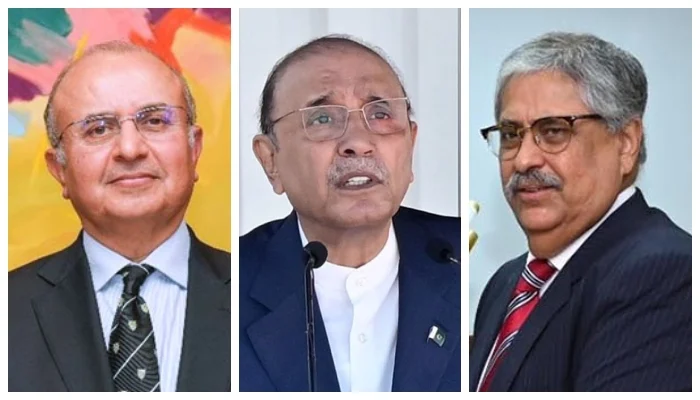
ISLAMABAD: President Asif Ali Zardari on Friday accepted the resignations of two of Pakistan’s most senior Supreme Court judges, Mansoor Ali Shah and Athar Minallah, a day after they stepped down in protest against the 27th Constitutional Amendment, which they described as a mortal blow to judicial independence and to the 1973 Constitution itself.
The acceptances were announced in a brief post on the president’s official X account, bringing to a sudden end the tenures of the court’s second-most-senior puisne judge and one of its most outspoken members.
Justice Shah submitted a 13-page resignation letter in English and Urdu in which he declared the amendment “a grave assault on the Constitution of Pakistan” that “dismantles the Supreme Court of Pakistan, subjugates the judiciary to executive control, and strikes at the very heart of our constitutional democracy.” “By fracturing the unity of the nation’s apex court,” he wrote, “it has crippled judicial independence and integrity, pushing the country back by decades.”
He added that the changes made justice “more distant, more fragile and more vulnerable to power.” Justice Shah said he faced a clear choice: continue on a court whose foundational independence had been undermined or resign in loyalty to the Constitution. “I therefore resign as the senior-most judge of the Supreme Court of Pakistan,” he wrote, “in full awareness of the reasons that compel it and in loyalty to the Constitution that has guided every step of my judicial life.”
Justice Minallah, in a letter heavy with sorrow, wrote that the Constitution he had sworn to defend eleven years earlier was “no more.” “Much as I have tried to convince myself otherwise,” he wrote, “I can think of no greater assault on its memory than to pretend that as new foundations are now laid, they rest upon anything other than its grave.” “What is left of it,” he continued, “is a mere shadow; one that breathes neither its spirit, nor speaks the words of the people to whom it belongs.”
Both judges had, in the days before the amendment became law, written separately to Chief Justice Yahya Afridi requesting an urgent full-court meeting to discuss its implications. The chief justice did convene a full-court meeting on Friday, but according to an official Supreme Court press release, the 27th Amendment was not discussed. Instead, the meeting gave final approval to the new Supreme Court Rules, 2025, thanked the four-judge committee that drafted them, and unanimously conferred the title of senior advocate of the Supreme Court on Muhammad Munir Paracha.
The resignations drew immediate and sharp criticism from the government. Defence Minister Khawaja Asif, speaking on the floor of the National Assembly amid opposition chants of “Who will save Pakistan? Imran Khan, Imran Khan,” accused the two judges of “selective amnesia” and said their consciences had awakened only after “their monopoly was curtailed.”
Asif recited a detailed history of judicial decisions that, he said, had been weaponised years earlier against former Prime Minister Nawaz Sharif, decisions, he noted, in which some of the same judges who now styled themselves guardians of democracy had participated or remained silent. “When these kangaroo courts were being formed,” Asif said, referring to the Panama Papers cases that led to Sharif’s lifetime disqualification from politics, “Nawaz was being victimized, and an agenda was being implemented that he would not remain a leader and would be expelled from politics forever; at that time, no one felt any shame.” “These judges from yesterday were serving in the Supreme Court and high courts back then,” he continued. “Now they’re writing poetry and issuing political statements.”
The 27th Amendment, signed into law by President Zardari on Thursday, establishes a new Federal Constitutional Court composed of superior court judges from all provinces to hear constitutional matters, while leaving other cases to the existing courts. Supporters say it will reduce backlog, improve representation, and streamline governance. Critics, including the resigning judges and most of the country’s legal community, call it a thinly veiled attempt to pack the judiciary with government-friendly appointees and to strip the Supreme Court of its primacy in constitutional bench.
Copyright © 2021 Independent Pakistan | All rights reserved