By Staff Reporter
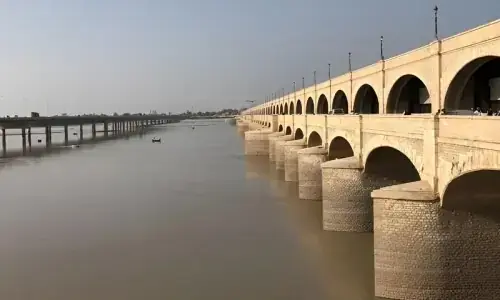
KARACHI: A dispute over conflicting floodwater data has erupted between Punjab and Sindh authorities as swollen eastern rivers roar towards Guddu Barrage, heightening fears in the downstream south of a looming deluge that has already displaced millions by devastating floods, Dawn newspaper reported on Tuesday.
The Chenab, Ravi, and Sutlej rivers, engorged by heavy monsoon rains, have triggered confusion over inflow estimates at Guddu Barrage on the Indus River, with media reports citing wildly varying figures. Last month, the National Disaster Management Authority (NDMA) forecast 1.3 million cusecs would hit Guddu, likely based on over one million cusecs recorded at Qadirabad Barrage on the Chenab on August 27.
Guddu had already endured a medium flood of 390,107 cusecs on July 30, followed by a high flood peaking at 501,299 cusecs on August 23 at noon and 510,798 cusecs the next day. Alarms over a potential “super flood”, high Chenab flows, and multiple embankment breaches in Punjab sparked panic in Sindh, where initial estimates pegged combined Indus inflows at 900,000 cusecs.
Sindh’s chief minister later revised this to a peak of 650,000 to 700,000 cusecs at Guddu. The controversy intensified after Sindh irrigation officials, suspecting discrepancies, sent a delegation to Panjnad on September 7.
Speaking anonymously to Dawn, they blamed Punjab’s data, citing a variance at the Chacharan Bridge gauge in Rahim Yar Khan, which tracks flows to Sindh before Guddu. “We shared this image with our Punjab counterparts, and they then corrected it. This was before Guddu attained its peak on September 14,” one official said, noting a correct reading of 11.3 feet against Punjab’s 11.7 feet.
A federal official monitoring the Indus system outside Sindh concurred. “This can possibly be due to the fact that the rating table that helps understand staged discharges was not calibrated, especially at Panjnad, Islam, and Sidhnai barrages,” he told Dawn.
Rating tables, critical for accurate discharge measurements, were reportedly outdated for flows exceeding 600,000 cusecs – levels unseen in years – potentially leading to errors. “Rating tables were not calibrated to record a correct flow at Panjnad [875,000 cusecs designed discharge], so there remains a possibility that correct discharges weren’t shared,” the official said, attributing it to “administrative inaccuracy” rather than intent.
Another official noted discrepancies between automated and manual readings at Panjnad. “We noted SCADA [Supervisory Control and Data Acquisition] had different readings while flows recorded manually were different. To us, those readings had an upward variation of 60,000-70,000 cusecs. But this was corrected when the barrage passed the peak of 600,000 cusecs on the evening of September 7,” he said.
Punjab officials rejected the claims, insisting their systems were accurate. “Please ask them whether or not they (Sindh government) have communicated this issue in writing to date? Why are they not writing to us if the discharges are more than the inflows?” Khurram Amin, Punjab Irrigation Department’s Additional Secretary (Technical), told Dawn.
Amin said a Sindh delegation, including the minister and secretary, recently inspected Head Panjnad, reviewing both automated and manual systems. He explained that automated readings can vary in real-time during high floods, prompting reliance on manual checks from a “gauge well” on the river’s left bank, where flows are stable. Rejecting Sindh’s allegations, Amin demanded written clarification on the disputed readings. “And even if there is some difference, that should not be more than 4-5,000 cusecs and is very minor… must not be taken as a big issue,” he said.
Faisal Mushtaq, Bahawalpur irrigation region’s Superintending Engineer, also dismissed Sindh’s concerns. “This is very simple to check. Gauge inflow and discharge first at Panjnad, then at Chachran Sharif, and finally at Guddu Barrage,” he told Dawn. “If there is any major difference in the reading at Chachran and Guddu, it means the problem exists on our part. And if there is no difference, it means the problem exists on their part,” he said, adding that Sindh’s team raised no issues during their visit.
Meanwhile, floodwaters from the Sutlej, Ravi, and Chenab continued to inundate Multan, Bahawalpur, Lodhran, Muzaffargarh, and Khanewal districts, displacing thousands and damaging infrastructure. Controlled breaches to divert flows failed, submerging dozens of villages and paralysing roads.
A breach at Noraja Bhutta Bund in Jalalpur Pirwala to ease Sutlej pressure led to a second breach, flooding urban and rural areas. The Sukkur-Multan Motorway has been closed for two days, with the Jalalpur Pirwala Interchange underwater. Villages including Noraja Bhutta, Mouza Kanu, and Rasoolpur, and union councils like Chenab Rasoolpur, are submerged.
Rescue teams recovered a 65-year-old man’s body from Bahadarpur near the interchange. In Alipur tehsil, the Azmatpur dyke continues flooding lowlands despite Panjnad Headworks levels dropping from 700,000 to 296,000 cusecs.
Deputy Commissioner Waseem Hamid Sindhu said the motorway closure from Multan to Uch Sharif was due to the Gillani Road breach. “Urgent efforts were underway to seal the breach,” he added, noting receding levels at Basti Inayatpur and Mauza Dhondhu, with relief camps aiding the displaced.
The Punjab Provincial Disaster Management Authority (PDMA) warned of an 11th monsoon spell starting Tuesday, with increased flows expected in Rawalpindi, Murree, and Galiyat on September 18-19, urging vigilance in urban areas.
PDMA’s Relief Commissioner Nabil Javaid reported 4,700 villages hit: 2,484 by the Chenab, 719 by the Sutlej, and 1,458 by the Ravi. Some 4.72 million people are affected, with 2.564 million evacuated. Over 370 relief camps, 450 medical camps, and 385 veterinary camps operate, with 2.07 million animals relocated.
Dams are near capacity: Mangla at 94 percent, Tarbela at 100 percent, India’s Bhakra at 88 percent, Pong at 94 percent, and Thein at 88 percent.
Copyright © 2021 Independent Pakistan | All rights reserved