By Staff Reporter
MUZAFFARABAD: The prime minister of Azad Jammu and Kashmir placed the blame for more than two dozen deaths squarely on a banned civil rights alliance on Tuesday, as the territory entered the eighth day of a crippling shutdown strike that has left residents of its capital struggling to find food, medicine and fuel.
Speaking in the Legislative Assembly before addressing reporters separately, Faisal Mumtaz Rathore said the Joint Awami Action Committee — proscribed by authorities in recent weeks — bore “primary responsibility” for a crisis that has claimed at least 20 lives since last week, among them four law enforcement officers.
“Those who lost their lives on both sides were our own people,” Rathore said. “However, the primary responsibility for this situation rests with the banned Joint Awami Action Committee, which brought matters to this point.” He added that both the government and the committee’s leadership had understood that continuing on the present course would cost lives, yet the alliance pressed on regardless. “We kept trying to stop it and continued making appeals, but they chose instead to take the situation to its present stage.”
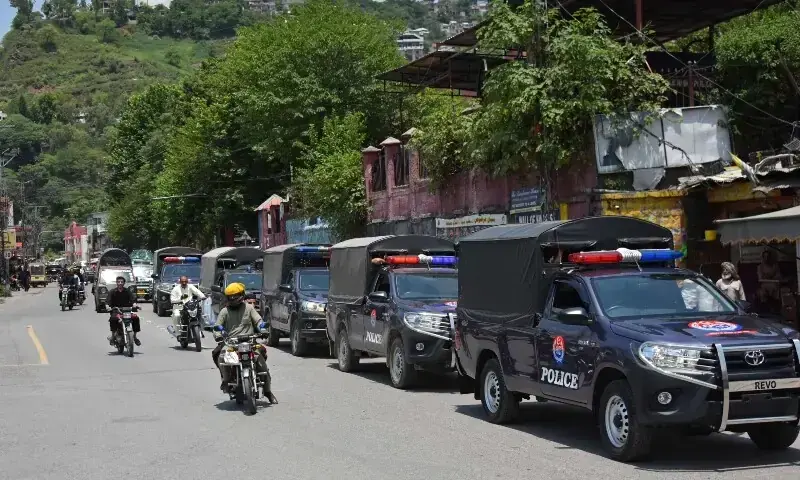
The remarks came as streets in Muzaffarabad, the regional capital, wore a deserted appearance for the eighth consecutive day. The JAAC has led a sustained campaign of sit-in protests and rolling closures against the Azad Kashmir administration this month, triggering repeated clashes with security forces. Its central grievance concerns 12 legislative assembly seats reserved for refugees from Indian-administered Kashmir, which the alliance alleges are exploited by mainstream Pakistani political parties to install compliant governments in the territory.
For ordinary residents, the political deadlock has translated into acute hardship. Muhammad Masqeen, 64, described searching the entire city for medication he had been prescribed at a local hospital. “Even the big store here is closed,” he said. “I do not know what to do. I do not have enough resources to go to another city to get the medicine.” Khawaja Rayaz, 35, said he had run out of fuel and could find no petrol anywhere. “The administration should ensure the supply of petrol for the convenience of the public so that people can maintain mobility and attend to urgent needs during emergencies,” he said. For Sabar Hussain, a 60-year-old labourer, the past week had been one of near-constant roaming through the city’s shuttered streets. “We are not able to find anything to eat except vegetables,” he said. “The children are very upset because there is nothing for them, not even toys.”
By Tuesday evening, some relief was apparent. Medical stores, restaurants, bakeries, and fruit and vegetable stalls had begun reopening across parts of Muzaffarabad. Public transport, however, remained suspended — the administration had ordered petrol pumps to stay shut — and the standoff in the city of Rawalakot continued, though without fresh violence.
Addressing the assembly during a debate on resolutions, Rathore struck a tone that balanced personal contrition with pointed accusation. “For me, the value of human life comes above everything else,” he said. “I am the prime minister of the state, and I accept my responsibility. We must act with a sense of responsibility to extinguish this fire and safeguard the identity of Azad Kashmir.” He also spoke of the damage to the relationship between Pakistan and the territory. “We need to think about what has happened that has created hatred in people’s hearts,” he said.
The prime minister defended his seven-month administration’s record at some length, insisting it had fulfilled every clause of an earlier agreement with the JAAC that lay within the AJK government’s powers, and had secured resolution of most issues requiring federal action — particularly those tied to the budget. He said his government had addressed grievances affecting media workers, reduced property tax, provided Rs10 billion to help the Bank of AJK achieve scheduled-bank status, settled the division of the educational board, and paid compensation to 45 individuals affected by previous unrest. Of 37 demands, he said, all but one had been met — a remaining constitutional question currently before a committee — yet, he argued, an impression was being deliberately fostered that the agreement had been dishonoured entirely.
On the reserved seats — the issue at the heart of the current protests — Rathore said the original agreement with the JAAC had never included their abolition, only a commitment to address the matter through a dedicated committee. He said he had personally visited JAAC leaders to invite them to an all-parties conference, but that they declined to attend. “If they enjoy public support, they should become part of the system and bring reforms from within,” he said.
The prime minister also moved to quash speculation, evidently circulating widely in the territory, that subsidised flour and electricity concessions won after last year’s negotiations would be quietly withdrawn if the movement collapsed. “It is being portrayed that if the movement fails, the flour and electricity concessions will be taken back,” he said. “This is completely incorrect. These concessions will not be withdrawn at any cost.”
Among the more immediate political concerns is the fate of legislative assembly elections scheduled for 27 July. Rathore said the atmosphere had become so volatile that candidates were unable to campaign. “What could be more unfortunate than the fact that elections are due on 27 July and no candidate is able to campaign?” he said. “An environment has emerged in which electioneering has become virtually impossible.”
Copyright © 2021 Independent Pakistan | All rights reserved