By Staff Reporter
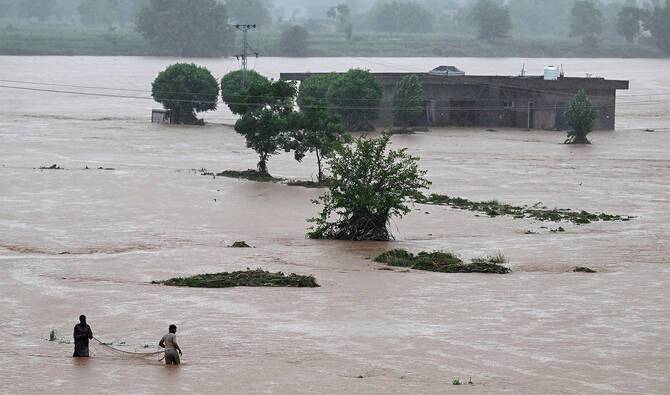
ISLAMABAD: Floodwaters from the Indus and Chenab rivers have submerged over a dozen villages across several districts in Pakistan’s Punjab province, forcing thousands of residents to evacuate to safer ground.
As rescue operations continue, authorities are bracing for more potential flooding and landslides with a new monsoon spell expected to begin today. In the southern districts of Punjab, including Rajanpur, Taunsa, and Dera Ghazi Khan, the raging waters of the Indus River have devastated agricultural lands and residential areas. Standing crops were washed away, and numerous houses were destroyed or submerged. District administrations issued emergency alerts as the floods swept through villages, leaving communities reeling.
In Layyah and Taunsa, panic spread after a crack emerged in a protective embankment built by the National Highway Authority to safeguard the Layyah-Taunsa bridge. Though the bridge itself remained intact, the breach unleashed floodwaters that submerged several villages, including Basti Kumharan, Basti Mangotha, and Basti Sohbewala.
Hundreds of residents from Bait Ashraf and Jarh Leghari in Taunsa were forced to flee to higher ground as their homes and roads disappeared under water. Rescue and relief operations are underway, with the government providing tents, food packs, and setting up kitchens for the displaced.
In central Punjab, the Chenab River has wreaked havoc in Jhang district, where more than ten villages have been inundated. The floods have destroyed crops, homes, and key road networks, isolating communities and complicating relief efforts.
In Hafizabad, rapid erosion along the Chenab’s banks has washed away hundreds of acres of farmland. The district, along with neighboring Sukheke, is also grappling with stagnant rainwater that has lingered for over ten days, deepening the misery of residents.
The Pakistan Meteorological Department (PMD) has issued alerts for low to medium-level flows in the Jhelum and Chenab rivers due to anticipated rainfall from July 29 to 31. Flash flooding is expected in the tributaries of the River Kabul and the hill torrents of Dera Ghazi Khan during the same period.
The PMD also forecasts a medium-level flood at Taunsa and Guddu in the Indus River, while Tarbela, Kalabagh, Chashma, and Sukkur are already experiencing low floods. The National Disaster Management Authority (NDMA) has warned of widespread rainfall across Punjab, Khyber Pakhtunkhwa, Gilgit-Baltistan, and Azad Jammu & Kashmir, raising the risks of further flooding, landslides, and urban flooding in vulnerable districts.
The NDMA has instructed all relevant departments to remain on high alert, pre-deploy flood response teams and equipment, and ensure the immediate clearance of drainage systems.
In Punjab, significant rainfall is anticipated in Sargodha, Hafizabad, Gujranwala, Gujrat, Sialkot, Faisalabad, Lahore, Narowal, and adjoining areas. Southern districts like Dera Ghazi Khan, Rajanpur, and Rahim Yar Khan may see moderate rainfall, potentially reactivating torrents and nullahs originating from the Pir Panjal range.
A Monday report by the Punjab Disaster Management Authority detailed the staggering human and material cost of this year’s monsoon rains: 152 people killed and 539 injured in incidents ranging from lightning strikes and building collapses to drownings and electrocutions. Additionally, 210 houses have been affected, and 121 livestock have been lost.
In Khyber Pakhtunkhwa, moderate rainfall and localized thunderstorms are expected to affect central and lower districts, including Kohistan, Swat, Malakand, Dir, and Buner. The NDMA has cautioned that tributaries like the River Swat, Panjkora, Bara, and Kalpani Nullah may swell, contributing to rising flows in the River Kabul at Nowshera. Urban flooding is also anticipated in cities such as Peshawar, Mardan, Nowshera, and Abbottabad.
In Chitral Valley, a combination of glacial melting and rainfall could surge the River Chitral and its tributaries in areas like Booni and Reshun. In Gilgit-Baltistan and Azad Jammu & Kashmir, rainfall is forecasted for Gilgit, Skardu, Hunza, Shigar, Muzaffarabad, Neelum Valley, and Bagh, prompting flood alerts from the authorities.
Across the affected regions, rescue and relief operations are in full swing. In Gilgit-Baltistan, the Ghanche district administration has set up a tent village with running water and electricity for displaced villagers from Kundus valley and Haldi. Machinery has been mobilized to clear roads to the Kundus and Saltoro valleys, while a mobile veterinary dispensary tends to livestock at the flood site.
The Baltistan Division commissioner has arranged 4,500 feet of pipe to permanently restore drinking water to Kundus residents, with work expected to finish in two to three days. GB government spokesperson Faizullah Faraq reported that the Babusar-Naran Highway, partially reopened Monday for one-way traffic, remains a lifeline as search operations continue for those swept away by torrents.
“Several families…have contacted the government about the missing people and appealed for help in their search,” he said.
A TV anchor reported among the missing has not been found, though her wrecked vehicle was recovered. GB Disaster Management Authority Director General Zakir Hussain emphasized the round-the-clock efforts of relief teams. “Machinery had been mobilized to restore roads, irrigation, and water channels,” he said, underscoring the commitment to supporting affected communities.
Copyright © 2021 Independent Pakistan | All rights reserved