By Staff Reporter
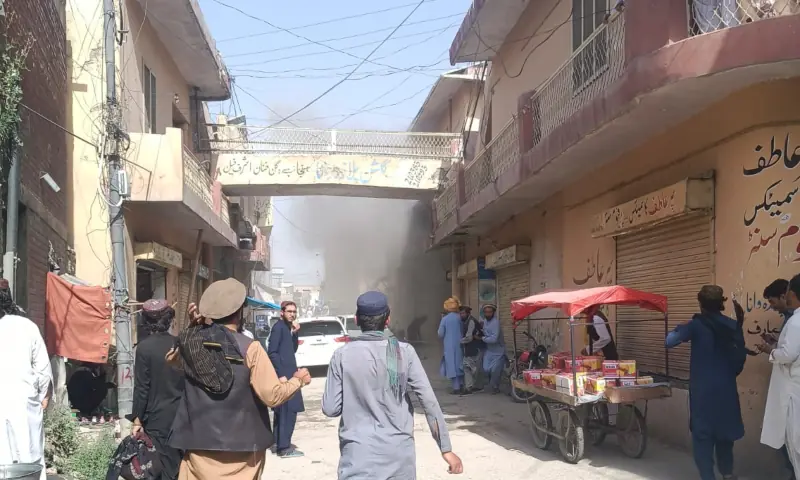
WANA: A powerful improvised explosive device ripped through the crowded Rustam Bazaar in this town in Pakistan’s northwestern Khyber Pakhtunkhwa province on Monday morning, killing three people — including a prominent tribal elder who had long worked to mediate local disputes — and wounding four others, officials said.
The blast occurred near Gulshan Plaza as a vehicle carrying Malik Tariq Wazir, chief of the Ahmadzai Wazir tribe and a respected figure in Lower South Waziristan, passed through the market, District Police Officer Muhammad Tahir Shah told reporters. Unidentified militants had planted the device overnight, police said, and it was detonated as the vehicle approached.
The three men died at the scene. Police identified them as Malik Tariq Wazir, Sarfraz Khan and Abdul Jabbar. The injured were identified as Saeed Anwar, Umar, Rashid Khan and Sabir. Rescue workers and residents rushed the wounded to the District Headquarters Hospital in Wana, where medical superintendent Dr. Jan Mohammad said two were in critical condition and receiving emergency care.
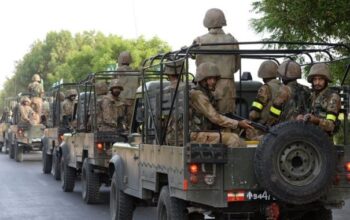
Within minutes, police cordoned off the area and launched a search operation. Heavy contingents of security forces arrived at the site as traders and shopkeepers shuttered their businesses, sending waves of panic through the market. Local residents described the force of the explosion shaking the entire locality. No group immediately claimed responsibility. Pakistani officials have long linked such attacks in the region to the Tehreek-e-Taliban Pakistan, the militant network also known as the Pakistani Taliban, which has targeted both security forces and tribal leaders in recent years.
Malik Tariq Wazir had been a leading voice for peace in the district, participating in traditional jirgas — community councils — aimed at resolving disputes and calming tensions. Residents described him as a bridge between the local population and the government. “He was a key figure advocating peace and tranquility in the region,” said Noor Jamal Wazir, a vegetable trader who witnessed the aftermath.
The killing fit a grim pattern. Security analysts and local officials have noted that tribal elders have increasingly become soft targets for militants seeking to undermine traditional authority structures in the former Federally Administered Tribal Areas, now part of Khyber Pakhtunkhwa. Mansur Khan Mahsud, executive director of the Islamabad-based FATA Research Center, has estimated that roughly 2,500 to 3,000 tribal elders have been killed since 2004. “For years now, tribal elders remain a soft target for militants who are decimating them systematically because tribal chiefs play the role of a bridge between the government and people,” Mahsud said.
The attack came barely two weeks after three children were killed and several others wounded in two separate incidents in South Waziristan. On May 1, another tribal elder, Malik Saifullah Khan Dawar, was shot dead outside his home in neighbouring North Waziristan after he reportedly confronted suspected militants who had occupied a local mosque. In late April, unidentified gunmen killed Malik Fazal Wahid — who had survived previous assassination attempts — in Bajaur district.
Copyright © 2021 Independent Pakistan | All rights reserved