By Staff Reporter
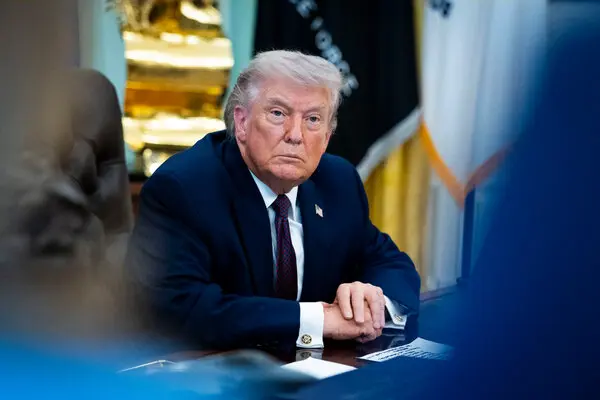
ISLAMABAD: President Donald Trump will receive a classified briefing on Thursday on US military options for the Strait of Hormuz and potential actions inside Iran, as the administration grapples with a punishing naval blockade that has driven energy prices to their highest levels in years and shown no sign of breaking an impasse with Tehran.
Adm. Brad Cooper, commander of US Central Command, is scheduled to update Trump and his senior national security team at the White House on the ongoing enforcement of the American blockade of Iranian ports, according to a US media. The session comes after an Axios report this week detailed contingency plans prepared by Central Command, including a series of “short and powerful” strikes aimed at compelling Iran to return to negotiations over the vital waterway.
The briefing arrives at a moment of acute economic strain. The international benchmark Brent crude surged overnight to more than $126 a barrel — its highest level since Russia’s 2022 invasion of Ukraine — before easing to about $114 early on Thursday. In the United States, average gasoline prices climbed to $4.30 a gallon, the highest in nearly four years. International Energy Agency Director Fatih Birol described the situation bluntly at a conference in Paris: “Our world is facing a major economic and energy challenge.”
The standoff traces back to late February, when the United States and Israel launched a joint military campaign against Iran that included strikes killing then-Supreme Leader Ayatollah Ali Khamenei. His son, Mojtaba Khamenei, was appointed supreme leader on March 9 but has not appeared publicly since, reportedly recovering from injuries sustained in the same attack. Traffic through the Strait of Hormuz — through which about one-fifth of the world’s oil supply normally passes — has been at a virtual standstill since Iran responded by attacking commercial shipping. The United States imposed its own blockade of Iranian ports in retaliation, a measure Trump has said will remain in place until Tehran agrees to a nuclear deal.
In a written statement read on Thursday on state television to mark Persian Gulf Day, the new supreme leader struck a defiant tone, framing the moment as a turning point after what he called “the United States’ disgraceful defeat in its plans.” Two months after “the largest military deployment and aggression by the world’s bullies in the region,” Khamenei said, “a new chapter is unfolding for the Persian Gulf and the Strait of Hormuz.” He vowed that Iran would protect its “nuclear and missile capabilities” as national assets and hailed a “new legal framework and management” of the strait that would bring “comfort and progress” to the nations of the region.
“Foreigners who maliciously covet it from thousands of kilometres away have no place there except at the bottom of its waters,” the statement said. Khamenei also praised Iranians for treating their “national capacities — identity, spiritual, human, scientific, industrial, and advanced technologies from nano and bio to nuclear and missile — as their national capital.”
President Masoud Pezeshkian echoed the resistance in his own Persian Gulf Day remarks, declaring the US blockade “doomed to fail” and arguing that any attempt to impose maritime restrictions violates international law and threatens regional stability. A senior Revolutionary Guard commander, Seyed Majid Mousavi, warned on social media of “prolonged and wide-ranging painful strikes” in retaliation if the United States resumes military operations, adding, “We have seen the fate of your fragile bases in the region; we will also see your warships.”
The White House has shown little flexibility. Trump told Axios on Wednesday that the blockade was “somewhat more effective than the bombing” and would continue until a nuclear agreement is reached. He has dismissed an Iranian proposal to reopen the strait without first resolving the nuclear impasse. In a Truth Social post, the president wrote: “Iran can’t get their act together. They don’t know how to sign a nonnuclear deal. They better get smart soon!”
Administration officials have explored multiple paths forward. Trump and his national security team met this week with energy industry executives to discuss sustaining the blockade “for months if needed,” a White House official told NBC News. Separately, officials presented the president with options for adjusting the US military posture in the strait — whether to increase or decrease forces and whether to conduct more aggressive operations.
On the ground, the blockade has had a measurable effect. In a statement Wednesday, Cooper said U.S. forces had redirected 42 vessels attempting to violate it. Forty-one tankers carrying 69 million barrels of Iranian oil — valued at more than $6 billion — remain unable to sell their cargoes. “The blockade is highly effective and US forces remain fully committed to total enforcement,” he wrote on X.
Iran has shown scant willingness to yield. Its currency has hit record lows amid rising prices and job losses, yet officials continue to project confidence. Navy Commander Shahram Irani signaled that newly developed naval weaponry would be deployed “in the very near future.” Maj. Gen. Mohsen Rezaee, a military adviser to the supreme leader, wrote on X that “the siege scenario will fail” and predicted that history would record Iran sinking “the superpower of America in the Persian Gulf and the Sea of Oman.”
Gulf Arab states, particularly the United Arab Emirates, have condemned Iran’s effective control of the strait as piracy. The United States has begun exploring ways to coordinate post-conflict oversight of the waterway, including reviving and expanding the International Maritime Security Construct, a 12-nation naval partnership originally formed to counter Iranian threats to shipping.
Copyright © 2021 Independent Pakistan | All rights reserved