By Staff Reporter
The collapse of talks in Islamabad on Sunday was not a surprise. What followed was. Within hours of Vice President JD Vance boarding his plane home from Pakistan — after the highest-level direct negotiations between the United States and Iran since the 1979 revolution — President Donald Trump announced that the United States Navy would begin blockading Iranian ports and enforcing restrictions on the Strait of Hormuz. The fragile two-week ceasefire that had paused a war begun by American and Israeli strikes in late February now hangs by a thread. Oil prices leapt more than 8 percent on Monday, with both Brent and West Texas Intermediate crossing the $100-a-barrel threshold. Tankers turned back. Markets priced in the possibility of a deeper energy shock than anything the world has seen since the 1970s. This is not the way great-power crises are supposed to end. It is the way they spiral.
The Islamabad talks were never going to be easy. Mediated by Pakistan, they brought together a high-level American delegation led by Vance, special envoy Steve Witkoff and Jared Kushner with an Iranian team headed by parliamentary speaker Mohammad Bagher Ghalibaf. Twenty-one hours of discussion produced no agreement on the two central issues: Iran’s claimed right to enrich uranium and the question of who would effectively control traffic through the Strait of Hormuz, the narrow waterway through which roughly one-fifth of the world’s traded oil once flowed. The Americans presented what Vance called Washington’s “final and best offer.” Tehran countered that the United States had moved the goalposts and shown “maximalism.” Both sides left blaming the other. Neither side has yet declared the ceasefire over. That narrow opening is where hope, however faint, still resides.
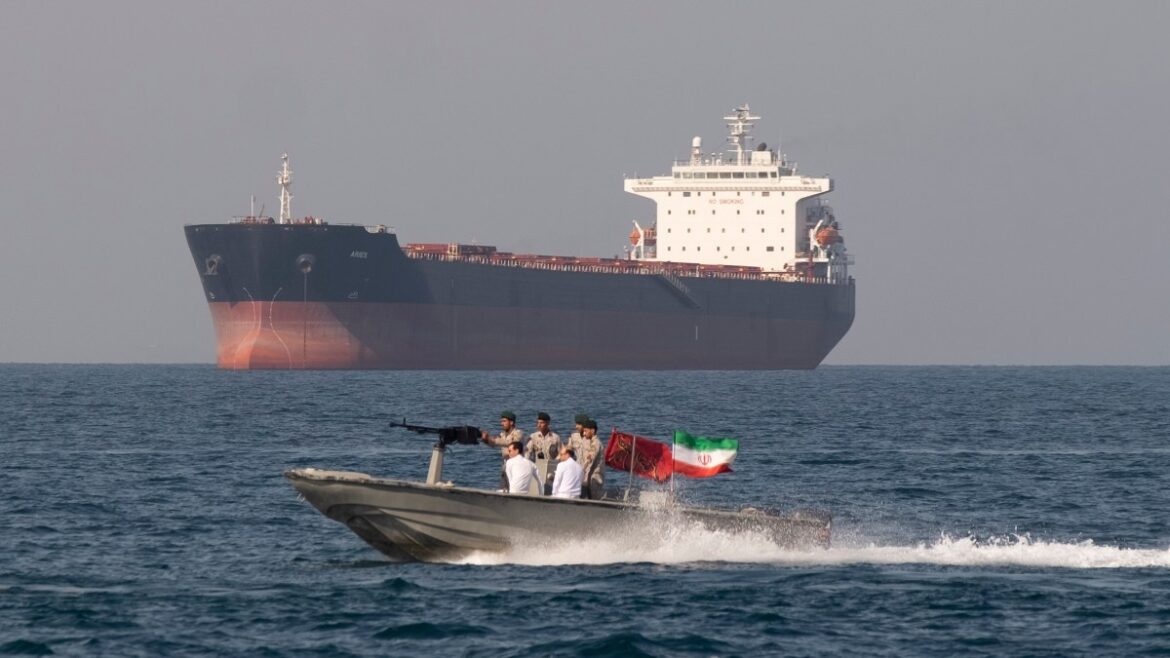
The Trump administration’s immediate pivot to a naval blockade is being sold as leverage — a way to force Iran back to the table on American terms. US Central Command was careful to say the operation, beginning at 10 a.m. Eastern time Monday, would target vessels entering or leaving Iranian ports while preserving “freedom of navigation” for ships bound to or from non-Iranian ports. In practice, the distinction is razor thin. Iran has already been restricting traffic through the strait; the Revolutionary Guards warned that any military vessels approaching would be met with a “deadly vortex.” Shipping data showed tankers altering course even before the blockade formally began. The economic signal is unmistakable: a further squeeze on global oil supply at a moment when the Persian Gulf has already been reduced to a trickle.
This is not mere posturing. It is a high-stakes gamble with the global economy. The disruption that began in late February has already been described by the head of the International Energy Agency as the worst energy shock in history — worse, in its speed and scale, than the 1970s oil crises or the early months of the war in Ukraine. Fertiliser and helium prices are climbing. Inflation forecasts are being revised upward. Emerging markets that depend on Gulf energy and commodities face the sharpest pain. And the blockade risks drawing in third parties. China, Iran’s largest oil customer, has continued to receive shipments; a full cutoff could quickly escalate tensions between Washington and Beijing. India and Pakistan, which had quietly negotiated safe-passage arrangements, now find themselves caught in the crossfire.
The international reaction has been swift and almost uniformly cautious. Turkey’s foreign minister, Hakan Fidan, who has been in contact with both sides, insisted that Iran and the United States remain “sincere” about a ceasefire even as he warned that Israeli actions in Lebanon could derail the process. Beijing dismissed reports of Chinese weapons supplies to Iran as “baseless smears.” The European Union praised Pakistan’s mediation and said diplomacy was “essential.” Russia’s Vladimir Putin told his Iranian counterpart he was ready to help mediate. Britain’s prime minister, Keir Starmer, made clear that London would not join any blockade. Japan and Australia urged both sides to return to negotiations. Pakistan’s government, which hosted the talks and has invested heavily in its mediator role, said it would continue to facilitate dialogue.
These voices matter because the war has never been purely bilateral. It began with American and Israeli strikes on Iran; Iran retaliated against Gulf states and Israeli cities. Hezbollah’s rocket fire into northern Israel and Israel’s expanded campaign in southern Lebanon — which Lebanese officials and others have likened to the destruction seen in Gaza — have kept the region on a knife-edge. Israeli Prime Minister Benjamin Netanyahu told troops last week that the fight there was “far from over.” Lebanese Prime Minister Nawaf Salam is scrambling to secure an Israeli withdrawal even as separate Israeli-Lebanese talks are scheduled in Washington. The ceasefire in the broader conflict cannot hold if the Lebanese front keeps burning.
The deeper tragedy is how familiar this impasse feels. The nuclear question at the heart of the dispute is the same one that the 2015 Iran nuclear deal once constrained — until the Trump administration withdrew from it in 2018. Iran insists it seeks only a civilian program and has no bomb. The United States demands it abandon any enrichment capacity that could be turned toward weapons. Trust is nonexistent. Tehran wants sanctions lifted, assets unfrozen and reparations; Washington wants verifiable capitulation on the nuclear front and free passage through Hormuz without Iranian transit fees or interference. The gap was always going to be hard to bridge in one weekend. But the alternative to bridging it is escalation — naval clashes, renewed airstrikes, proxy warfare — at a moment when the global economy can least afford it.
Some analysts, including Trita Parsi of the Quincy Institute, argue that the blockade should still be understood as a negotiating tactic rather than a declaration of renewed war. Neither side has formally abandoned the ceasefire or ruled out further talks. The United States has carved out exceptions for non-Iranian traffic. Iran has not yet responded with force. There is, in this reading, still space for de-escalation. But the risks of miscalculation are enormous. International law offers no clear cover for the American action; only Iran and Oman border the strait, and even they are barred from suspending transit passage. Shipowners already face sanctions exposure. A single incident — an Iranian patrol boat, a mine, a misread radar signal — could turn a blockade into open combat. The summer heat in the Gulf will soon make large-scale ground operations difficult, but naval and air confrontation requires no such pause. And once the logic of escalation takes hold, it is notoriously difficult to reverse.
There is still a path forward, however narrow. Pakistan has earned quiet respect for its mediation; its foreign minister, Ishaq Dar, has pledged to keep the channels open. Turkey, with its contacts on both sides, could play a supporting role. Russia and China have their own interests in stability; so does Europe. The United States and Iran do not have to love each other to recognise that continued war serves neither. Tehran has shown it can absorb pressure without collapsing. Washington has shown it can inflict pain without achieving its goals. The question now is whether either side possesses the imagination to step back from the brink.
President Trump has said he does not care whether the Iranians return to the table. That is the rhetoric of a man who believes strength is measured in threats. History suggests otherwise. Winston Churchill was right: jaw-jaw is better than war-war. The Strait of Hormuz is not a prize to be seized; it is a global artery whose closure injures everyone. The Lebanese border is not a sideshow; it is part of the same regional fire. And the nuclear issue, however intractable, cannot be solved by blockade alone. The ceasefire has a little more than a week left before it formally expires. The talks have not ended; they have simply paused. The world is watching to see whether Washington and Tehran choose to widen the pause into a genuine diplomatic opening — or whether they let the logic of the blockade turn a manageable crisis into a catastrophe. There are no winners in the second scenario. Only losers — starting with the millions whose lives and livelihoods depend on oil that no longer flows, on ports that no longer open, and on a peace that, for now, still remains possible.
Copyright © 2021 Independent Pakistan | All rights reserved