By Staff Reporter
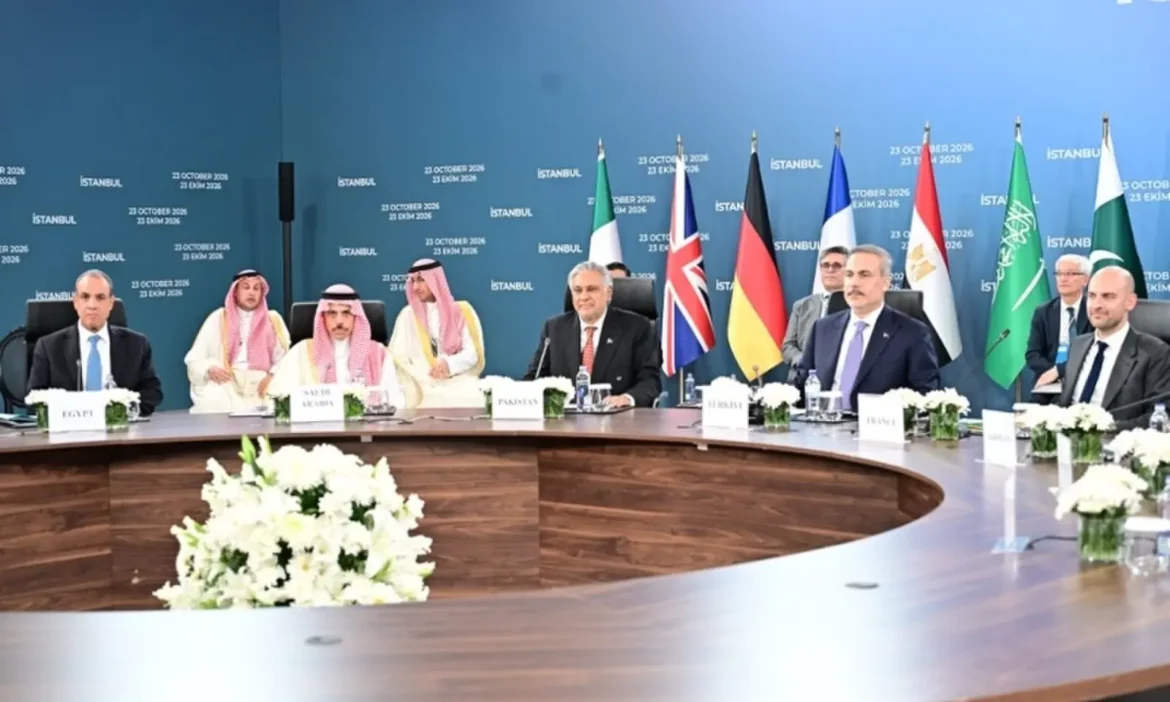
ISLAMABAD: Foreign ministers from Pakistan, Turkey, Saudi Arabia and Egypt held their first joint talks with counterparts from Britain, France, Germany and Italy on Friday, seeking a diplomatic route out of the Gulf crisis created by the US-Israeli war on Iran.
The meeting was convened at Turkey’s initiative and hosted by foreign minister Hakan Fidan. It was the first time the R4 group and the European E3 had met in a combined format. The talks took place at a hotel overlooking the Bosphorus. Italy’s foreign minister, Antonio Tajani, also attended, alongside Britain’s Foreign Secretary Ed Miliband, France’s Jean-Noel Barrot and Germany’s Johann Wadephul.
A Turkish foreign ministry official said the agenda took in the Palestinians, developments in Yemen, the Strait of Hormuz and ways to end the war in Ukraine.
Miliband’s office said the discussions would centre on Hormuz and the situation in Saudi Arabia. A British statement said that, despite progress by the US and regional partners, passage through the strait remained under threat, with traffic sharply down on pre-war levels. The Foreign Secretary was to argue for a diplomatic solution that restores full navigational rights and freedoms. He was also to warn that Iranian tactics were being replicated across the region, with attacks on Saudi Arabia adding pressure on chokepoints such as Bab el-Mandeb and the Suez Canal.
Britain said this week it would commit RAF Typhoons to help defend Saudi airspace against Houthi attacks.
The pressure on Riyadh has grown sharply. Intensifying Houthi attacks have forced Saudi Arabia to close its main airport and postpone a major investment conference, while a maritime blockade threatens oil exports from the world’s largest crude exporter. On Wednesday, Egyptian president Abdel Fattah al-Sisi said Egypt would defend Saudi territory but would not take part in any attack on Yemen.
France described the talks as a first in this format, held “against a backdrop of extreme instability and uncertainty”. Its foreign ministry said the aim was to strengthen coordination between Europeans and Middle Eastern states over crises that none of them had chosen.
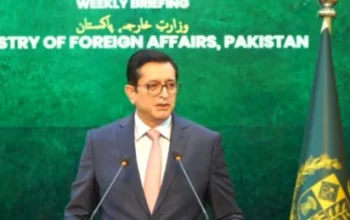
Pakistan’s Foreign Office said the ministers exchanged views on developments in the Gulf, their social and economic impact, and the need for diplomatic engagement. Ishaq Dar, Pakistan’s deputy prime minister and foreign minister, briefed the meeting on Islamabad’s mediating role in easing tensions and preventing a resumption of hostilities. “All ministers agreed for continued engagement in this format,” the Foreign Office said.
The R4 ministers also held a separate session, their sixth meeting. The group emerged in March and has focused on regional security and mediation between the United States and Iran. Dar sat with Fidan, Egyptian foreign minister Badr Abdelatty and Saudi foreign minister Prince Faisal bin Farhan. They reviewed events since their last meeting, in New York in September, expressed solidarity with Saudi Arabia and reaffirmed support for its sovereignty and territorial integrity. They also condemned the Houthi attacks on the kingdom.
Turkish officials had said Fidan would use the talks to restate Ankara’s backing for Saudi security and press for permanent freedom of navigation in Hormuz and Bab el-Mandeb. He was also expected to urge greater international pressure on Israel over settlement expansion.
On the sidelines, Dar met Fidan, Abdelatty, Prince Faisal and Wadephul. With the Turkish minister, he condemned the Houthi attacks and reaffirmed commitment to the Makkah Defence Agreement, signed by Pakistan, Turkey and Saudi Arabia on 7 August, which lets signatories treat an attack on one as an attack on all.
The Saudi meeting touched on that pact and on a separate bilateral defence agreement between Islamabad and Riyadh. With Abdelatty, he discussed trade, agriculture, pharmaceuticals, renewable energy, connectivity and defence. Dar told Wadephul that Pakistan wanted closer ties with Germany, and welcomed the engagement of Germany, France, Italy and the UK with the R4 framework.
The diplomacy is under way while the fighting shows little sign of ending. US media have reported a Trump envoy saying the war could last another year, with oil prices still rising.
Copyright © 2021 Independent Pakistan | All rights reserved