By Staff Reporter
GWADAR: Security forces killed 10 militants, including a woman, in Gwadar after attacks on the port city and a nearby border crossing with Iran, the military said on Friday.
The Inter-Services Public Relations (ISPR), the army’s media wing, said the attacks took place on Thursday near the Gabd crossing and in Gwadar city, in the south-western province of Balochistan. One civilian was killed and several vehicles were damaged. No members of the security forces were killed or injured, it said.
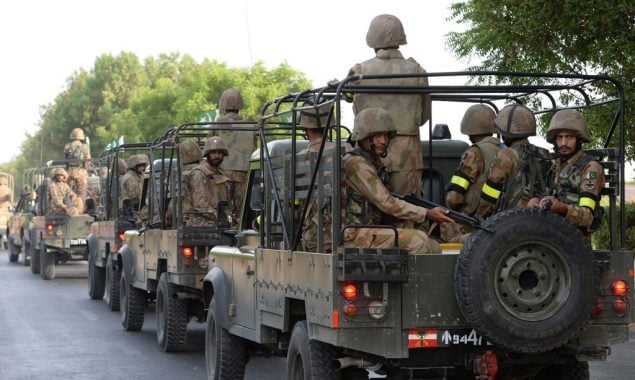
Troops launched clearance operations in and around the city, according to the ISPR. In the exchanges of fire that followed, it said, ten attackers, including one woman, “were sent to hell”. The military said order had been restored.
The ISPR attributed the attacks to “Fitna al-Hindustan”, the label the Pakistani state applies to Baloch militant groups to underline India’s role in fuelling violence across the country. It described the attackers as Indian-sponsored.
The military said a Baloch woman had been coerced into the attack, calling it “a crime not only against the state but against the hurmat of Baloch women”, using an Urdu word for sanctity or respect. It accused militants of exploiting women as propaganda to inflame public sentiment, and said such tactics ran counter to Baloch and Islamic traditions. It did not identify the woman or say how she took part.
Field Marshal Asim Munir, the Chief of Defence Forces and army chief, said earlier on Friday that the armed forces would pursue Indian-sponsored groups “to the fullest” and “hit them hard wherever they are”.
The Gabd crossing has been at the centre of a diplomatic dispute this week. Pakistan suspended trade with Iran through the Gabd-Rimdan and Taftan crossings at the weekend. Shahid Rind, an adviser to the Balochistan chief minister, said the closure was meant to address security concerns, prevent smuggling and make border management more effective. Field Marshal Munir, visiting Tehran, told Iranian officials on Tuesday that the crossings had reopened and that the problems had been “temporary and technical”. Fada-Hossein Maleki, an Iranian MP who heads the Iran-Pakistan parliamentary friendship group, then warned that Iran could close its own border if Islamabad kept blocking trucks. Pakistan has been mediating between Tehran and Washington.
Other violence has hit Gwadar district in recent days. Radio Pakistan reported that security forces killed three militants while foiling an attack on an unoccupied construction company camp in the district the day before the ISPR’s statement. Security sources said other suspects had been surrounded, and a separate operation was targeting militants hiding in a hotel near the Gwadar Highway. The district’s general officer commanding was leading it, the report said. The results of that operation were not reported.
Earlier this week the ISPR said an army major and four militants were killed in intelligence-based operations in Balochistan. On 12 October the Baloch Liberation Army claimed that its maritime wing had killed 13 Pakistani personnel in an attack on two Coast Guard boats off Jiwani, also in Gwadar district. That claim has not been independently verified.
Gwadar, on the Arabian Sea, is a strategically important port and a centrepiece of the China-Pakistan Economic Corridor, a multibillion-dollar infrastructure and energy programme. The port and related projects have been attacked repeatedly by Baloch separatist militants.
Balochistan is Pakistan’s largest province by area but its least populated. It is rich in minerals and other natural resources yet remains one of the country’s poorest regions. Separatist groups accuse the federal government of exploiting those resources without benefiting local communities. Islamabad denies this.
Militant attacks in the province rose 7 percent, from 83 in July to 89 in August, according to the Pakistan Institute for Conflict and Security Studies, which named Balochistan the country’s worst-affected province. Across Pakistan, attacks have risen every year since 2022, according to the monitoring group Armed Conflict Location & Event Data (ACLED). It recorded 2,425 in 2025, up from 658 in 2022, while attacks by the Pakistani Taliban (TTP) rose more than sevenfold to 838 from 118. Khyber Pakhtunkhwa has borne the brunt, but Balochistan has also been repeatedly targeted.
In July, at least 30 people, including 27 police officers, were killed when militants ambushed police in the Kach Mangi Phase III area of Ziarat, setting off gun battles that lasted for hours. The attackers also abducted several civilians and police personnel. The army, Frontier Corps and Balochistan Police launched a joint operation that is still under way. Last week, armed men abducted 20 trainee police officers travelling from Kalat. They came from Kharan, Nushki, Chagai and Washuk districts.
The ISPR said the counter-terrorism campaign running under the “Azm-e-Istehkam” vision and approved by the Federal Apex Committee on the National Action Plan would continue at full pace.
Copyright © 2021 Independent Pakistan | All rights reserved