By Staff Reporter
ISLAMABAD: For the seventh straight night, American warplanes and warships struck targets across Iran on Saturday, and Iran struck back at US allies across the Persian Gulf, as the region’s fragile ceasefire dissolved further into what officials on both sides now describe as a return to open war.
Iran’s Health Ministry said on Saturday that at least 50 people have been killed and more than 500 wounded in US strikes since July 6, an update from the 46 dead and 400 wounded the ministry had reported just a day earlier. The US military’s Central Command said its overnight raids targeted surveillance sites, weapons depots, and maritime facilities, part of a campaign that has hit bridges, power plants, and — for the first time acknowledged by Tehran — a desalination facility that left 10,000 people in 20 villages without drinking water.
The US suffered its own losses. Central Command said two US service members were killed in Jordan as “partner forces defended against Iranian ballistic missile and drone attacks.” Another service member is “missing in action,” the first American military deaths in the conflict since March.
The escalation came a day after Iran’s Supreme Leader, Mojtaba Khamenei, broke a week of public silence with a written statement accusing the United States of repeated bad faith. “At the same time as this great public display, the Great Satan’s repeated violations of the memorandum signed between the presidents of Iran and the United States once again proved to everyone how worthless and unreliable the signature of the U.S. president is. Bullying, hegemonic ambition, and brutality are inseparable elements of the American way,” Khamenei said, in remarks read aloud on Iranian state television. He warned that Iran and its regional allies had “unforgettable lessons” in store if the United States did not stop.
Khamenei has not appeared in public since the war began in late February, when US and Israeli strikes killed his father, longtime Supreme Leader Ali Khamenei, and other senior officials — an event that thrust his son into the role. The Supreme Leader has not appeared in public since the war began.
The exchange of fire marks the formal unraveling of an agreement that just five weeks ago had been billed by the Trump administration as a breakthrough. The interim peace framework, known as the Islamabad memorandum of understanding, was signed in mid-June after Pakistani and Qatari mediators helped broker talks between Washington and Tehran. It called for a 60-day window to negotiate a permanent end to the war, including who controls shipping through the Strait of Hormuz, the narrow waterway through which roughly a fifth of the world’s oil and gas normally passes.
That question proved unresolvable. Iran has insisted it has the right to regulate — and charge for — passage through the strait. The United States and much of the world have long treated it as an international waterway open to all. When Iranian forces began targeting commercial tankers to enforce their own transit rules, President Trump declared the agreement dead. “As far as I’m concerned, it’s over,” he said, referring to the ceasefire agreement outlined in the Islamabad Memorandum of Understanding signed by Iran and the US last month. He reimposed a naval blockade on Iranian ports and revoked a sanctions waiver that had allowed Iran to export oil.
Iran’s Deputy Foreign Minister, Kazem Gharibabadi, said on Saturday that Tehran considers itself released from its own obligations under the deal as a result, telling state media the US had violated and suspended its own commitments and that Iran had done the same in response, saying the country was now focused on defending itself. Iran’s Foreign Ministry spokesman, Esmaeil Baghaei, echoed the position on Saturday, saying Iran had not sought war and was defending itself against what he called an imposed conflict.
Strikes spread across the Gulf
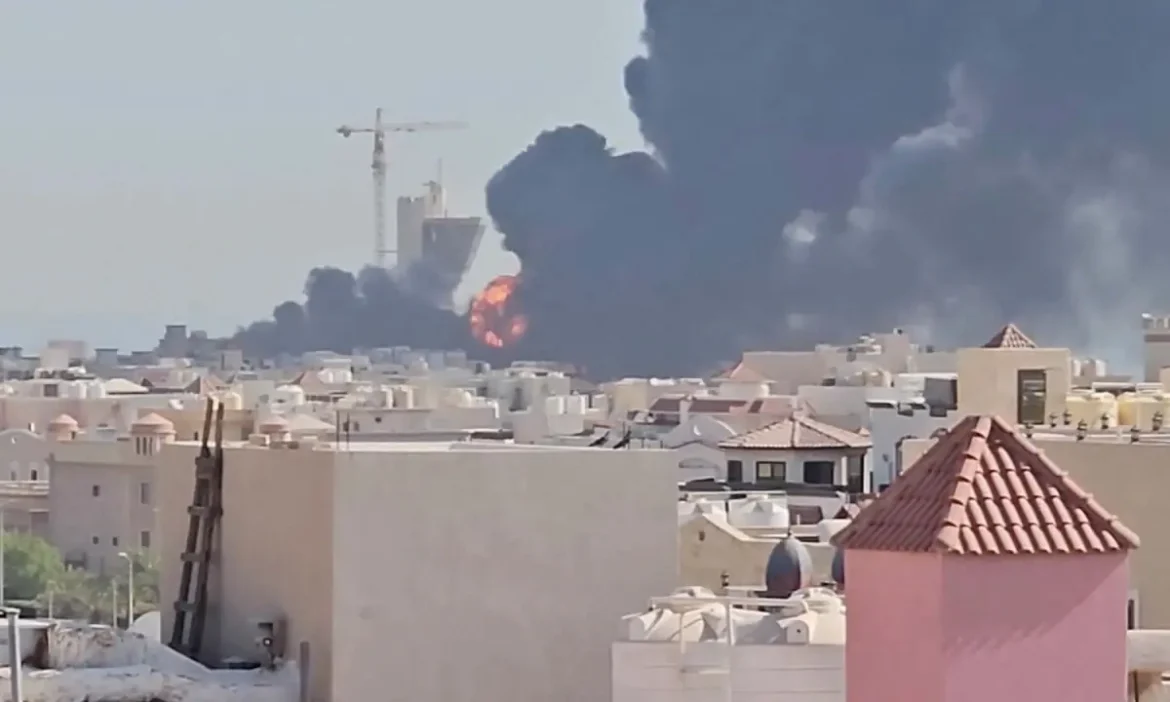
The fighting has increasingly drawn in countries that are not formal parties to the conflict but host American forces. Kuwait absorbed the heaviest blow on Saturday: Iranian missiles and drones struck a water desalination plant for the second time in two days, and Kuwait’s state oil company reported significant damage and injuries at one of its facilities. Kuwait International Airport briefly suspended operations and the country closed its airspace amid repeated missile threats. Firefighters and an oil worker were injured battling blazes set off by the strikes, according to the Kuwait Fire Force, which said it was responding to fires at two separate locations, resulting in injuries among firefighters and a worker. Kuwait depends on desalination for roughly 90 percent of its drinking water.
Iran’s Islamic Revolutionary Guard Corps said its forces had struck a US military support center at Camp Arifjan in Kuwait and destroyed a radar installation at Ali Al Salem Air Base. The Guard also claimed strikes on a site in Bahrain where American combat aircraft were staged, and said it destroyed two US fighter jets and three other aircraft in a strike on a base in Azraq, Jordan. Those claims could not be independently verified.
Jordan’s military said it intercepted roughly ten Iranian missiles fired toward the kingdom overnight and reported no damage. Air raid sirens sounded repeatedly in Bahrain, where officials urged residents to take shelter. Iraqi forces said they shot down attack drones over the northern city of Irbil.
The Gulf Cooperation Council’s secretary-general condemned the strikes on Kuwait, Jordan and Bahrain as a grave violation of international law and accused Iran of deliberately targeting civilian infrastructure. Kuwait’s Foreign Ministry said it holds Tehran fully responsible for endangering civilians.
The Revolutionary Guard defended the strikes on Gulf infrastructure by invoking a religious injunction, warning that countries hosting American forces should expect further strikes.
Southern Iran bears the brunt
Inside Iran, the heaviest reported damage has concentrated along the southern coast near the Strait of Hormuz. Iranian state television reported early Saturday that strikes in Hormozgan province killed three people and wounded eight, and damaged two bridges and a road tunnel. A day earlier, Iranian officials said US strikes hit at least five bridges across the south, including in the port town of Bandar Khamir, where a train station was also damaged and seven people were reported killed. An airport further east, in Iranshahr, was also reported struck.
American officials have said the strikes on southern Iran are intended in part to give President Trump additional leverage, including the possibility — which he has not ruled out — of a ground operation along Iran’s coast or its islands in the strait.
A separate strike destroyed a seawater pumping station and power transformer at a desalination plant near the town of Jask, cutting off water to 20 villages and roughly 10,000 residents. Local officials later said emergency water deliveries had begun for the affected communities. More than 100 telecommunications towers were also reportedly knocked offline in the province, disrupting phone and internet service across a wide stretch of southern Iran.
Iran’s Energy Ministry issued an unusual public appeal Friday asking residents in southern provinces to conserve electricity amid what it called extreme heat — the government’s first acknowledgment that strikes had affected the country’s power grid, though it did not specify which facilities were hit.
The United States has disputed some of Iran’s claims about the scope of the damage. The US also confirmed destroying a control tower at the port of Chabahar, which officials described as part of an Iranian military surveillance network.
Oil markets react
The renewed fighting has rattled global energy markets. Global oil prices surged more than 9% on the news of the collapsing truce earlier this month, and prices climbed again as traffic through the Strait of Hormuz fell to its lowest level in three weeks. Before the war began, about 110 ships a day transited through the vital waterway. At least 13 commercial vessels transited the Strait of Hormuz in the past 24 hours during one recent stretch, according to shipping trackers — a fraction of normal traffic.
The price pressure adds to a political problem for President Trump, who has said publicly he wants to bring down gasoline and energy costs ahead of November’s midterm congressional elections.
No clear path back to talks
Diplomats from Qatar and Pakistan, who helped broker the original ceasefire, have called on both sides to return to the negotiating table. Neither Washington nor Tehran has shown public appetite to do so. A senior Iranian military adviser warned this week that Iran could move to broader offensive operations if American strikes continue for another two or three days. United Nations Secretary-General António Guterres has voiced alarm over the expanding scope of the fighting, particularly strikes on civilian infrastructure.
Some analysts see little reason for optimism, arguing the ceasefire had little chance of survival because the Iranian government that signed it has limited authority over the Islamic Revolutionary Guard Corps. The war that set all of this in motion began Feb. 28, when the United States and Israel launched coordinated strikes on Iran. Iran responded with attacks on Israel and on American interests across the Gulf, and by moving to choke off shipping through the Strait of Hormuz — the leverage point that has remained at the center of the conflict ever since.
Copyright © 2021 Independent Pakistan | All rights reserved