By Staff Reporter
LAHORE: As floodwaters crept toward Lahore’s fringes on Friday, Pakistani officials pointed fingers across the border, blaming India for amplifying a catastrophic deluge through its suspension of a critical river-sharing treaty and the failure of gates on a key barrage that unleashed uncontrolled torrents downstream.
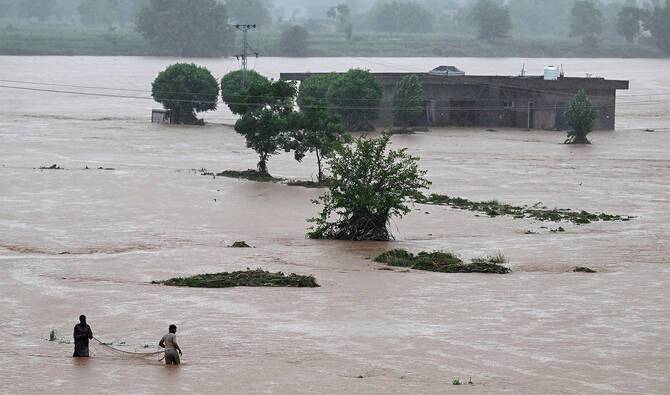
The deluge has hammered the uneasy neighbors all week, swelling rivers to levels unseen in eastern Pakistan for nearly 40 years, killing hundreds and displacing thousands, with forecasters warning of more heavy rains through the weekend. Authorities have mandated evacuations along the riversides, where barrages are logging perilously high flows, and summoned the army this week to aid rescue and relief.
In Jhang, the threat loomed large enough to prompt engineers to blast open a riverbank, shunting water into fields to keep the town above water.
These shared waterways, born in India’s highlands and feeding Pakistan’s plains, long managed under the 1960 Indus Waters Treaty, a pact forged in an era of fragile peace between the nuclear-armed rivals. This water lifeline is now in limbo. India pulled the plug earlier this year after militants gunned down 26 people in an attack blamed on Pakistan-backed groups, a link Islamabad flatly denies.
Without the treaty’s framework, vital data on water flows has trickled in too late or too sparsely, Planning Minister Ahsan Iqbal told Reuters, leaving the country blindsided. “We could have managed better if we had better information,” Iqbal said. “If the Indus Waters Treaty was in operation, we could have mitigated the impact.”
Iqbal’s words carried personal weight. His home constituency of Narowal, hugging the Indian border, lay sodden under the floods. He framed the crisis not just as a bilateral spat but as a human imperative in an era of erratic weather. “Climate change is not a bilateral issue,” he said. “It relates to humanity.”
The immediate trigger, Pakistani officials said, was the collapse at India’s Madhopur barrage on the Ravi River. Indian media footage from Thursday captured the middle section crumbling under pounding waters, sending unchecked surges into Pakistan and inundating parts of Lahore by Friday.
An Indian government official told Reuters that two gates of Madhopur barrage had given way, but pushed back against suggestions of deliberate harm. “Efforts are underway to rein in the Ravi using the upstream Ranjit Sagar Dam,” the official said, insisting that communication lines remained open. “India is doing whatever can be done and all the information is being passed on,” he added. “Incessant rain is causing this flood.”
Yet the channels for sharing have narrowed since the treaty’s suspension ended direct exchanges between water officials. India has relayed four flood alerts to Islamabad since Sunday, including Friday’s, but solely on humanitarian grounds via its embassy, a far cry from the detailed, routine data once provided.
As tensions simmered, the ground reality in Pakistan grew dire. Three rivers, the Chenab, Ravi, and Sutlej, swelled to perilous heights in a rare “triple flooding” that officials feared could cascade into the mighty Indus, pushing it to unprecedented levels downstream and imperiling vast swaths of the country.
In Punjab province, home to half of Pakistan’s 240 million people, the crisis has unfolded with brutal force. Fueled by record rains tied to climate change and inflows from India, the deluge has prompted mass evacuations and army deployments for rescue operations. Since the monsoon ignited on June 26, more than 820 have perished nationwide, with thousands injured and over 210,000 displaced, 40,000 of them fleeing voluntarily since mid-August. Friday alone brought reports of at least 20 more deaths as “exceptionally high” floods menaced Punjab.
On the Chenab, authorities took drastic action, blasting a section of riverbank to divert water into fields and avert catastrophe in Jhang. “A major flood wave in the River Chenab is rapidly moving toward Chiniot, Jhang and Trimmu Headworks,” Punjab Relief Commissioner Nabeel Javed said in a statement. “By evening, the flood wave will pass through Jhang and Chiniot and reach Trimmu Headworks. To reduce pressure, breaching has been carried out at three locations in Jhang.”
Flows there hit alarming peaks: 184,000 cubic feet per second (cusecs) at Khanki, 185,000 at Qadirabad, and 129,000 at Trimmu, according to Punjab’s Provincial Disaster Management Authority (PDMA), which urged immediate evacuations. The National Disaster Management Authority (NDMA) reported a severe situation with 855,000 cusecs at Chiniot bridge.
The Ravi, too, roared unchecked, logging 164,000 cusecs at Balloki Headworks and 184,000 at Shahdara, with escalations looming at Sidhnai Barrage. “At present, the water flow at Balloki point on River Ravi is about 147,000 cusecs,” the NDMA said in a handout. “Between September 2 and 3, this flood is expected to reach Sadhanai, with flows ranging between 125,000 to 150,000 cusecs. At Sadhanai, this huge inflow of water may create a severe flood situation.”
Lahore’s urban core and its Raiwind suburb stood in the crosshairs, alongside a string of downstream areas: Kasur, Pattoki, Okara, Renala Khurd, Depalpur, Gogera, Tandlianwala, Kamalia, Pir Mahal, Adda Hakim, and Sidhnai. The alert factored in downpours forecast for the upper catchment through September 3, plus anticipated releases from India’s Thein Dam.
The Sutlej added to the peril, breaching 350,000 cusecs at Ganda Singh Wala barrage—what the NDMA termed “unprecedented flood levels” that could climb higher with rain and possible Indian discharges. “The flow may increase further due to rain and potential floodwater releases from India,” the agency posted on X. “Authorities and rescue agencies are on high alert. The public is urged to follow the instructions of [the] local administration.”
To shield Kasur, the Punjab PDMA planned an embankment breach at Rahimyar. “Increased water flow from India means that water in the Sutlej is rushing towards Kasur,” Director General Irfan Ali Kathia said. “We are forced to breach the Rahimyar embankment in order to save Kasur.” Teams from Rescue 1122, the PDMA, and provincial government were on the job.
As these rivers converged on the Indus, the NDMA sounded alarms for “exceptionally high” flooding ahead, with peaks up to 1.2 million cusecs possible. Between September 3 and 4, 900,000 to 950,000 cusecs might hit Panjnad Headworks, potentially spiking to 825,000-900,000 if breaches occur. Downstream, Guddu Barrage could face 1.1 million cusecs by September 5-6, Sukkur the same on 6-7, and Kotri on 8-9.
In Sindh, Chief Minister Syed Murad Ali Shah chaired an emergency meeting in Karachi, eyeing the oncoming wave at Guddu. “In case of a major flood wave, not a single life, human or animal, should be lost,” he instructed officials, mandating rescue boats, over 500 relief camps, and coordination with the Pakistan Navy’s 26 standby vessels.
More than 50,000 families risked displacement if embankments failed, prompting Rescue 1122 to mobilise 30,000 personnel in districts like Sukkur, Ghotki, Khairpur, and Shikarpur, with boats at the ready.
Compounding the threat, the ninth monsoon spell unleashed fresh rains across Punjab through September 2, targeting Rawalpindi, Murree, Galiat, Attock, Chakwal, Jhelum, Gujranwala, Lahore, Gujrat, Sialkot, Narowal, Hafizabad, Mandi Bahauddin, Okara, Sahiwal, Kasur, Jhang, Sargodha, Mianwali, Dera Ghazi Khan, Multan, and Rajanpur. Javed flagged urban flash flood risks, ordering officials to erect tent villages and stock medical supplies.
Heavy downpours loomed over already inundated Gujranwala, Gujrat, and Lahore districts in the next 12-18 hours. “These rains could further worsen the current flood situation, as unusually high water flow persists in the Sutlej, Ravi and Chenab rivers,” the NDMA warned on X.
Prime Minister Shehbaz Sharif will convene an emergency meeting with chief ministers and agency heads to craft a climate and flood strategy, the government announced on X. “A strategy is being formulated for the construction of water reservoirs in all four provinces, Azad Kashmir, and Gilgit-Baltistan, and for better water management,” the post said, stressing provincial buy-in.
“Climate change is a reality, and only through effective preparation for it can the damage from natural disasters be prevented,” it added. “All four provinces, Azad Kashmir, Gilgit-Baltistan and the federation must work together to protect people from the adverse effects of climate change. This is a national issue on which everyone must work together.”
Copyright © 2021 Independent Pakistan | All rights reserved