
By Staff Reporter
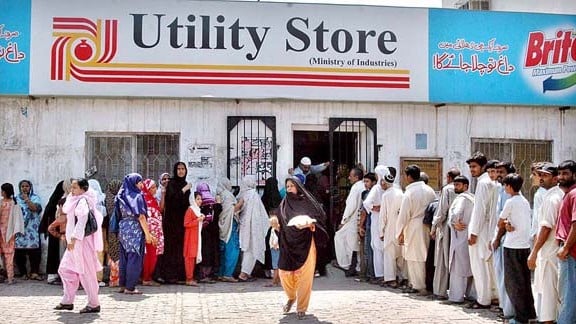
The Economic Coordination Committee (ECC) of the cabinet on Thursday greenlit a roughly Rs40 billion plan to wind down the state-run Utility Stores Corporation (USC), a once-profitable retailer that has haemorrhaged funds for over a decade.
The decision, aimed at curbing fiscal losses while safeguarding employee rights, includes terminal benefits for thousands of workers and payments to clear vendor dues, according to an official statement.
The meeting, chaired by Finance Minister Muhammad Aurangzeb, approved a technical supplementary grant of Rs30.216 billion to facilitate the closure, with an additional Rs9.935 billion budgeted for 2026-27 to settle outstanding vendor liabilities.
The move marks the end of a 54-year-old institution established in 1971 to provide subsidised essentials to low-income households, but which has struggled financially since 2013, racking up losses of Rs23.8 billion by June 2025.
The government’s decision follows months of deliberation and protests by USC employees and unions. On June 28, 2025, Prime Minister Shehbaz Sharif weighed two options: shuttering the corporation by July 31 or sustaining operations with a Rs14 billion grant to stabilise cash flow and clear vendor dues. The government opted for closure, tasking Aurangzeb with overseeing the process, including voluntary separation schemes.
The ECC’s plan allocates Rs13.225 billion for severance packages for regular employees and Rs5.751 billion for terminal dues covering both regular and contract staff, including compensation for widows of employees who died in service. A one-time payment for contractual and daily-wage workers, estimated between Rs2.192 billion and Rs6.337 billion, is subject to negotiations with the Collective Bargaining Agent (CBA), the statement said.
To cover immediate operational costs, Rs1.467 billion has been set aside for pending salaries, including half a month’s pay for April 2025 and full salaries for July and August 2025, for 7,710 employees. The plan also includes retaining 832 staff members from September to November 2025 at a cost of Rs630 million to handle audits, stock reconciliation, and litigation. From December 2025 to June 2026, a leaner workforce of 326 employees, costing Rs805 million, will manage property disposals and residual tasks.
The ECC directed the Ministry of Industries and Production to streamline financial requirements for the wind-down process. To offset costs, USC’s assets, including 21 properties, will be sold within the current fiscal year. Preliminary valuations by the State Bank of Pakistan estimate these properties’ worth between Rs10.5 billion and Rs12.6 billion.
However, complications persist: some properties belong to the defunct Roti Corporation of Pakistan and have not been transferred to USC, while others face issues like leasehold rights, missing completion certificates, and unpaid commercialisation charges. The Privatisation Commission has been instructed to release the original title documents to facilitate sales.
The USC’s financial woes trace back to a rapid expansion in 2007, when its network ballooned from 1,023 to 5,557 outlets and its workforce grew from 3,892 to 12,749 by 2009. This growth, intended to broaden access to subsidised goods, made the corporation heavily reliant on government subsidies. By 2013, it began posting consistent losses, which escalated to Rs23.8 billion by mid-2025. Efforts to stem the bleeding proved insufficient.
In August 2024, the federal cabinet placed USC on the active privatisation list and discontinued subsidies. Between December 2024 and February 2025, USC closed nearly half its stores, reducing the count from 3,742 to 1,904, and trimmed its workforce from 11,614 to 7,710.
Despite these measures, projected annual losses remained at Rs8.315 billion, prompting the government to accelerate closure plans. Between July 3 and 14, 2025, USC shuttered 1,059 rented stores and 1,230 franchise outlets. By July 31, nationwide operations ceased, and remaining stock was shifted to warehouses for disposal.
The process faced resistance from the CBA and staff unions, whose protests delayed earlier closure plans. A finalised closure package, costing between Rs16 billion and Rs19.5 billion, was eventually agreed upon to address employee concerns.
The government has emphasised that the closure package prioritises employee rights while aligning with broader fiscal discipline goals. Finance Minister Aurangzeb directed USC to obtain fresh valuations of its properties to maximise returns and reduce the financial burden on the state.
Copyright © 2021 Independent Pakistan | All rights reserved