By Staff Reporter
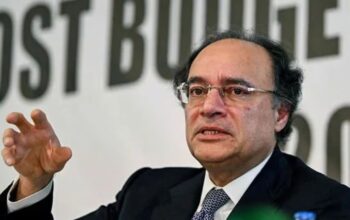
ISLAMABAD: Pakistan’s economy has entered a stabilisation phase, with the government advancing structural reforms in taxation, energy, privatisation and digitalisation to drive sustainable and inclusive growth, Finance Minister Muhammad Aurangzeb said on Monday.
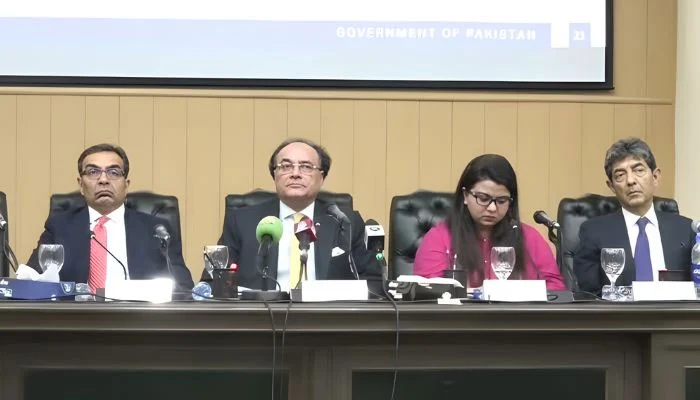
Addressing a press conference alongside cabinet members, Aurangzeb pointed to credit rating upgrades from three global agencies and a staff-level agreement with the International Monetary Fund as evidence of improving fundamentals. The government has “made significant progress in respect to macroeconomic stability,” Aurangzeb said. “Pakistan’s credit rating upgrade from three global credit rating agencies, alongside a staff-level agreement with the IMF, is the external validation that we are moving in the right direction.”
The briefing, which included Federal Minister for Power Awais Ahmad Khan Leghari, Federal Minister for IT & Telecom Shaza Fatima Khawaja, Advisor to the Prime Minister on Privatization Muhammad Ali, and other officials, focused on advancements under the administration’s economic agenda. Key areas highlighted were taxation, energy, privatisation, the Digital Pakistan initiative, public finance, government rightsising, and fiscal and debt management.
Aurangzeb said the government now aims to shift toward “sustainable and inclusive growth.” It’s time to leverage this macroeconomic stability, along with geopolitical tailwinds, “into trade and investment flows,” he added. External reforms in sectors such as energy, state-owned enterprises and privatization are underway, Aurangzeb said. “These are the areas consistently highlighted by analysts, think tanks, and our bilateral and multilateral partners,” he said.
Responding to a question, Aurangzeb acknowledged that Pakistan’s trade deficit has risen 9%. “However, remittances are providing us with a cushion. We expect remittances to hit $41-42 billion by the end of this fiscal year.” The current account deficit, at $0.5 billion, remains “very manageable,” Aurangzeb added.
Taxation Push
Federal Board of Revenue Chairman Rashid Mehmood Langrial said Pakistan’s tax-to-GDP ratio has increased by 1.49% in the past year, marking the first such rise of 1.5%. The ratio is targeted to reach 18% by 2028, including provincial revenue and the petroleum development levy, representing a 5.79 percentage point increase from 2025 levels, Langrial said. “Of this 18% tax-to-GDP ratio, 15% would be made up by FBR and 3% from provinces,” he said. “There is a lot of soul searching, which has to take place on the provincial level.”
The number of individual tax filers grew 18% this year, from 4.9 million to 5.8 million. “This is a significant increase,” Langrial said. Income tax filings also saw an 18% jump compared to the previous year, with the number of taxpayers rising to 5.9 million. Despite a tax shortfall of nearly Rs275 billion in July-October of the 2025-26 fiscal year, the government doesn’t plan to impose contingency measures. “There is no immediate need for new taxes by the FBR,” Langrial said, emphasising the importance of improving tax compliance and broadening the tax base to strengthen revenue collection.
The FBR provisionally collected Rs3,837 billion during the period against a target of Rs4,109 billion. Citing data, Langrial said the income tax gap for the top 1% of income earners is Rs1.2 trillion, while the total income tax gap stands at Rs1.7 trillion.
Energy Overhaul
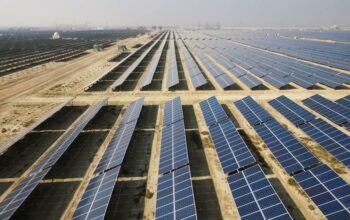
Power Minister Leghari said the government is targeting lower electricity rates for consumers as it reorganises the energy sector on modern lines. Wherever opportunities arose, every possible effort was made to provide relief to the public, he added. Pakistan’s energy cost is Rs9.97 per unit, which is internationally competitive, though capacity payments remain high. The government plans to operationalise the Competitive Trading Bilateral Contract Market in January or February. “This is going to be the biggest reform in Pakistan’s history.”
Under the CTBCM, the government would no longer purchase electricity. “For the first time in history, a plan is in place to eliminate Rs1.2 trillion circular debt in the next six years,” Leghari said. Circular debt was reduced by Rs700 billion in one year, and a loan agreement of Rs1,200 billion was concluded to reduce circular debt. The government is aggressively rolling out automation in the power sector. “In the next three years, the entire landscape of metering in Pakistan will be overhauled,” he said, adding that via automatic metering, consumers would be provided a pre-paid billing facility.
Automated metering is being introduced with prepaid options for consumers, and the entire electricity system will be on automated metering in the next three years. Leghari said the government renegotiated agreements with Independent Power Producers to reduce costs. In the past 18 months, the price of electricity was reduced by up to 10.5%, the EV rate was reduced from Rs71 to Rs39, and technical issues resolved in the energy sector achieved savings of billions of rupees.
Privatization Drive
Advisor on Privatization Ali said the government remains committed “at the highest level” to privatization, with “commitment and capacity building are already in place.” His ministry is “working on as many transactions as possible”. The pace of the privatization process will accelerate in the coming period, he added.
On the privatisation of the state-owned First Women Bank Limited, which was sold to the Abu Dhabi-based International Holding Company, Ali said FWBL was sold at a valuation of Rs5 billion, a premium of nearly 60%. “Through FWBL privatisation, IHC, a major entity in the UAE, will enter Pakistan,” he added.
Regarding Pakistan International Airlines, Ali said the government failed in its initial attempt to sell the national carrier, which occurs in these complex transactions. “Currently, we have changed the transaction structure and remain actively engaged with investors. At this time, our buyers, including Pakistan’s top groups, are conducting due diligence.”
The PIA privatisation is in its final stages, with the bidding process expected to be completed by the end of 2025. “We want to see a turnaround of PIA,” he added. Four companies — Arif Habib Limited, Fauji Fertiliser Company, Air Blue and Lucky Group — have participated in the privatization process of PIA. The groups coming forward for privatization are those with vast experience, and efforts are being made to complete the privatization of the national airline before the end of the year, he added. The aim is for a business group to acquire the national airline that will make major investments in it.
“Through privatisation, we want to create a market-based economy in Pakistan,” he said. Financial experts are being engaged, and the government is determined to achieve its targets related to privatization, he added.
Government Rightsizing
Coordinator to the Prime Minister on Rightsizing Salman Ahmed said 54,000 vacant posts were abolished, leading to a saving of Rs56 billion. Twenty ministries have undergone the rightsizing process. Out of 39 ministries, 20 are running 301 departments, and work is ongoing in 9 of the remaining 19 ministries, which oversee 78 institutions.
PASSCO is in the process of winding up, Ahmed said. PASSCO is an institution running at a heavy loss and will be shut down. Taxpayers’ money should not be wasted, and an attempt has been made to maintain, with profitable institutions or departments allowed to continue operations, he added.
Digital and Fiscal Measures
IT & Telecom Minister Khawaja said the country is moving toward a cashless economy. @The prime minister had formed three committees on the cashless economy, and we are moving towards a cashless economy,” Khawaja said. The roadmap of Digital Nation Pakistan is being implemented, and the Digital Nation Pakistan Act was approved in January this year.
All government institutions will work together on the digital exchange layer, and the Raast payment system will make digital transactions easier. “People will no longer be able to conceal their transactions, and under digitalization, all national institutions will be harmonized,” Khawaja added.
Copyright © 2021 Independent Pakistan | All rights reserved