By Staff Reporter
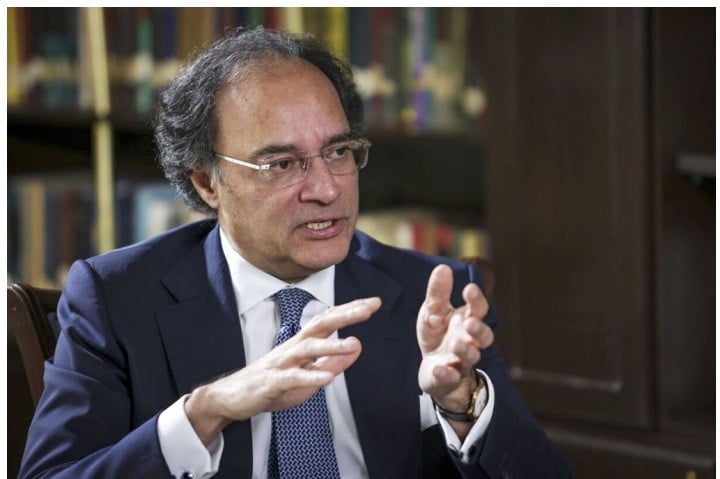
KARACHI: Pakistan’s blue economy could swell to $100 billion by 2047 and serve as a “game changer” for the nation’s growth, Finance Minister Muhammad Aurangzeb said, as the government pushes to harness ocean resources amid efforts to stabilise the broader economy.
Aurangzeb delivered the remarks in a virtual address on Tuesday at the inaugural session of the Pakistan International Maritime Expo & Conference in Karachi, organised by the Pakistan Navy and the Ministry of Maritime Affairs.
The minister reaffirmed the administration’s focus on policy continuity to drive long-term initiatives. The maritime sector currently accounts for just 0.4% to 0.5% of gross domestic product, or about $1 billion. “But it has significant room for growth, Aurangzeb said, aligning with the World Bank’s definition of the blue economy as the sustainable use of ocean resources for economic expansion, better livelihoods and jobs, while protecting marine ecosystems.
The minister backed the Ministry of Maritime Affairs’ plan to build the sector into a $100 billion powerhouse by 2047, marking Pakistan’s centennial and dovetailing with the country’s aim to become a $3 trillion economy. “Ambitious but very reachable,” Aurangzeb said of the target, citing a “clear and robust roadmap” to get there.
Aurangzeb said key opportunities lie in bolstering fisheries and aquaculture with value-added processing, modern cold-chain logistics and hygiene standards that meet global benchmarks “Pakistan’s seafood exports, currently around $500 million, could feasibly increase to $2 billion within the next three to four years under the National Fisheries and Aquaculture Policy, which has been developed in strategic partnership with the Food and Agriculture Organization (FAO).”
Aurangzeb also stressed upgrading and digitizing operations at the ports of Karachi, Qasim and Gwadar to match international standards and boost regional trade links. He flagged prospects in renewable energy, such as tidal and offshore wind power, and called for tapping innovative funding like blue bonds and blended finance to support sustainable development and conservation.
The comments come as Pakistan touts gains in macroeconomic stability. Foreign exchange reserves now cover more than two and a half months of imports, exceeding $14 billion, while the exchange rate has held steady. “Inflation has been a very good story, although we have seen it coming back up slightly because of the unfortunate floods that afflicted the country this year, but it remains in single digits,” the minister said.
The policy rate has eased alongside cooling inflation, and all three major global rating agencies have shifted Pakistan’s outlook to stable after almost three years, signaling renewed faith in its economic path. “After a hiatus of 2.5 years, we have three global rating agencies that are fully aligned not only in terms of upgrades but also outlook, which is stable for Pakistan’s economy,” Aurangzeb said.
A recent staff-level agreement with the International Monetary Fund in Washington bolsters confidence in the reform agenda and fiscal handling. “We find ourselves in a good spot at this point because there is a confluence of factors.” Pakistan should capitalize on ties with partners like China, the US and Gulf nations including Saudi Arabia and the UAE, moving beyond state-to-state deals toward more trade and investment, Aurangzeb said.
Copyright © 2021 Independent Pakistan | All rights reserved